 |

Ingolf Huhn (born in 1955) is a German opera manager and theatre director.
|
Ingolf Huhn (born in 1955) is a German opera manager and theatre director.
Born in Magdeburg, after the Abitur Huhn studied opera direction in Berlin, musicology in Leipzig and theology. Afterwards he was a master student at the Academy of Arts with Ruth Berghaus. He then worked for ten years as an opera director at the Meiningen Court Theatre. During this period he was also a frequent guest director at the Graz Opera in Styria/Austria. From 1998 to 2003 Huhn worked as the artistic director of the Mittelächsisches Theater in Freiberg and Döbeln. From 2003 to 2008 he held the position of General Director of the Theater Plauen-Zwickau .
On 1 January 2010 Huhn succeeded Hans-Hermann Krug as managing director of the Eduard-von-Winterstein-Theater in Annaberg-Buchholz.

Dieter Dorn is a German theatre director, also for the opera, the manager of the Münchner Kammerspiele from 1983 to 2001 and now manager of the Bavarian Staatsschauspiel.
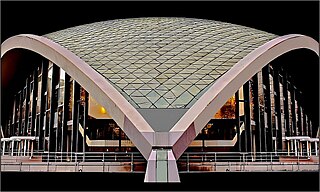
Opernhaus Dortmund is the opera house of Dortmund, Germany, operated by the Theater Dortmund organisation. A new opera house opened in 1966, replacing an earlier facility which opened in 1904 and was destroyed during World War II. It was built on the former site of the Old Synagogue, which was demolished by the Nazi local government in the 1930s.
Claudia Garde is a German film director and screenwriter. She has worked for the German TV-series Stubbe – Von Fall zu Fall, Doktor Martin, Flemming or the series Tatort.

Das Gesicht im Spiegel is an opera in 16 scenes by Jörg Widmann, with a libretto in German by Roland Schimmelpfennig. The opera is about the emotional consequences and ethical issues of human cloning. The opera was premiered at the Cuvilliés Theatre in Munich on 17 July 2003, conducted by Peter Rundel.
Rudolf Sellner, born Gustav Rudolf Sellner was a German actor, dramaturge, stage director, and intendant. He represented in the 1950s a radical Instrumentales Theater. After decades of acting and directing plays, he turned to staging operas, and was a long-time intendant of the Deutsche Oper Berlin from 1961, when the Berlin Wall was built. He staged notable world premieres, including Ernst Barlach's play Der Graf von Ratzeburg in 1951, Ionesco's Mörder ohne Bezahlung in 1958, Giselher Klebe's Alkmene in 1961 for the opening of the Deutsche Oper, and Aribert Reimann's opera Melusine in 1971.
Günter Krämer is a German stage director, especially for opera, and a theatre manager who has staged internationally.

Christof Nel was a German theatre and opera director. He began his career as an actor but moved on to direct opera productions at major opera houses. Plays that he directed were invited to the Berliner Theatertreffen, such as the world premiere of Thomas Brasch's Rotter in 1978 and Thomas Bernhard's Alte Meister in 1998. Nel directed the world premiere of Rolf Riehm's Das Schweigen der Sirenen at the Staatstheater Stuttgart in 1994. His works at Oper Frankfurt included Puccini's Madama Butterfly in 2001, Wagner's Tristan und Isolde in 2003 and the first production in German of Aulis Sallinen's Kullervo in 2011. He taught at the Akademie für Darstellende Kunst Baden-Württemberg from 2011 to 2022.
Klaus Kropfinger was a German musicologist and classical pianist.
Gösta Neuwirth is an Austrian musicologist, composer and academic teacher. He studied in Vienna and Berlin, where he wrote a dissertation on harmony in Franz Schreker's Der ferne Klang. He has taught at universities and music schools including the Musikhochschule Graz, University of Graz, Hochschule der Künste Berlin and University of Freiburg. His compositions include a string quartet and a chamber opera.
Christoph Sramek is a German music historian and music critic.
Werner Wolf was a German musicologist and music critic. The acknowledged Wagner researcher was co-editor of Sämtlicher Briefe of the composer from 1967 to 1979. He also presented several opera performances. In 1981 he was appointed professor at the Leipzig University.
Sigrid Neef is a German musicologist and theatre scholar, focused on Russian and Soviet opera. She has been a dramaturge of the director Ruth Berghaus at the Deutsche Staatsoper Berlin for decades.

Joachim Kaiser (1928–2017) was a German musicologist, critic, and journalist. He worked as a senior editor and cultural critic for the Süddeutsche Zeitung from 1959, contributing reviews and articles on music, literature, and theatre. From 1977 to 1996, he was a professor of music history at the State University of Music and Performing Arts Stuttgart.
Helmut Neuhaus is a German historian who specialises on the Early modern period. From 1989 to 2009 he held the Chair of Modern History I at the University of Erlangen–Nuremberg.
Reinhard Schau was a German opera director and lecturer.
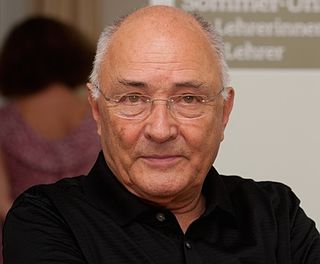
Klaus Harnisch is a German director, dramaturg and cultural manager.

Günther Hofmann was a German operatic bass-baritone, opera manager and director.
Joachim Herz was a German opera director and manager. He learned at the Komische Oper Berlin as an assistant to Walter Felsenstein. His major stations were the Leipzig Opera where he opened the new house with Wagner's Die Meistersinger von Nürnberg, Komische Oper and Semperoper in Dresden, where he opened the restored house with Weber's Der Freischütz in 1985. He staged many world premieres, and worked internationally. Herz was the first director to apply Felsenstein's concepts to Wagner's Der Ring des Nibelungen, staged in Leipzig from 1973 to 1976.
Michael Hampe was a German theatre and opera director, general manager (Intendant) and actor. He developed from acting and directing plays at German and Swiss theatres including the Bern Theatre, to focus on directing opera and managing opera houses, first at the Mannheim National Theatre, then the Cologne Opera from 1975. He was professor at the Hochschule für Musik und Tanz Köln since 1977. Hampe was influential for both the Salzburg Festival and, after the reunification of Germany, the Dresden Music Festival for which he commissioned and directed world premieres. He directed at international opera houses and festivals, including productions recorded for television, film and DVD.
Ernst Huhn (1894–1964) was a German architect who first rebuilt and later designed cinemas, theatres and inns, including the Schauspielhaus Bad Godesberg, Germany's first new theatre after the Second World War
| International | |
|---|---|
| National | |


