Related Research Articles

The economy of Liechtenstein is based on industry, with a small but significant agricultural sector, and services. The country participates in a customs union with Switzerland and uses the Swiss franc as its national currency. It imports more than 85% of its energy requirements. Liechtenstein has been a member of the European Free Trade Association (EFTA) since 1991. It also has been a member of the European Economic Area (EEA) since May 1995 and participates in the Schengen Agreement for passport-free intra-European travel.

Customs is an authority or agency in a country responsible for collecting tariffs and for controlling the flow of goods, including animals, transports, personal effects, and hazardous items, into and out of a country. Traditionally, customs has been considered as the fiscal subject that charges customs duties and other taxes on import and export. In recent decades, the views on the functions of customs have considerably expanded and now covers three basic issues: taxation, security, and trade facilitation.

The World Customs Organization (WCO) is an intergovernmental organization headquartered in Brussels, Belgium. The WCO works on customs-related matters including the development of international conventions, instruments, and tools on topics such as commodity classification, valuation, rules of origin, collection of customs revenue, supply chain security, international trade facilitation, customs enforcement activities, combating counterfeiting in support of Intellectual Property Rights (IPR), illegal drug enforcement, combating counterfeiting of medicinal drugs, illegal weapons trading, integrity promotion, and delivering sustainable capacity building to assist with customs reforms and modernization. The WCO maintains the international Harmonized System (HS) goods nomenclature, and administers the technical aspects of the World Trade Organization (WTO) Agreements on Customs Valuation and Rules of Origin.
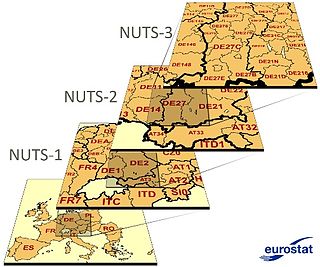
Nomenclature of Territorial Units for Statistics or NUTS is a geocode standard for referencing the subdivisions of countries for statistical purposes. The standard, adopted in 2003, is developed and regulated by the European Union, and thus only covers the member states of the EU in detail. The Nomenclature of Territorial Units for Statistics is instrumental in the European Union's Structural Funds and Cohesion Fund delivery mechanisms and for locating the area where goods and services subject to European public procurement legislation are to be delivered.
The special territories of the European Union are 32 territories of EU member states which, for historical, geographical, or political reasons, enjoy special status within or outside the European Union.
Eurostat is a Directorate-General of the European Commission located in the Kirchberg quarter of Luxembourg City, Luxembourg. Eurostat’s main responsibilities are to provide statistical information to the institutions of the European Union (EU) and to promote the harmonisation of statistical methods across its member states and candidates for accession as well as EFTA countries. The organisations in the different countries that cooperate with Eurostat are summarised under the concept of the European Statistical System.
An invoice, bill or tab is a commercial document issued by a seller to a buyer, relating to a sale transaction and indicating the products, quantities, and agreed prices for products or services the seller had provided the buyer.
The Harmonized Commodity Description and Coding System, also known as the Harmonized System (HS) of tariff nomenclature is an internationally standardized system of names and numbers to classify traded products. It came into effect in 1988 and has since been developed and maintained by the World Customs Organization (WCO), an independent intergovernmental organization based in Brussels, Belgium, with over 200 member countries.
VAT-free imports from the Channel Islands were imports into the United Kingdom from the neighbouring Channel Islands that were exempt from value added tax (VAT), a European Union purchase tax. The exemption was a result of low-value consignment relief (LVCR), a tax relief that applies to low-valued imports into the EU. The UK was a member of the EU from 1973 until Brexit in 2020, but the Channel Islands never became a part of the EU and they did not charge VAT on purchases. Once the UK government had applied LVCR to imports from the Channel Islands, distribution centres were set up and many low-valued goods were exported. The practice was unilaterally brought to an end by HM Treasury in April 2012.
A value added tax identification number or VAT identification number (VATIN) is an identifier used in many countries, including the countries of the European Union, for value added tax purposes.
ENTSO-E, the European Network of Transmission System Operators, represents 42 electricity transmission system operators (TSOs) from 35 countries across Europe, thus extending beyond EU borders. ENTSO-E was established and given legal mandates by the EU's Third Package for the Internal energy market in 2009, which aims at further liberalising the gas and electricity markets in the EU.
Council Regulation (EEC) No 2658/87 of 23 July 1987, creates the goods nomenclature called the Combined Nomenclature, or in abbreviated form 'CN', established to meet, at one and the same time, the requirements both of the Common Customs Tariff and of the external trade statistics of the European Union.

The European Union Customs Union (EUCU) formally known as the Community Customs Union is a customs union which consists of all the member states of the European Union (EU), Monaco, and the British Overseas Territory of Akrotiri and Dhekelia. Some detached territories of EU states do not participate in the customs union, usually as a result of their geographic separation. In addition to the EUCU, the EU is in customs unions with Andorra, San Marino and Turkey, through separate bilateral agreements.
The European Union value-added tax is a value added tax on goods and services within the European Union (EU). The EU's institutions do not collect the tax, but EU member states are each required to adopt a value added tax that complies with the EU VAT code. Different rates of VAT apply in different EU member states, ranging from 17% in Luxembourg to 27% in Hungary. The total VAT collected by member states is used as part of the calculation to determine what each state contributes to the EU's budget.
The Trade Control and Expert System (TRACES), is a web-based veterinarian certification tool used by the European Union for controlling the import and export of live animals and animal products within and without its borders. Its network falls under the responsibility of the European Commission. TRACES constitutes a key element of how the European Union facilitates trade and improves health protection for the consumer, as laid down in the First Pillar principle. Other countries use computer networks to provide veterinary certification, but TRACES is the only supranational network working at a continental scale of 28 countries and almost 500 million people.
The European Customs Information Portal (ECIP) is an importing and exporting service provided by the EU for business operators of the member states of the European Union.
When goods are imported into a European Union country from a non-EU territory, those goods may be subject to customs duty, excise duty and value-added tax.
Comext is a statistical database on trade of goods managed by Eurostat, the Statistical Office of the European Commission. It is an important indicator of the performance of the European Union (EU) economy, because it focuses on the size and the evolution of imports and exports.
A Customs declaration is a form that lists the details of goods that are being imported or exported when a citizen or visitor enters a customs territory . Most countries require travellers to complete a customs declaration form when bringing notified goods across international borders. Posting items via international mail also requires the sending party to complete a customs declaration form.
An Economic Operators Registration and Identification number is a European Union registration and identification number for businesses which undertake the import or export of goods into or out of the EU.
References
- ↑ Summaries of EU legislation, Intrastat system - statistics relating to the trading of goods between Member States
- ↑ HM Revenue & Customs, UK Customs Policy
- ↑ Ruffles, David (2003). "VAT missing trader intra-Community fraud: the effect on Balance of Payments statistics and UK National Accounts" (PDF). Economic Trends. 597: 58–70. Archived from the original (PDF) on 3 October 2013. Retrieved 26 September 2013.
- ↑ "СИСТЕМА ИНТРАСТАТ – най–важното, казано накратко във връзка с новия Закон за статистика на вътрешнообщностната търговия със стоки /ЗСВТС/" [INTRASTAT SYSTEM - the most important, in brief, concerning the new Act on the statistics relating to the intra-Community trading of goods /ASITG/](Microsoft Office Word 97 - 2003 Document). nap.bg (in Bulgarian). National revenue agency. Central office. July 2012. p. 1. Retrieved 16 July 2014.
- ↑ "Intrastat system - statistics relating to the trading of goods between Member States" . Retrieved 26 September 2013.
- 1 2 "2013 Intrastat reporting thresholds". VATlive. Archived from the original on 28 September 2013. Retrieved 26 September 2013.
- ↑ "Regulation (EC) No 222/2009 of the European Parliament and of the Council of 11 March 2009 amending Regulation (EC) No 638/2004 on Community statistics relating to the trading of goods between Member States". EurLex. Retrieved 29 September 2013.
- ↑ "Commission initiatives to cut red tape and reduce regulatory burdens – Questions and Answers" (PDF). European Commission. 19 September 2013. Retrieved 29 September 2013.
- ↑ "Modello Intrastat 2013: scadenza, istruzioni compilazione operazioni". GuidaFisco. Retrieved 26 September 2013.
- ↑ "Regulation (EC) No 638/2004 of the European Parliament and of the Council of 31 March 2004 on Community statistics relating to the trading of goods between Member States and repealing Council Regulation (EEC) No 3330/91". EurLex. Retrieved 27 September 2013.
- ↑ Pagani, Giuseppe. "Le novita' IVA 2010, prestazioni di servizi, reverse charge, modelli intrastat". Fisco e Tasse. Retrieved 26 September 2013.
- ↑ "Intrastat". Agenzia delle Dogane e dei Monopoli. Archived from the original on 5 August 2014. Retrieved 26 September 2013.
- ↑ "La Déclaration Européenne de Services (DES)". Douane. Retrieved 30 September 2013.
