Related Research Articles

Ammonia is an inorganic compound of nitrogen and hydrogen with the formula NH3. A stable binary hydride, and the simplest pnictogen hydride, ammonia is a colourless gas with a distinct pungent smell. Biologically, it is a common nitrogenous waste, particularly among aquatic organisms, and it contributes significantly to the nutritional needs of terrestrial organisms by serving as a precursor to 45% of the world's food and fertilizers. Around 70% of ammonia is used to make fertilisers in various forms and composition, such as urea and Diammonium phosphate. Ammonia in pure form is also applied directly into the soil.

In chemistry, a cyanide is a chemical compound that contains a C≡N functional group. This group, known as the cyano group, consists of a carbon atom triple-bonded to a nitrogen atom.
In chemistry, a hydride is formally the anion of hydrogen (H−). The term is applied loosely. At one extreme, all compounds containing covalently bound H atoms are called hydrides: water (H2O) is a hydride of oxygen, ammonia is a hydride of nitrogen, etc. For inorganic chemists, hydrides refer to compounds and ions in which hydrogen is covalently attached to a less electronegative element. In such cases, the H centre has nucleophilic character, which contrasts with the protic character of acids. The hydride anion is very rarely observed.

Henry Taube, was a Canadian-born American chemist who was awarded the 1983 Nobel Prize in Chemistry for "his work in the mechanisms of electron-transfer reactions, especially in metal complexes." He was the second Canadian-born chemist to win the Nobel Prize, and remains the only Saskatchewanian-born Nobel laureate. Taube completed his undergraduate and master's degrees at the University of Saskatchewan, and his PhD from the University of California, Berkeley. After finishing graduate school, Taube worked at Cornell University, the University of Chicago and Stanford University.
In polyatomic cations with the chemical formula PR+
4. These cations have tetrahedral structures. The salts are generally colorless or take the color of the anions.
A solvated electron is a free electron in a solution, and is the smallest possible anion. Solvated electrons occur widely. Often, discussions of solvated electrons focus on their solutions in ammonia, which are stable for days, but solvated electrons also occur in water and other solvents – in fact, in any solvent that mediates outer-sphere electron transfer. The solvated electron is responsible for a great deal of radiation chemistry.

Hexaamminecobalt(III) chloride is the chemical compound with the formula [Co(NH3)6]Cl3. It is the chloride salt of the coordination complex [Co(NH3)6]3+, which is considered an archetypal "Werner complex", named after the pioneer of coordination chemistry, Alfred Werner. The cation itself is a metal ammine complex with six ammonia ligands attached to the cobalt(III) ion.
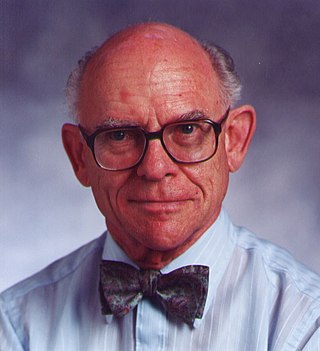
Frank Albert Cotton FRS was an American chemist. He was the W.T. Doherty-Welch Foundation Chair and Distinguished Professor of Chemistry at Texas A&M University. He authored over 1600 scientific articles. Cotton was recognized for his research on the chemistry of the transition metals.
In chemistry, a Zintl phase is a product of a reaction between a group 1 or group 2 and main group metal or metalloid. It is characterized by intermediate metallic/ionic bonding. Zintl phases are a subgroup of brittle, high-melting intermetallic compounds that are diamagnetic or exhibit temperature-independent paramagnetism and are poor conductors or semiconductors.
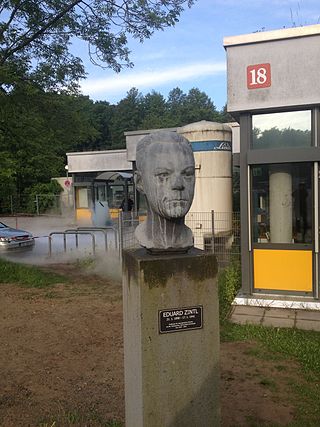
Eduard Zintl was a German chemist. He gained prominence for research on intermetallic compounds.

Kenneth Norman Raymond is a bioinorganic and coordination chemist. He is Chancellor's Professor of Chemistry at University of California, Berkeley, Professor of the Graduate School, the Director of the Seaborg Center in the Chemical Sciences Division at Lawrence Berkeley National Laboratory, and the President and Chairman of Lumiphore.
Charles Rogers Doering was a professor of mathematics at the University of Michigan, Ann Arbor. He is notable for his research that is generally focused on the analysis of stochastic dynamical systems arising in biology, chemistry and physics, to systems of nonlinear partial differential equations. Recently he had been focusing on fundamental questions in fluid dynamics as part of the $1M Clay Institute millennium challenge concerning the regularity of solutions to the equations of fluid dynamics. With J. D. Gibbon, he notably co-authored the book Applied Analysis of the Navier-Stokes Equations, published by Cambridge University Press. He died on May 15, 2021.

An ion is an atom or molecule with a net electrical charge.
In chemistry, ion association is a chemical reaction whereby ions of opposite electric charge come together in solution to form a distinct chemical entity. Ion associates are classified, according to the number of ions that associate with each other, as ion pairs, ion triplets, etc. Ion pairs are also classified according to the nature of the interaction as contact, solvent-shared or solvent-separated. The most important factor to determine the extent of ion association is the dielectric constant of the solvent. Ion associates have been characterized by means of vibrational spectroscopy, as introduced by Niels Bjerrum, and dielectric-loss spectroscopy.

The Birch reduction is an organic reaction that is used to convert arenes to 1,4-Cyclohexadiene. The reaction is named after the Australian chemist Arthur Birch and involves the organic reduction of aromatic rings in an amine solvent with an alkali metal and a proton source. Unlike catalytic hydrogenation, Birch reduction does not reduce the aromatic ring all the way to a cyclohexane.

Caesium auride is the inorganic compound with the formula CsAu. It is the Cs+ salt of the unusual Au− anion.

Frederick Nye Tebbe was a chemist known for his work on organometallic chemistry. Tebbe was born in Oakland, California on March 20, 1935. His father, Charles L. Tebbe, worked for the United States Forest Service so Fred’s early education took place in Montana, Oregon, Maryland and Pennsylvania. He married Margaret Manzer in 1960, and they had a son and a daughter. He died of pancreatic cancer at his home in Delaware on September 28, 1995.
Fulminating gold is a light- and shock-sensitive yellow to yellow-orange amorphous heterogeneous mixture of different polymeric compounds of predominantly gold (III), ammonia, and chlorine that cannot be described by a chemical formula. Here, the word fulminating has its oldest meaning, "explosive" ; the material contains no fulminate ions. The best approximate description is that it is the product of partial hydrolysis of . Upon combustion, it produces a purple vapor. The complex has a square planar molecular geometry with a low spin state. Generally, it is best to avoid accidentally creating this substance by mixing gold chloride or hydroxide salts with ammonia gas or ammonium salts, as it is prone to explosion with even the slightest touch.
Kim R. Dunbar is an American inorganic chemist and Distinguished Professor of Chemistry at Texas A&M University. Her research concerns inorganic and coordination chemistry, including molecular magnetism, metals in medicine, supramolecular chemistry Involving anions and anion-pi interactions, and multifunctional materials with organic radicals.
Peter Jonathan Rutledge is a New Zealand chemist and professor at the School of Chemistry, University of Sydney. His research has focused on drug development for tuberculosis, antibiotics, and metal sensing. He has engaged in some research activity on catalysis.
References
| General | |
|---|---|
| National libraries | |
| Other | |

   | This biographical article about an American chemist is a stub. You can help Wikipedia by expanding it. |