Related Research Articles

Titus Oates was an English priest who fabricated the "Popish Plot", a supposed Catholic conspiracy to kill King Charles II.
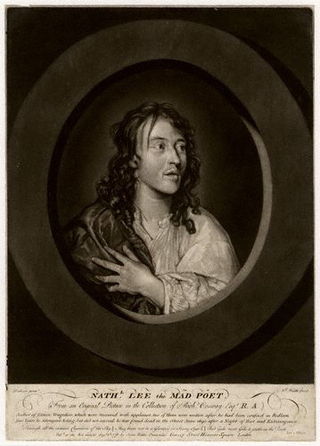
Nathaniel Lee was an English dramatist. He was the son of Dr Richard Lee, a Presbyterian clergyman who was rector of Hatfield and held many preferments under the Commonwealth; Dr Lee was chaplain to George Monck, afterwards Duke of Albemarle, but after the Restoration he conformed to the Church of England, and withdrew his approval for Charles I's execution.

Charles Middleton, 2nd Earl of Middleton, Jacobite 1st Earl of Monmouth, PC was a Scottish and English politician who held several offices under Charles II and James II & VII. He served as Secretary of State for Scotland, the Northern Department and the Southern Department, before acting as Jacobite Secretary of State and chief advisor to James II and then his son James III during their exile in France.
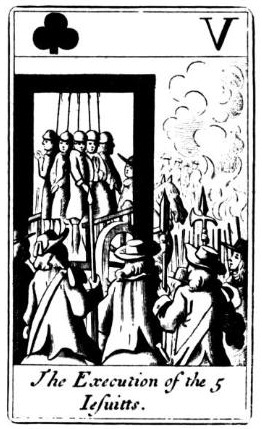
The Popish Plot was a fictitious conspiracy invented by Titus Oates that between 1678 and 1681 gripped the kingdoms of England and Scotland in anti-Catholic hysteria. Oates alleged that there was an extensive Catholic conspiracy to assassinate Charles II, accusations that led to the executions of at least 22 men and precipitated the Exclusion Bill Crisis. During this tumultuous period, Oates weaved an intricate web of accusations, fueling public fears and paranoia. However, as time went on, the lack of substantial evidence and inconsistencies in Oates's testimony began to unravel the plot. Eventually, Oates himself was arrested and convicted for perjury, exposing the fabricated nature of the conspiracy.
Charles Blount was an English deist and philosopher who published several anonymous essays critical of the existing English order.

White Kennett was an English bishop and antiquarian. He was educated at Westminster School and at St Edmund Hall, Oxford, where, while an undergraduate, he published several translations of Latin works, including Erasmus' In Praise of Folly.
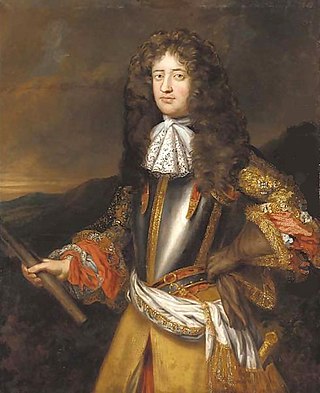
Major-General George Douglas, 1st Earl of Dumbarton KT was a Scottish military officer who spent much of his career in the service of King Louis XIV. In 1678, he returned to England; as a Catholic, he was a trusted servant of King James II and went into exile with him after the 1688 Glorious Revolution. He died at the palace of St Germain-en-Laye in March, 1692.
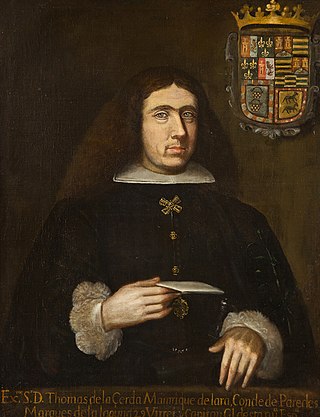
Tomás de la Cerda y Aragón, 3rd Marquess of la Laguna de Camero Viejo, GE, KOA, , was a Spanish nobleman, viceroy of Galicia and of New Spain from 1680 to 1686. He is better known as the Count of Paredes, though he held this title only as consort.

Giovanni Battista de Luca (1614–1683) was an Italian jurist and Cardinal of the Roman Catholic Church. He is considered one of the most important and influential jurists of 17th-century Europe.

William Winstanley was an English poet and compiler of biographies.
John Nalson was an English clergyman, historian and early Tory pamphleteer.
John Warner (1628–1692) was an English Jesuit, known as a controversialist and confessor to James II.

Robert Grove (1634–1696) was an English Bishop of Chichester.

Thomas Comber (1645–1699) was an English churchman, Dean of Durham from 1689.
William Falkner, D.D. was an English divine.
Andrew Sall (1624–1682) was an Irish Jesuit, later a convert to the Church of England.
John Wiltshire was an English stage actor of the Restoration Era. He joined the King's Company in 1675, before transferring to the rival Duke's Company in 1679 possibly as a replacement for Matthew Medbourne who was arrested in the Popish Plot and subsequently died in Newgate. From 1682 until his death he was part of the merged United Company. According to the autobiography of Colley Cibber he subsequently joined the English Army as captain and was killed in action fighting with William III's forces in Flanders during the Nine Years' War. His surname is also sometimes spelled as Wilshire.
Christopher Love Morley was an English physician.

William Denton was an English physician and political writer.
References
 This article incorporates text from a publication now in the public domain : Shaw, William Arthur (1897). "Salgado, James". In Lee, Sidney (ed.). Dictionary of National Biography . Vol. 50. London: Smith, Elder & Co.
| International | |
|---|---|
| National | |
