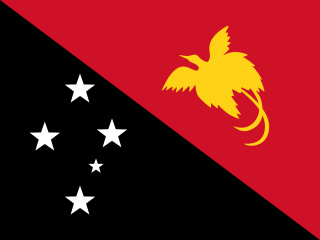
Papua New Guinea is a country in Oceania that comprises the eastern half of the island of New Guinea and its offshore islands in Melanesia. Officially the Independent State of Papua New Guinea, it shares its only land border with Indonesia to the west and it is directly adjacent to Australia to the south and the Solomon Islands to the east. Its capital, located along its southeastern coast, is Port Moresby. The country is the world's third largest island country, with an area of 462,840 km2 (178,700 sq mi).

Southern Highlands is a province in Papua New Guinea. Its provincial capital is the town of Mendi. According to Papua New Guinea's national 2011 census, the total population of Southern Highlands is 515,511 spread across 15,089 square kilometers (5,826 sq mi).
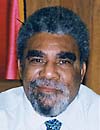
Sir Mekere Morauta was a Papua New Guinean politician and economist who served as the 7th Prime Minister of Papua New Guinea from 1999 to 2002. Inheriting a depressed economy and a fractious legislature, he embarked on fundamental reforms of the country's economy and political system.
The Papua New Guinea national Australian rules football team represents Papua New Guinea in the team sport of Australian rules football. It is one of the nation's most successful sporting teams, currently ranked 2nd in the world behind Australia.

The Kikori River is a major river in southern Papua New Guinea on the island of New Guinea. The river has a total length of 445 km (277 mi) and flows southeast into the Gulf of Papua, with its delta at the head of the gulf. The settlement of Kikori lies on the delta.

The Papua New Guinea National Rugby League Competition is a semi-professional rugby league competition held annually in Papua New Guinea. Changes in sponsorship have meant it was Formerly known as the SP Inter-City Cup or SP Cup (1990–2008) and later the Bemobile Cup (2009–2010). The current competition is sponsored by pacific telecommunications giant Digicel and new co-naming rights sponsor ExxonMobil which joined in 2023 and so it is currently called the Digicel-ExxonMobil Cup.

Papua New Guinea together with the West Papua region of Indonesia make up a major tropical wilderness area that still contains 5% of the original and untouched tropical high-biodiversity terrestrial ecosystems. PNG in itself contains over 5% of the world's biodiversity in less than 1% of the world's total land area. The flora of New Guinea is unique because it has two sources of origin; the Gondwana flora from the south and flora with Asian origin from the west. As a result, New Guinea shares major family and genera with Australia and the East Asia, but is rich in local endemic species. The endemicity is a result of mountainous isolation, topographic and soil habitat heterogeneity, high forest disturbance rates and abundant aseasonal rainfall year round. PNG boasts some 15–21,000 higher plants, 3,000 species of orchids, 800 species of coral, 600 species of fish, 250 species of mammals and 760 species of birds and 8 species of tree-kangaroos out of which 84 genera of animals are endemic. Ecosystems range from lowland forests to montane forests, alpine flora down to coastal areas which contains some of the most extensive pristine mangrove areas in the world. Much of this biodiversity has remained intact for thousands of years because the ruggedness of the terrain made the interior lands inaccessible; furthermore low population density and restrictions on the effectiveness of traditional tools, ensured that these biodiversity was never overexploited.
Oil Search was the largest oil and gas exploration and development company incorporated in Papua New Guinea, which operated all of the country's oilfields. In December 2021, it merged with the Australian company Santos.
Liquid Niugini LNG is a natural gas liquefaction project in Papua New Guinea. It is developed by Liquid Niugini Gas Ltd, and owned by PNG LNG Inc., a Bahamas-based parent holding company.
Papua New Guinea has exported liquefied natural gas (LNG) since 2014. The LNG sector is important to PNG's economy with US$2.95 billion in exports in 2020, and accounting for 5.25% of the GDP in 2019. On a global scale, PNG is a minor player, with 0.08% of world reserves In 2020, PNG was ranked 16th on the list of gas exporting countries.
Prior to its acquisition by Exxon, InterOil Corporation was an oil and gas company with a primary focus on Papua New Guinea. InterOil's assets included one of Asia's largest undeveloped gas fields, Elk-Antelope, in the Gulf Province. The company employed more than 2000 staff and contractors. Its main offices were in Singapore and Port Moresby. InterOil was formed in 1997 and was incorporated in Canada. The company was listed on the New York Stock Exchange and the Port Moresby Stock Exchange. It had a market capitalization of $2.8 billion.
Havila Kavo is a Papua New Guinean politician. He was Governor of the Gulf Province from 2007 to 2017 as a member of the People's National Congress. He briefly lost office in 2010 following a June attempt by opponents in the provincial assembly to oust him; the National Court recognised Pitom Bombom as interim governor in July before reinstating Kavo in August.
The Kikori Gas Pipeline Landowner Association (KGPLA) is a Papua New Guinea landowner association which received PGK 17.6 million [$6.5 million] in funding in 2009 and 2010 from the government for local infrastructure developments in Kikori, Gulf Province, as part of the benefits the country is receiving from ExxonMobil’s $16 billion Liquefied Natural Gas (LNG) Project in Hides.
Anderson Pawa Agiru was a Papua New Guinean politician. He was the Governor of Southern Highlands Province from 1997 to 2002 and 2007 to 2012 and the Governor of Hela Province from its creation in 2012 until his death. His position had been disputed for the final five months of his life, with a December 2015 attempt to oust him by members of the Hela assembly - posthumously decided in Agiru's favour - still being determined in the National Court at the time of his death.

The Papua New Guinea earthquake was a magnitude 7.5 earthquake that occurred in the Hela Province of Papua New Guinea on 26 February 2018, at 3:44 a.m. local time. The earthquake's epicenter was 10 kilometres (6.2 mi) west of the town of Komo. The maximum felt intensity was IX (Violent) on the Mercalli intensity scale. A total of 160 people were killed and many others were injured. An aftershock of M6.0 killed 11 people on 4 March, while another aftershock of M6.7 occurred at 00:13 local time on 7 March, killing at least 25 more. A 6.3 aftershock killed another 4 people on 7 April, more than a month after the first tremors hit the area.
Yolarnie Amepou is a zoologist and conservationist from Papua New Guinea. She is known for her work to protect the Papuan softshell turtle in Kikori. In 2017 she was a Youth Champion for the Sustainable Development Goals of the United Nations. She was also received a Pride of Papua New Guinea Award for Environment in 2015.
In 2019, at the age of 24, Raylance Mesa was the youngest winner of the Westpac Outstanding Woman Award (WOW) in Papua New Guinea (PNG) for her work to help her island to adapt to climate change.
Freda Talao is a human rights lawyer and development specialist from Papua New Guinea (PNG).
Sarah Garap is a prominent community development worker and human rights activist in the Highlands of Papua New Guinea (PNG).

Miriam Supuma is a conservationist in Papua New Guinea (PNG). She was the co-founder and co-director of the PNG Institute of Biological Research (PNGIBR), a scientific research NGO. Her field research has centred around Birds of Paradise, particularly in relation to the use of their feathers for traditional adornment by people in the highlands of PNG.
