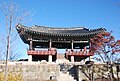
Namdaemun, officially known as the Sungnyemun, is one of the Eight Gates in the Fortress Wall of Seoul, South Korea. The gate formed the original southern boundary of the city during the Joseon dynasty, although the city has since significantly outgrown this boundary. It is located in Jung-gu between Seoul Station and Seoul Plaza, with the historic 24-hour Namdaemun Market next to the gate.

Gyeongbokgung, also known as Gyeongbokgung Palace, was the main royal palace of the Joseon dynasty. Built in 1395, it is located in northern Seoul, South Korea. The largest of the Five Grand Palaces built by the Joseon dynasty, Gyeongbokgung served as the home of the royal family and the seat of government.

The Japanese invasions of Korea, commonly known as the Imjin War, involved two separate yet linked invasions: an initial invasion in 1592, a brief truce in 1596, and a second invasion in 1597. The conflict ended in 1598 with the withdrawal of Japanese forces from the Korean Peninsula after a military stalemate in Korea's southern provinces.

Changgyeong Palace (Korean: 창경궁) is a palace located in Seoul, South Korea.

Yeoju is a city in Gyeonggi Province, South Korea. Yeoju was a county but was raised to the status of a city in September 2013. Together with the neighboring city of Icheon, it is known as a major center of contemporary South Korean ceramics, and hosts the World Ceramic Exposition every year. Other local products of note include rice, sweet potatoes, and yellow melons. Yeoju is the birthplace of Korea's last queen, Empress Myeongseong.

Jinju is a city in South Gyeongsang Province, South Korea. It was the location of the first (1592) and second (1593) Sieges of Jinju by Japanese forces during the Imjin War. The Republic of Korea Air Force Education and Training Command is located in the eastern part of the city. There are cultural-historical tourist attractions in Jinju such as Jinju Fortress, the Jinju National Museum, and the Nam-gang Prehistoric Site Museum.

Hamyang County (Hamyang-gun) is a county in South Gyeongsang Province, South Korea.
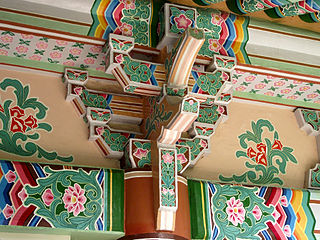
Korean architecture refers to an architectural style that developed over centuries in Korea. Throughout the history of Korea, various kingdoms and royal dynasties have developed a unique style of architecture with influences from Buddhism and Korean Confucianism.
The first siege of Jinju was one of two battles during the Japanese invasions of Korea – the first in 1592, and the second in 1593. The first siege attempt by the Japanese failed, leaving the Koreans holding the fortress. The second siege of Jinju was successful, and it fell to the Japanese.
Japanese Castles in Korea are Japanese castles built along the southern shores of Korea during Japanese invasions of Korea between 1592 and 1598 by the Japanese military.
Gim Si-min (1554–1592), also known as Kim Si-min, was a prominent Korean general during the Joseon Dynasty. He is most famous for having defended Jinju Castle against the Japanese invaders during the Seven Years' War. He came from the (old) Andong Kim clan.

Chester city walls consist of a defensive structure built to protect the city of Chester in Cheshire, England. Their construction was started by the Romans when they established the fortress of Deva Victrix between 70 and 80 [CE]. It originated with a rampart of earth and turf surmounted by a wooden palisade. From about 100 CE they were reconstructed using sandstone, but were not completed until over 100 years later. Following the Roman occupation nothing is known about the condition of the walls until Æthelflæd refounded Chester as a burgh in 907. The defences were improved, although the precise nature of the improvement is not known. After the Norman conquest, the walls were extended to the west and the south to form a complete circuit of the medieval city. The circuit was probably complete by the middle of the 12th century.

Geumjeongsanseong is the largest mountain fortress in the Republic of Korea today. It is located on Geumjeongsan in the Busan Metropolitan City.

Seoul, officially Seoul Special City, serves as the capital of South Korea, and is its most extensive urban center. The broader Seoul Capital Area, encompassing Gyeonggi province and Incheon metropolitan city, emerged as the world's fourth largest metropolitan economy in 2014, trailing only Tokyo, New York City, and Los Angeles, hosting more than half of South Korea's population. Although Seoul's population peaked at slightly over 10 million, it has gradually decreased since 2014, standing at approximately 9.97 million residents as of 2020. Seoul is the seat of the South Korean government.

The Fortress Wall of Seoul is a series of walls made of stone, wood and other materials, built to protect the city of Seoul against invaders. The wall was first built in 1396 to defend and show the boundaries of the city during the Joseon period. The wall stretches 18.6 km along the ridge of Seoul's four inner mountains, Bugaksan, Inwangsan, Naksan and Namsan. At present, a 12-km section of the wall is designated as Historic Site No. 10 (1963) and is protected accordingly, along with the gates, water gates, and signal fire mounds. The northern, eastern, and southern sections of Namsan walls have undergone extensive restoration work, having sustained damage or been entirely destroyed during the Japanese colonial period.

The Baekje Historic Areas are a group of monuments located in three South Korean cities: Gongju, Buyeo, and Iksan. They relate to the last period of the Baekje Kingdom, representing the period from 475 to 660 CE, which was one of the three kingdoms that flourished from 18 BC to 660 CE. The property designated as a UNESCO World Heritage Site has eight archaeological sites. These are: The Gongsanseong fortress and the royal tombs at Songsan-ri, related to the capital city of Ungjin, now Gongju; the Busosanseong Fortress and Gwanbuk-ri administrative buildings, the Jeongnimsa Temple, the Neungsan-ri royal tombs, and the Naseong city wall in Sabi, now Buyeo; and the Wanggung-ri Palace and the Mireuksa Temple in Iksan, a subsidiary capital region of Sabi.

The Fortifications of Diyarbakır are a set of fortifications enclosing the historical district of Sur in Diyarbakır, Turkey. They consist of an inner fortress, the citadel, and an outer ring of city walls.
Kim Chŏn-il was a Korean military leader in the 16th century. He was a Joseon dynasty official and became a righteous army leader during the Imjin war to repel the 1592 Japanese invasion of Korea. He was killed in the second siege of Jinju in 1593.

Iksan Mireuksaji Stone Pagoda is located in Mireuksaji, Geumma-myeon, Iksan-si, Jeollabuk-do, and is the oldest stone pagoda remaining in Korea. It is designated as the 11th national treasure.