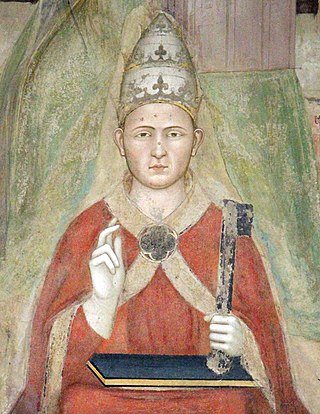
Pope Clement V, born Raymond Bertrand de Got, was head of the Catholic Church and ruler of the Papal States from 5 June 1305 to his death, in April 1314. He is remembered for suppressing the order of the Knights Templar and allowing the execution of many of its members. Clement moved the Papacy from Rome to Avignon, ushering in the period known as the Avignon Papacy.

Pope Innocent III, born Lotario dei Conti di Segni, was the head of the Catholic Church and ruler of the Papal States from 8 January 1198 until his death on 16 July 1216.

Stephen Langton was an English cardinal of the Catholic Church and Archbishop of Canterbury from 1207 until his death in 1228. The dispute between King John of England and Pope Innocent III over his election was a major factor in the crisis which produced the Magna Carta in 1215. Langton is also credited with having divided the Bible into the standard modern arrangement of chapters used today.

Robert Grosseteste, also known as Robert Greathead or Robert of Lincoln, was an English statesman, scholastic philosopher, theologian, scientist and Bishop of Lincoln. He was born of humble parents in Suffolk, but the associations with the village of Stradbroke is a post-medieval tradition. Upon his death, he was revered as a saint in England, but attempts to procure a formal canonisation failed. A. C. Crombie called him "the real founder of the tradition of scientific thought in medieval Oxford, and in some ways, of the modern English intellectual tradition". As a theologian, however, he contributed to increasing hostility to Jews and Judaism, and spread the accusation that Jews had purposefully suppressed prophetic knowledge of the coming of Christ, through his translation of the Testaments of the Twelve Patriarchs.
John Acton is the name of:

Henry Chichele was Archbishop of Canterbury (1414–1443) and founded All Souls College, Oxford.
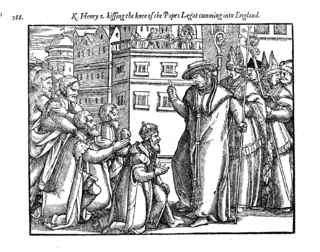
A papal legate or apostolic legate is a personal representative of the Pope to foreign nations, to some other part of the Catholic Church, or representatives of the state or monarchy. He is empowered on matters of Catholic faith and for the settlement of ecclesiastical matters.
Decretals are letters of a pope that formulate decisions in ecclesiastical law of the Catholic Church.
William Lyndwood was an English bishop of St. David's, diplomat and canonist, most notable for the publication of the Provinciale.
Walter Wardlaw was a 14th-century bishop of Glasgow in Scotland.
Collections of ancient canons contain collected bodies of canon law that originated in various documents, such as papal and synodal decisions, and that can be designated by the generic term of canons.

Henry de Lichton [de Lychtone, Leighton] was a medieval Scottish prelate and diplomat, who, serving as Bishop of Moray (1414–1422) and Bishop of Aberdeen (1422–1440), became a significant patron of the church, a cathedral builder, and a writer. He also served King James I of Scotland as a diplomat in England, France, and Italy.
The Liber Septimus may refer to one of three Catholic canon law collections of quite different value from a legal standpoint which are known by this title.
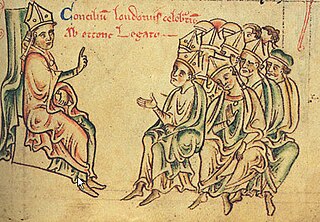
Otto of Tonengo was an Italian papal diplomat and cardinal, first as deacon of San Nicola in Carcere from 1227 and then as bishop of Porto e Santa Rufina from 1244.
Richard de Morins, also known as Richard of Mores, Richard de Mores, Ricardus de Mores, and Ricardus Anglicus was an English Augustinian canon of Merton Priory, before becoming prior at Dunstable Priory in 1202.

Napoleone Orsini was a Roman cardinal. His ecclesiastical career lasted 57 years, 54 of them as a cardinal, and included six conclaves.
The Catholic Church utilizes the oldest continuously functioning legal system in the West, much later than Roman law but predating the evolution of modern European civil law traditions. The history of Latin canon law can be divided into four periods: the jus antiquum, the jus novum, the jus novissimum and the Code of Canon Law. In relation to the Code, history can be divided into the jus vetus and the jus novum. Eastern canon law developed separately.

Raymond de Canillac was a French lawyer, bishop, and cardinal. He was born at Roche de Canilhac, the family castle, in the diocese of Mende in the Gevaudan in central France, the son of Guillaume de Canillac and a sister of Cardinal Bertrand de Déaulx. Both of his uncles, Pons and Guy, were successively abbots of Aniane, as was a nephew of the Cardinal, also called Pons. In 1345 his niece Garine, the daughter of his brother Marquis and of Alixène de Poitiers-Valentinois, married Guillaume Roger, Vicount of Beaufort, the brother of Cardinal Pierre Roger de Beaufort, who became Pope Clement VI. Raymond became a member of the Canons Regular of Saint Augustine (CRSA). He studied law at the University of Montpellier, and obtained the degree of Doctor in utroque iure.

Philip of Tripoli, sometimes Philippus Tripolitanus or Philip of Foligno, was an Italian Catholic priest and translator. Although he had a markedly successful clerical career, his most enduring legacy is his translation of the complete Pseudo-Aristotelian Secretum secretorum from Arabic into Latin around 1230.
Stephen of Anagni was an Italian priest in papal service.


