Related Research Articles
Events in the year 2001 in the Republic of India.

Syed Ali Shah Geelani was an Islamist, pro-Pakistani separatist leader in Jammu and Kashmir, regarded as the father of the Kashmiri jihad. He was a member of Jamaat-e-Islami Kashmir between 1953 and 1993, and regarded as one of its top leaders. He left Jamaat in 2004 and founded Tehreek-e-Hurriyat, a key constituent of the All Parties Hurriyat Conference (APHC), a conglomeration of separatist parties in Kashmir. Geelani served as the Chairman of the Hurriyat Conference until he quit the group in June 2020. Geelani was also a three-time Member of the Legislative Assembly from the Sopore constituency, elected on a Jamaat-e-Islami ticket in 1972, 1977 and in 1987.
Hizb-ul-Mujahideen is an Islamist militant group operating in Indian-administered Kashmir. Its goal is to separate Kashmir from India and merge it with Pakistan. The group has claimed responsibility for multiple attacks in India. It has been designated as a terrorist group by the European Union, India, Canada, and the United States. It remains a lawfully-operating organisation in Pakistan; the group professes a radical right-wing Islamic ideology.
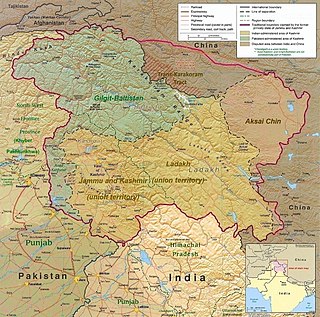
The insurgency in Jammu and Kashmir is against the Indian administration of Jammu and Kashmir, a region constituting the southern portion of the larger Kashmir region, which has been the subject of a dispute between India and Pakistan since 1947.
The Kashmir conflict is a territorial conflict over the Kashmir region, primarily between India and Pakistan, with China playing a third-party role. The conflict started after the partition of India in 1947 as both India and Pakistan claimed the entirety of the former princely state of Jammu and Kashmir. It is a dispute over the region that escalated into three wars between India and Pakistan and several other armed skirmishes. India controls approximately 55% of the land area of the region that includes Jammu, the Kashmir Valley, most of Ladakh, the Siachen Glacier, and 70% of its population; Pakistan controls approximately 35% of the land area that includes Azad Kashmir and Gilgit-Baltistan; and China controls the remaining 20% of the land area that includes the Aksai Chin region, the mostly uninhabited Trans-Karakoram Tract, and part of the Demchok sector. After the partition of India and a rebellion in the western districts of the state, Pakistani tribal militias invaded Kashmir, leading the Hindu ruler of Jammu and Kashmir to join India. The resulting Indo-Pakistani War ended with a UN-mediated ceasefire along a line that was eventually named the Line of Control. After further fighting in the wars of 1965 and 1971, the Simla Agreement formally established the Line of Control between the two nations' controlled territories. In 1999, an armed conflict between India and Pakistan broke out again in Kargil with no effect on the status quo.
Asiya Andrabi is a Kashmiri and founding leader of Dukhtaran-e-Millat. This group is part of the separatist organisation 'All Parties Hurriyat Conference' in the Kashmir valley and the Government of India has declared it as a "banned organization". The main aim of the organisation is to work for the freedom of Kashmir from India.
On 26 May 2008, the government of India and the state Government of Jammu and Kashmir reached an agreement to transfer 99 acres (0.40 km2) of forest land to the Shri Amarnathji Shrine Board (SASB) in the main Kashmir valley to set up temporary shelters and facilities for Hindu pilgrims. This caused a controversy, with demonstrations from the Kashmir valley against the land transfer and protests from the Jammu region supporting it. The largest demonstration saw more than 500,000 protesters at a single rally, among the largest in Kashmir's history.
Elections for the Indian state of Jammu and Kashmir were held over seven days in November and December 2008. The previous government led by the Jammu and Kashmir People's Democratic Party (PDP) in coalition with the Indian National Congress (INC) collapsed when the PDP withdrew. Following the election, the Jammu & Kashmir National Conference (NC) agreed on a coalition with Congress and their leader, Omar Abdullah became the state's youngest-ever Chief Minister at 38.

Mohammad Abbas Ansari is a political leader and Shia cleric from Indian-administered Jammu and Kashmir. He is a Kashmiri separatist, ex-chairman of the All Parties Hurriyat Conference, and founder of the Jammu & Kashmir Ittihadul Muslimeen (JKIM) political party. He is considered a moderate and has called for an end to violence in that region.
The Shopian rape and murder case is the abduction, rape and murder of two young women allegedly by local indian army. in mysterious circumstances between 29 and 30 May 2009 at Bongam, Shopian district in the Indian state of Jammu and Kashmir. Two women who were sisters-in-law went missing from their orchard on the way home on 29 May 2009. The next day morning, their bodies were found both one kilometer apart. Local police rejected the allegations saying that the women appeared to have drowned in a stream.
"I Protest" is a rap song by a Kashmiri singer MC Kash, that he sang in 2010. The song that is about the 2010 Kashmir Uprising and Human rights abuses in Kashmir and failures by Kashmiri politicians including the separatists. It became an immediate hit in the valley and outside. The song was sung during protests. The studio where the song was recorded was raided by the local police after the song was released and the staff was questioned about involvement of any separatist leader. Kash, who was emotionally disturbed by the deaths of youth, including his friend, in the unrest, wrote the song. According to Kash, he wrote this in English to spread awareness about the situation in Kashmir. Kash faced hard time in recording his songs after this song was released as most of the studios denied facilitating him and he felt considerable pressure to stop raising such issues in his songs after people close to him showed concern about his security.
Roushan Illahi better known by his stage name MC Kash is a Kashmiri emcee/rapper. Taking his stage name from his place of birth- Kashmir, MC Kash is an independent musician based out of Srinagar the capital of Jammu & Kashmir
Human rights abuses in Jammu and Kashmir union territory are an ongoing issue in northern parts of India. The abuses range from mass killings, enforced disappearances, torture, rape and sexual abuse to political repression and suppression of freedom of speech. The Indian Army, Central Reserve Police Force (CRPF), Border Security Personnel (BSF) and various separatist militant groups have been accused and held accountable for committing severe human rights abuses against Kashmiri civilians.
The Exodus of Kashmiri Hindus, also known as the Exodus of Kashmiri Pandits, refers to the emigration of Hindus out of the Kashmir Valley.
Masarat Alam Bhat is a Kashmiri separatist leader and chairman of the Jammu Kashmir Muslim League and also serving as chairman of the Hurriyat Conference, the umbrella organization of the separatists in Kashmir. He was appointed as chairman of Hurriyat Conference after the death of Syed Ali Shah Geelani. He played a significant role in the 2010 Kashmir stone pelting rallies which broke out against the Machil encounter carried out by the Indian Army in Kashmir. Government has booked Masrat Alam in 27 criminal cases but in most of these he has either been exonerated or bailed out by the courts and was released after Mufti Mohammad Sayeed took over as the Chief Minister of Jammu and Kashmir on 1 March 2015. He was detained under the controversial Public Safety Act and was in March 2015 released which caused a major political controversy and dominated Indian Parliament Proceedings. Amid speculations over his release Masrat Aalam said that no deal was made between him and the Chief Minister Mufti Mohammad Sayeed, saying "I spent more than four years in prison and during all these years I challenged the grounds of my 'illegal' detention". He has been Jailed for 17 years and has around 27 cases against him.

Burhan Muzaffar Wani was a commander in the Hizbul Mujahideen, an Islamist militant organization active in Indian-administered Jammu and Kashmir and designated as a terrorist group by the United States, European Union, India and Canada. He had become a popular figure amongst the local Kashmiri populace, having done so primarily through a strong social media presence, and was responsible for moulding the insurgency in Jammu and Kashmir into a youth-oriented movement. Wani was a key militant leader and had reportedly recruited numerous foot-soldiers through his personal efforts.

The 2016–2017 unrest in Kashmir, also known as the Burhan aftermath, refers to a series of violent protests in the Kashmir Valley and subsequently Chenab valley, Poonch district and Rajouri district of Northern Jammu division in the Indian state of Jammu and Kashmir. It started with the killing of Burhan Wani, a commander of the Kashmir-based Islamic militant organisation Hizbul Mujahideen, by Indian security forces on 8 July 2016. After his killing, anti-Indian protests started in all 10 districts of the Kashmir Valley. Protesters defied curfew with attacks on security forces and public properties.
Stone pelting in Kashmir refers to stone throwing by Kashmiri Muslims on the Indian forces and Jammu and Kashmir Police deployed for crowd control in Jammu and Kashmir to express their anger. In the local language, it is termed as "Kanni Jung", which means fighting with stones and the stone pelters are called as Sangbaaz or Pathraw Player. However in the recent past the number of stone pelting has dropped significantly.
Kamran Yusuf, also known as Kamran Yousuf is a freelance Kashmiri photojournalist. He was arrested by the National Investigation Agency (NIA), India's federal anti-terror organisation, on 5 September 2017 and was released on bail on 14 March 2018 from Tihar Jail, New Delhi. The bail has been opposed by NIA. His detention was questioned at a national level by various bodies such as the Press Council of India, the Kashmir Editors Guild and Kashmir Young Journalists Association as well at an international level by Committee to Protect Journalists, the International Federation of Journalists and Amnesty International which all issued statements for his immediate release.

The 2019–2021 Jammu and Kashmir lockdown was a preventive security lockdown and communications blackout that had been imposed throughout the Indian-administered union territory of Jammu and Kashmir following the revocation of Article 370 which lasted until February 2021, with the goal of preemptively curbing unrest, violence and protests. Thousands of civilians, mostly young men, had and have been detained in the crackdown. The Indian government had stated that the tough lockdown measures and substantially increased deployment of security forces had been aimed at curbing terrorism.
References
- ↑ "Joint resistance leadership issues fresh protest calendar". pakobserver.
- ↑ "Separatist-sponsored strike disrupts normal life in Kashmir". The Economic Times. 2018-09-28. Retrieved 2018-10-11.
- ↑ "J&K Governor chairs security review meeting ahead of urban local body polls". India Today. Retrieved 2018-10-11.