Jonathan Kovler

Last updated

[1] [2] [3] [4] [5] [6] [7] [8] [9] [10] [11] [12] [13] [14] [15] [16] [17] [18] Jonathan Kovler is an American businessman and investor that was born and raised on the South Side of Chicago, Illinois. He is the grandson of Harry Blum and son of Everett Covler, two influential figures in the distillation and distribution of Jim Beam bourbon whiskey. Though Jon Kovler was a descendant of the legendary liquor empire, he is best remembered as former part owner of the NBA's Chicago Bulls for 13 years. In the year 1972 at the age of 25, Jon Kovler became part of an ownership consortium that purchased the Bulls from original owners Richard Klein and Elmer Rich. Heading this consortium was Chicago Stadium owner and Chicago Blackhawks patriarch Arthur Wirtz. Amongst other notable investors were highly respected financier Lester Crown and New York Yankees czar George Steinbrenner.

Out of all the various investors that collectively purchased the Chicago Bulls, Wirtz was the majority stakeholder above all others. Arthur Wirtz despite having majority ownership was more attentive and devoted to the Chicago Blackhawks as owner of that franchise also. Jonathan Kovler on the other hand was a highly devout basketball fan who took a very sincere interest in the Bulls. At the time, the everyday basketball operations were handled by then head coach Dick Motta. A few years after Kovler's investment into the Bulls, he was also granted the title of managing partner and chief executive over basketball operations. Kovler now had complete autonomy in the Bulls basketball operations. When examining the entire ownership group, most of the investors were really nominal owners who displayed a minute interest in the Bulls. This was because they had other prioritized ventures and obligations. Jon Kovler out of all the owners was actively involved in the organization.

For 13 years, the Bulls ownership group operated in a quite complex manner. It was really an ownership by committee with decisions made through voting and teleconferencing. Though Arthur Wirtz [who died in 1983] and his subsequent estate were technically the principal owners, the inner running's of the organization were left to others. Jonathan Kovler though having a minority stake was the face of the Bulls and really functioned as the de facto owner to the general public. He exercised complete control over the basketball aspect and served as a liaison to fellow stockholders while Lester Crown presided as chairman of the board. The Bulls investors made decisions generally in unison as the executive board, but were often absent elsewhere except for Jon Kovler. The ownership structure was deemed unorthodox, dysfunctional and confusing at times. Some of the stakeholders even expressed a desire to divest their stake in the club because of the loss of profits. This was attributed to the fact that as time went on, the Bulls team became an NBA laughingstock which of course resulted in poor home game attendance.

During the 1970s, the Bulls under both Dick Klein's ownership and the successive ownership association did enjoy a considerable measure of success. A few of those teams were highly competitive, nearly advancing to the NBA Finals. However, as the 1970s drew to a close and entering the early 1980s, there was a gradual, steep decline into mediocrity and futility. There were draft picks that some deemed questionable such as the infamous Quintin Dailey draft selection in 1982. There were also trades that many felt were ill advised with other potential ones vetoed by Kovler that fans thought would improve the quality of the team. The Bulls teams of the early 1980s featured players though talented, were highly underachieving and personally troubled. As a result, Chicago Stadium became a half empty wasteland averaging slightly over 6,000 fans per game. Many amongst the media and fans blamed Jon Kovler for the Bulls failures. Yet despite any criticism, he proved to be instrumental in what can be termed the biggest decision in the history of the Chicago Bulls franchise that would reverse the organizations misfortunes.

On June 19, 1984, the Chicago Bulls selected shooting guard Michael Jordan out of the University of North Carolina as the third overall pick. This was done under the oversight of both Jonathan Kovler and then Bulls general manager Rod Thorn, the latter being hired back in 1978. Early into Jordan's rookie season in the winter of 1985, more organizational changes would take place that would greatly affect Jon Kovler's position with the Bulls franchise. In February 1985, an investment syndicate purchased Bulls ownership interests belonging to the Arthur Wirtz estate and George Steinbrenner. Leading this investment group was Chicago White Sox co-owner, attorney and real estate investor Jerry Reinsdorf. Amongst other investors unloading their shares were Walter Shorestein and Philip Klutznick. This buyout made Reinsdorf the Bulls controlling and principal owner with over a 56 percent stake. A few investors from the preceding ownership did retain their stake in the franchise.

Lester Crown, then the Bulls chairman who had a considerable ownership percentage retained his stake. Jon Kovler for the time being retained his interest, which was 7 percent. Lamar Hunt, the NFL trailblazer and long time Kansas City Chiefs owner was a founding investor with Dick Klein. He decidedly retained his shares under both the Wirtz/Kovler consortium and the new Reinsdorf ownership syndicate. Now with Jerry Reinsdorf as the new principal owner and also chairman of the board, the previous ownership by committee arrangement was now eliminated. It did not matter who was considered an owner or investor, there was no confusion as to who made the final decisions. All other Bulls shareholders would be completely subordinate to Reinsdorf. Upon his taking the reins, the new Bulls owner would make a decision that would effectively diminish the authority that Jon Kovler once had.

In March 1985, Rod Thorn was terminated by the Chicago Bulls chairman as general manager being immediately replaced by Jerome Krause, who was now the chief basketball executive as vice president and GM. Kovler for quite sometime under the old regime was self-autonomous as a minority owner, managing partner and vice president. Now with Jerry Krause appointed as the new basketball operations chief, this was no longer the case under the new regime. How this developed was ironic because Krause was previously a Bulls employee in two separate stints under the first two ownership structures. On both occasions he was relieved of his duties, but now was given responsibilities Jon Kovler once had. Kovler though still an owner with a seat on the board of directors now had very little input in the Bulls everyday functionalities as he once did. Now critical and dissatisfied with the Bulls new direction, Jon Kovler shortly thereafter sold his ownership stake, officially signaling his exit from the organization after 13 years. Reinsdorf's ownership stock as a result increased even further to over 63 percent.
Related Research Articles

<span class="mw-page-title-main">Michael Jordan</span> American basketball player and businessman (born 1963)

Michael Jeffrey Jordan, also known by his initials MJ, is an American former professional basketball player and businessman. Widely considered to be the greatest basketball player of all time, the official National Basketball Association (NBA) website states that "by acclamation, Michael Jordan is the greatest basketball player of all time." He played fifteen seasons in the NBA, winning six NBA championships with the Chicago Bulls. He was integral in popularizing the sport of basketball and the NBA around the world in the 1980s and 1990s, becoming a global cultural icon.

<span class="mw-page-title-main">Chicago Bulls</span> National Basketball Association team in Chicago

The Chicago Bulls are an American professional basketball team based in Chicago. The Bulls compete in the National Basketball Association (NBA) as a member of the league's Eastern Conference Central Division. The team was founded on January 16, 1966, and played its first game during the 1966–67 NBA season. The Bulls play their home games at the United Center, an arena on Chicago's West Side.

<span class="mw-page-title-main">Jerry Colangelo</span> American basketball player, coach, executive

Jerry Colangelo is an American businessman and sports executive. He formerly owned the Phoenix Suns of the NBA, the Phoenix Mercury of the WNBA, the Arizona Sandsharks of the Continental Indoor Soccer League, the Arizona Rattlers of the Arena Football League, and the Arizona Diamondbacks of Major League Baseball. He was also instrumental in the relocation of the original Winnipeg Jets team in the NHL to Phoenix to become the Phoenix Coyotes. In 2014, Grand Canyon University renamed its Christian based school of business after Jerry Colangelo, replacing Ken Blanchard's namesake. From December 2015 to April 2016, Colangelo served as Chairman of Basketball Operations for the Philadelphia 76ers, before serving as a special advisor to the team until December 2018.

Jerome Richard Krause was an American sports scout and executive who was the general manager of the Chicago Bulls in the National Basketball Association (NBA) from 1985 to 2003.

William Wadsworth Wirtz was the chief executive officer and controlling shareholder of the family-owned Wirtz Corporation. He was best known as the owner of the Chicago Blackhawks of the National Hockey League, who are part of Wirtz Corp's holdings. Wirtz also served as the Blackhawks' team president for over four decades.

<span class="mw-page-title-main">Jerry Reinsdorf</span> American sports executive

Jerry Michael Reinsdorf is the owner of the NBA's Chicago Bulls and MLB's Chicago White Sox. He started his professional life as a tax attorney with the Internal Revenue Service. He has been the owner of the White Sox and Bulls for over 35 years. As of November 2021, his net worth was estimated at US$1.7 billion.

Yankee Global Enterprises, LLC, formerly YankeeNets, LLC, is an American limited liability company (LLC) which owns the New York Yankees baseball team, along with a plurality stake in YES Network and a 20% and 10% stake in New York City FC and AC Milan soccer clubs, respectively. It was formed in 1999 and is controlled by the family of George Steinbrenner. Other investors, including Lester Crown, Donald Marron and Jerry Speyer, own minority stakes.

<span class="mw-page-title-main">Rod Thorn</span> American basketball player (born 1941)

Rodney King Thorn is an American basketball executive and a former professional player and coach, Olympic Committee Chairman, with a career spanning over 50 years. In 2018, Thorn was inducted into the Naismith Memorial Basketball Hall of Fame.

Arthur Michael Wirtz was an American entrepreneur. He was the founder of Wirtz Corporation, a holding company that owned Chicago Stadium, the Bismarck Hotel in Chicago, the Chicago Black Hawks, and the Chicago Bulls. He was the father of the late Blackhawks owner Bill Wirtz, as well as the grandfather of the late Blackhawks owner Rocky Wirtz, who died on July 25, 2023.

Dick Öland Klein was an American athlete and businessman who founded the National Basketball Association's Chicago Bulls in 1966. He served as the team's first general manager and later worked as a scout for the Phoenix Suns.

<span class="mw-page-title-main">Fox Sports Net Chicago</span> Defunct regional sports network based in Chicago

Fox Sports Net Chicago was an American regional sports network that was headquartered in Chicago, Illinois and was owned by Cablevision for most of its history. News Corporation acquired a minority ownership interest in the network in 1997, which Cablevision bought out in 2005. The network was affiliated with SportsChannel from 1987 to 1997, when it became an affiliate of Fox Sports Net.

<span class="mw-page-title-main">NBC Sports Chicago</span> American regional sports network

NBC Sports Chicago is an American regional sports network that broadcasts regional coverage of professional sports teams in the Chicago metropolitan area, as well as college sports events and original sports-related news, discussion and entertainment programming. It is branded as part of the NBC Sports Regional Networks.

<span class="mw-page-title-main">Rocky Wirtz</span> American businessman (1952–2023)

William Rockwell "Rocky" Wirtz was an American businessman. He was the principal owner and chairman of the Chicago Blackhawks of the National Hockey League. He was also president of the Blackhawks' parent company, the Wirtz Corporation, a diversified conglomerate headquartered in Chicago. Under Wirtz's leadership, the Chicago Blackhawks won three Stanley Cups between 2010 and 2015, reversing a period of declining fan interest and on-ice performance. He oversaw Wirtz Corporation's commercial and residential real estate companies, wine and spirits distributor Breakthru Beverage Group, an insurance company, and banks in Illinois and Florida. Wirtz was also half-owner of the Blackhawks' home arena, the United Center, along with Chicago Bulls owner Jerry Reinsdorf. He and Reinsdorf were co-chairmen of the arena's Executive Committee.

The 1984–85 Chicago Bulls season was the 19th season of the franchise in the National Basketball Association (NBA). In the summer of 1984, the team's fortunes changed when it received the third pick of the NBA draft, after Houston and Portland. The Rockets selected Hakeem Olajuwon, the Blazers selected Sam Bowie, and the Bulls picked shooting guard Michael Jordan out of the University of North Carolina. The team, with new management in owner Jerry Reinsdorf and Jerry Krause in the front office, decided to rebuild around Jordan. Jordan set franchise records during his rookie campaign for scoring and steals, and led the Bulls back to the playoffs, for which he was rewarded with a berth on the All-NBA second team and NBA Rookie of the Year Award.

The 2002–03 NBA season was the Bulls' 37th season in the National Basketball Association. In the 2002 NBA draft, the Bulls selected Jay Williams out of Duke University with the second overall pick. During the off-season, the team signed free agent Donyell Marshall. After a 4–6 start to the season, the Bulls went on a nine-game losing streak between November and December. The Bulls finished sixth in the Central Division with a 30–52 record. They also posted a franchise worst road record of 3–38. Jalen Rose led the team in scoring with 22.1 points per game, while Marshall provided the team with 13.4 points and 9.0 rebounds per game. Williams averaged 9.5 points and 4.7 assists per game, and was named to the NBA All-Rookie Second Team. Following the season, Williams suffered a career-ending motorcycle accident, while guards Trenton Hassell and Fred Hoiberg both signed as free agents with the Minnesota Timberwolves.

<span class="mw-page-title-main">Statue of Michael Jordan</span> Public sculpture in Chicago

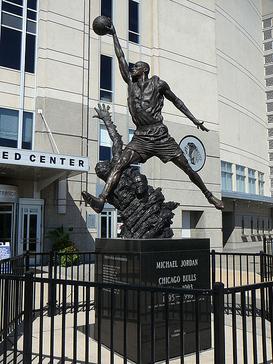
The statue of Michael Jordan, also known as The Spirit, is a bronze sculpture by Omri Amrany and Julie Rotblatt-Amrany that has been located inside the United Center in the Near West Side community area of Chicago since March 1, 2017. The sculpture was originally commissioned after Jordan's initial retirement following three consecutive NBA championships and unveiled prior to the Bulls taking residence in their new home stadium the following year. Depicting Basketball Hall of Fame member Michael Jordan and unveiled outside the United Center on November 1, 1994, the 12-foot (3.7 m) sculpture stands atop a 5-foot (1.52 m) black granite base. Although not critically well received, the statue has established its own legacy as a meeting place for fans at subsequent Bulls championships and as a rallying point for Chicago Blackhawks fans.

WGN Sports was the programming division of WGN-TV, an independent television station located in Chicago, Illinois, United States—which is owned by the Nexstar Media Group—that was responsible for all sports broadcasts on the station, some of which were previously also broadcast on its former national superstation feed, WGN America.

Wirtz Corporation is an American holding company headquartered in Chicago, Illinois. It was founded in 1926 by Arthur Wirtz as a family-owned corporation to oversee his real estate holdings. The company shortly thereafter expanded into liquor distribution. The company grew significantly throughout the 20th century by purchasing many competing liquor distributors, as well as the Chicago Blackhawks NHL team, and the Chicago Bulls NBA team in 1972. Wirtz Corporation is part owner of the United Center arena, and also owns banking and insurance interests.

References

  1. "Nobody Cheers for Jerry Krause". 26 April 1990.
  2. "The Man Behind Green Thumb Industries". August 2021.
  3. "Thorn Loses Bulls Job After 6-year Struggle - UPI Archives".
  4. "Kovler Fires Shot in Transition Game". Chicago Tribune . 14 March 1985.
  5. "NBA: Thorn enters Hall with long list of accomplishments in basketball". 7 September 2018.
  6. "Lester Crown, who owns nearly a one-third interest in... - UPI Archives".
  7. "New York Yankees". New York Daily News . 12 September 2023.
  8. "Reinsdorf Buys Bulls". Chicago Tribune . 9 February 1985.
  9. "George Steinbrenner Owned a Portion of the Chicago Bulls for More Than a Decade". 21 April 2020.
  10. "Unsatisfied with $650,000 Paycheck, 21-Year-Old Michael Jordan's Bargaining with Bulls Owner Was Brutally Rejected: "6,000 People a Game"". 18 July 2023.
  11. "The Miracle on Madison Street". NBA.com .
  12. "Disgruntled Part Owner Sells Interest in Bulls". 30 January 1986.
  13. "Kovler Bows Out as a Bull's Owner". Chicago Tribune . 13 March 1985.
  14. ""He'd better put people in the seats" - when Chicago Bulls owner Jonathan Kovler rejected Michael Jordan's request for attendance clause in contract". January 2023.
  15. "SPORTS PEOPLE; Basketball Buyout a group of investors headed by". The New York Times. 9 February 1985.
  16. "Choice Seats at the Bull Ring". Sports Illustrated Vault | Si.com.
  17. "Sports News in Brief". The New York Times. 26 July 1972.
  18. "N.B.A. Approves Sale of Bulls". The New York Times. 11 August 1972.