Joseph F. King

Last updated

Joseph F. King (born c. 1948 [1] ) is a former senior US Customs agent and criminal justice academic. He served for 33 years as a Special Agent in the United States Customs Service's New York office. He is an associate professor at the John Jay College of Criminal Justice (since September 2003).

United States Customs Service former customs service of the United States

The United States Customs Service was an agency of the U.S. federal government that collected import tariffs and performed other selected border security duties.

John Jay College of Criminal Justice College of the City University of New York

The John Jay College of Criminal Justice is a senior college of the City University of New York in Midtown Manhattan, New York City. John Jay was founded as the only liberal arts college with a criminal justice and forensic focus in the United States. The college is known for its criminal justice, forensic science, forensic psychology, and public affairs programs.

Contents

Background and education

King graduated in history from St. Francis College, Brooklyn, in 1968, and gained an MA from the John Jay College of Criminal Justice in 1975. He later gained an MPhil and PhD from the City University of New York CUNY Graduate Center (1990 and 1999). [2]

St. Francis College college in Brooklyn, New York City

St. Francis College, often referred to as St. Francis of Brooklyn or SFC, is a private, coeducational college located in Brooklyn Heights, New York. It was founded in 1859 by the Franciscan Brothers of Brooklyn, a Franciscan order, as the St. Francis Academy and was the first private school in the Roman Catholic Diocese of Brooklyn. St. Francis College began as a parochial all-boys academy in the City of Brooklyn and has become a small liberal arts college that has 19 academic departments which offer 72 majors and minors.

City University of New York Public university system in New York City

The City University of New York is the public university system of New York City. It is the largest urban university system in the United States. CUNY was founded in 1961 and comprises 24 campuses: eleven senior colleges, seven community colleges, one undergraduate honors college, and seven post-graduate institutions. The university enrolls more than 275,000 students, and counts thirteen Nobel Prize winners and twenty-four MacArthur Fellows among its alumni.

Career

King was a Special Agent in the United States Customs Service's New York office from 1968 to 1985, acting as a lead agent for undercover operations regarding Middle Eastern and Irish groups. [2] From 1985 to 2003 he was Supervisory Special Agent in the Strategic Investigations Division in the United States Customs Service's New York office. In this capacity, and due to his specialist knowledge, he was a member of the White House Legal Task Force on the Iran-Contra affair, [2] and in 1992 briefly assigned to the House October Surprise Task Force. [3]

The House October Surprise Task Force was a task force instituted by the United States House of Representatives in 1992 to examine the October Surprise allegations: that during the 1980 United States presidential election the Reagan campaign had sought to negotiate a solution to the Iran hostage crisis in competition to the US government of Jimmy Carter, in order to prevent the successful resolution of the crisis giving Carter an electoral boost. Following the publication of the report in January 1993, Task Force chairman Rep. Lee H. Hamilton published an editorial in The New York Times summarising the Task Force conclusion that "there was virtually no credible evidence to support the accusations."

King's undercover work included a role in a 1980 case involving arms smuggling to South Africa, [4] a role in the 1984 case against Cyrus Hashemi and his brothers, [5] and playing what he described as a "corrupt former C.I.A.-type" in a 1986 arms deal which became known as the Brokers of Death arms case. [1] [6] Later he played an Irish arms dealer named Joe Kennedy, foiling a 1993 plot to smuggle zirconium to Iraq. [1]

Cyrus Hashemi was an Iranian arms dealer linked to the Iran-Contra affair and October Surprise conspiracy theory. Hashemi was named by Robert Dreyfuss as a CIA and Mossad agent; Hashemi sued Dreyfuss and Lyndon LaRouche, whose Executive Intelligence Review had linked Hashemi to funding of Iranian terrorism, with the case dismissed in June 1983 due to Hashemi's failure to respond to legal documents. Hashemi died in 1986 in London in mysterious circumstances; the official cause of death was "a rare and virulent form of leukemia that was diagnosed only two days before Hashemi died."

The 'Brokers of Death' arms case was a US trial in the 1980s relating to the attempted shipment of $2.5bn worth of US-made arms to Iran; it was described by the Los Angeles Times in 1986 as "the largest arms conspiracy prosecution ever brought by the Justice Department". The case was dropped in January 1989 after the prosecution said it could not prove the defendants did not believe their dealings were officially sanctioned. The planned deals were being arranged at the same time as the White House was secretly seeking to arrange arms sales to Iran, in what became known as the Iran-Contra affair; some evidence indicated that defendants were aware of these efforts.

Zirconium Chemical element with atomic number 40

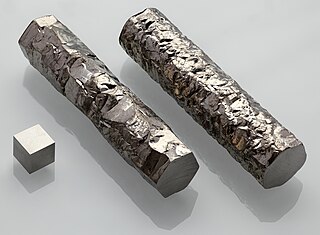
Zirconium is a chemical element with the symbol Zr and atomic number 40. The name zirconium is taken from the name of the mineral zircon, the most important source of zirconium. It is a lustrous, grey-white, strong transition metal that closely resembles hafnium and, to a lesser extent, titanium. Zirconium is mainly used as a refractory and opacifier, although small amounts are used as an alloying agent for its strong resistance to corrosion. Zirconium forms a variety of inorganic and organometallic compounds such as zirconium dioxide and zirconocene dichloride, respectively. Five isotopes occur naturally, three of which are stable. Zirconium compounds have no known biological role.

Related Research Articles

A Special Agent, in the United States, is usually a criminal investigator or detective for a federal or state government, who primarily serves in investigatory positions. Additionally, many federal and state "Special Agents" operate in "criminal intelligence" based roles as well. Within the US federal law enforcement system, dozens of federal agencies employ federal law enforcement officers, each with different criteria pertaining to the use of the titles Special Agent and Agent.

The Mollen Commission is formally known as The City of New York Commission to Investigate Allegations of Police Corruption and the Anti-Corruption Procedures of the Police Department. Former judge Milton Mollen was appointed in June 1992 by then New York City mayor David N. Dinkins to investigate corruption in the New York City Police Department. Mollen's mandate was to examine and investigate "the nature and extent of corruption in the Department; evaluate the departments procedures for preventing and detecting that corruption; and recommend changes and improvements to those procedures".

A crime boss, crime lord, don, kingpin, or mob boss is a person in charge of a criminal organization. A boss typically has absolute or nearly absolute control over the other members of the organization, is greatly feared for his ruthlessness and willingness to take lives to exert their influence, and profits from the criminal endeavors in which the organization engages.
Coast Guard Investigative Service

The Coast Guard Investigative Service (CGIS) is a division of the United States Coast Guard that investigates crimes where the U.S. Coast Guard has an interest. It is composed of civilian (GS-1811), active duty, reserve enlisted, and warrant officer Special Agents.

Border guard Government service concerned with security of national borders

A border guard of a country is a national security agency that performs border security, i.e., enforces the security of the country's national borders. Some of the national border guard agencies also perform coast guard and rescue service duties.

Raymond J. Wean a.k.a. "Big Ray" was a Bonanno crime family associate who worked under capo Joe Massino and Dominick Napolitano.

Richard M. "Richie" Roberts is an American attorney. Roberts was a former law enforcement officer who worked as a detective in the Essex County Prosecutor’s Office and Essex County Bureau of Narcotics. After completing a law degree at Seton Hall University and passing the bar examination, Roberts served as an Assistant Prosecutor in the Essex County Prosecutor's Office.

John P. Torres Homeland security official

John P. Torres was acting assistant secretary of homeland security for U.S. Immigration and Customs Enforcement (ICE). He was appointed on November 17, 2008.

William Copeland Dodge was an American lawyer and Democratic politician in New York City, New York, United States. He was an associate of the Tammany Hall political organization in the city.

Selwyn Raab is an American journalist, author and former investigative reporter for The New York Times. He has written extensively about the American Mafia and criminal justice issues.

ATF gunwalking scandal 2000s affair of ATF officers allowing illegal firearms sale

"Gunwalking", or "letting guns walk", was a tactic of the Arizona Field Office of the United States Bureau of Alcohol, Tobacco, Firearms and Explosives (ATF), which ran a series of sting operations between 2006 and 2011 in the Tucson and Phoenix area where the ATF "purposely allowed licensed firearms dealers to sell weapons to illegal straw buyers, hoping to track the guns to Mexican drug cartel leaders and arrest them". These operations were done under the umbrella of Project Gunrunner, a project intended to stem the flow of firearms into Mexico by interdicting straw purchasers and gun traffickers within the United States. The Jacob Chambers Case began in October 2009 and eventually became known in February 2010 as "Operation Fast and Furious" after agents discovered Chambers and the other suspects under investigation belonged to a car club.

Jaime Zapata US agent

Jaime Jorge Zapata was an Immigration and Customs Enforcement, Homeland Security Investigations Special Agent who was ambushed and murdered by the Mexican criminal group Los Zetas in San Luis Potosí, Mexico. He was one of the two agents that were ambushed in a part of the country that is increasingly under the influence of drug violence. Zapata's death is the second highest-profile killing of a U.S. agent in Mexico—the first one was Enrique Camarena, an undercover DEA agent who was tortured and murdered by the former Guadalajara Cartel.

William Northrop intelligence officer

William Warren "Will" Northrop is a military historian, investigator and writer. He is best known for the controversy regarding his claims of military and combat service, and prior to that for his role in the so-called "Brokers of Death" arms case, a precursor to the Iran–Contra scandal in 1986. He is a writer and has written articles over the years for such diverse venues as Penthouse, New Dimensions magazine, and The Jerusalem Post. He has also written several articles in Recall, the magazine of the North Carolina Military Historical Society, mostly battle analyses.

David Locke Hall is a highly decorated former Assistant United States Attorney, Naval Intelligence officer, and author.

Amir Hossein Ardebili is an Iranian businessman and convicted arms dealer.

Luke Alvez Fictional television character

Luke Alvez is a fictional character on the CBS crime drama Criminal Minds, portrayed by Adam Rodríguez.

References