Related Research Articles
The Queen Elizabeth Range is a rugged mountain range of the Transantarctic Mountains System, located in the Ross Dependency region of Antarctica.
Belgica Mountains is an isolated chain of mountains about 10 miles (16 km) long, standing 60 miles (97 km) east-southeast of the Sor Rondane Mountains in Queen Maud Land, in the Antarctic. The chain was discovered by the Belgian Antarctic Expedition (1957-1958) under Gaston de Gerlache, and named after the ship Belgica, commanded by his father, Lt. Adrien de Gerlache, leader of the Belgian Antarctic Expedition of 1897–99.

The Prince Charles Mountains are a major group of mountains in Mac. Robertson Land in Antarctica, including the Athos Range, the Porthos Range, and the Aramis Range. The highest peak is Mount Menzies, with a height of 3,228 m (10,591 ft). Other prominent peaks are Mount Izabelle and Mount Stinear. These mountains, together with other scattered peaks, form an arc about 420 km (260 mi) long, extending from the vicinity of Mount Starlight in the north to Goodspeed Nunataks in the south.
Athos Range is the northernmost range in the Prince Charles Mountains of Mac. Robertson Land, Antarctica. The range consists of many individual mountains and nunataks that trend east–west for 40 miles (64 km) along the north side of Scylla Glacier.
Morrill Peak is a sharp-pointed peak, about 550 metres (1,800 ft) high, in the Desko Mountains, rising 2 nautical miles (4 km) west-northwest of Thuma Peak in southeast Rothschild Island, Antarctica. It was named by the Advisory Committee on Antarctic Names for Captain Peter A. Morrill, U.S. Coast Guard, Executive Officer on USCGC Westwind in U.S. Navy Operation Deep Freeze 1967 and 1968.
The Annandags Peaks are a group of small, isolated peaks about 15 nautical miles (30 km) southwest of the Jule Peaks in Queen Maud Land. They were mapped by Norwegian cartographers from surveys and from air photos by the Norwegian–British–Swedish Antarctic Expedition (1949–52) and named "Annandagstoppane".
Jekselen Peak is, at 1,405 metres (4,610 ft), the highest peak in a small ridge 7 nautical miles (13 km) east-southeast of Mount Schumacher, in the Ahlmann Ridge of Queen Maud Land, Antarctica. It was mapped by Norwegian cartographers from surveys and air photos by the Norwegian–British–Swedish Antarctic Expedition (1949–52) and from air photos by the Norwegian expedition (1958–59) and named Jekselen.
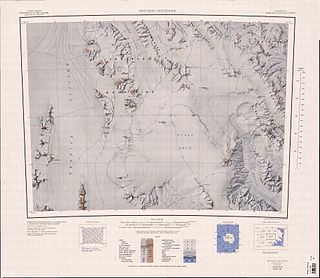
The Freyberg Mountains are a group of mountains in Victoria Land, Antarctica, bounded by Rennick Glacier, Bowers Mountains, Black Glacier, and Evans Neve. Named for New Zealand's most famous General, Lord Bernard Freyberg, by the Northern Party of New Zealand Geological Survey Antarctic Expedition (NZGSAE), 1963-64. This mountain group includes the Alamein Range. These topographical features all lie situated on the Pennell Coast, a portion of Antarctica lying between Cape Williams and Cape Adare.
Dugurdspiggen Peak is an isolated peak about 4 nautical miles north of the Borg Massif in Queen Maud Land. It was mapped by Norwegian cartographers from surveys and air photos by Norwegian–British–Swedish Antarctic Expedition (1949–52) and from air photos by the Norwegian expedition (1958–59) and named Dugurdspiggen.

Edwards Peninsula is an ice-covered peninsula about 20 nautical miles (40 km) long, between Murphy Inlet and Koether Inlet on the north side of Thurston Island. It was delineated from aerial photographs made by U.S. Navy Operation HIGHJUMP in December 1946 and by U.S. Navy Squadron VX-6 in January 1960, and was named by the Advisory Committee on Antarctic Names for Lieutenant Donald L. Edwards, the navigator of the USS Burton Island on the U.S. Navy Bellingshausen Sea Expedition to this area in February 1960. Mount Bubier sits about 4 nautical miles south of the northern tip of the peninsula. Tribby Peak sits about 1.5 nautical miles west of Mount Bubier.
Fidase Peak is a distinctive peak 9 nautical miles (17 km) east of Mount Jacquinot, rising to 915 metres (3,000 ft) at the west end of Mott Snowfield, Trinity Peninsula. The name represents the initial letters of the Falkland Islands and Dependencies Aerial Survey Expedition (FIDASE) (1955–57) led by P.G. Mott.
Flårjuven Bluff is a flat-topped, largely ice-free bluff about 1 nautical mile (2 km) north of Storkletten Peak, on the Ahlmann Ridge in Queen Maud Land, Antarctica. It was mapped by Norwegian cartographers from surveys and air photos by the Norwegian–British–Swedish Antarctic Expedition (1949–52) and named Flårjuven. Aurnupen Peak lies 1 mile (1.6 km) north.
The Flårjuvnutane Peaks are a group of small rock peaks about 1 nautical mile (2 km) west of Flårjuven Bluff, on the Ahlmann Ridge in Queen Maud Land, Antarctica. They were mapped by Norwegian cartographers from surveys and air photos by the Norwegian–British–Swedish Antarctic Expedition (1949–52) and named Flårjuvnutane.

Klebelsberg Glacier is a glacier, 7 nautical miles (13 km) long and 2 nautical miles (4 km) wide, situated at the south side of Finsterwalder Glacier and flowing from Hemimont Plateau northwestward between Armula Peak and Smilyan Bastion on Graham Land, Antarctica, toward the head of Lallemand Fjord. With Finsterwalder Glacier and Haefeli Glacier, its mouth merges with Sharp Glacier where the latter enters the fjord. It was first surveyed from the plateau in 1946–47 by the Falkland Islands Dependencies Survey, and named by them for Raimund von Klebelsberg, an Austrian glaciologist.
Kjellberg Peak is a small rock peak at the head of Frostlendet Valley, about 4 nautical miles (7 km) west of Ryvingen Peak, in the southern part of the Borg Massif of Queen Maud Land, Antarctica. It was mapped by Norwegian cartographers from surveys and air photos by the Norwegian–British–Swedish Antarctic Expedition (1949–52) and named for Sigvard Kjellberg, a photographer with the Norwegian air unit of the expedition.
Mana Mountain is a prominent ice-free mountain bordering the south side of Frostlendet Valley about 5 nautical miles (9 km) southwest of Møteplassen Peak, in the Borg Massif of Queen Maud Land, Antarctica. It was mapped and named by Norwegian cartographers from surveys and air photos by the Norwegian–British–Swedish Antarctic Expedition (1949–52).
Tierney Peninsula is an ice-covered peninsula about 14 nautical miles (26 km) long, between Savage Glacier and Morgan Inlet in the east end of Thurston Island. The east extremity of the peninsula is Cape Annawan. These features were discovered on helicopter flights from the USS Burton Island and Glacier of the U.S. Navy Bellingshausen Sea Expedition in February 1960 and named by the Advisory Committee on Antarctic Names (US-ACAN). The peninsula was named for J.Q. Tierney, oceanographer aboard the Burton Island on this expedition. The cape was named for the ship Annawan of the United States Expedition of 1829–31, which with the Penguin sailed west from the South Shetland Islands in February 1830, holding a course between 62S and 58S and exploring as far as 103W, northward of this cape.
Langford Peak is an isolated peak in Antarctica, 2 nautical miles (4 km) west of the lower part of Reedy Glacier and 5 nautical miles (9 km) northwest of Abbey Nunatak. It was mapped by the United States Geological Survey from ground surveys and U.S. Navy air photos, 1960–63, and was named by the Advisory Committee on Antarctic Names for Lawrence G. Langford, Jr., a builder with the Byrd Station winter party, 1958.
The Liljequist Heights are the heights about 2 nautical miles (4 km) south of the Grunehogna Peaks, in the Ahlmann Ridge of Queen Maud Land, Antarctica. They were mapped by Norwegian cartographers from surveys and air photos by the Norwegian–British–Swedish Antarctic Expedition (NBSAE) (1949–52) and air photos by the Norwegian expedition (1958–59). The heights are named for Gösta Hjalmar Liljequist, a Swedish meteorologist with the NBSAE.
References
- ↑ "Jule Peaks". Geographic Names Information System . United States Geological Survey, United States Department of the Interior . Retrieved 2013-04-08.
- ↑ "Annandags Peaks". Geographic Names Information System . United States Geological Survey, United States Department of the Interior . Retrieved 2011-05-11.
 This article incorporates public domain material from "Jule Peaks". Geographic Names Information System . United States Geological Survey.