This article has multiple issues. Please help improve it or discuss these issues on the talk page . (Learn how and when to remove these template messages)
|
Just Us: An American Conversation is a 2020 book and anthology of essays, poems, and personal anecdotes written by American author and poet Claudia Rankine. An "arrangement of essays, poems, and images [which] includes the voices and rebuttals of others", [1] it describes and outlines an ideal response to forms of racism in contemporary settings. [1] The book received mixed reviews from critics. [2] [3]
In Just Us: An American Conversation, Rankine describes encounters throughout the course of her life in which she had to deal with the ignorance of others–the majority of those typically being white men. In the face of ignorance she began to tap into subjects that she believes aren't discussed frequently enough. Rankine finds herself in numerous social situations where she feels she is being silenced. She expresses the desire to ask men she encounters about their white privilege and their opinions on the matter. She refers back to an issue that happened during a police training seminar–a female officer in the audience draws attention to the leading officer's statement concerning his dubious understanding of where the police brutality statistics comes from. When asked about the percentage of transgender victims of police brutality the female officer calls out his skewed perception through a lens of white privilege. The conflict was initiated when the officer said he did not understand the percentage of victims to police brutality because he and his friends had never encountered such situations. After she made her comment on his privilege, he said that the comment was extremely offensive. Rankine discloses how this particular situation led to her hesitation in calling out patriarchal privileges and asking the questions she wanted to ask. Eventually, she did ask those difficult questions in many of her future encounters.
Rankine acknowledges that her past experiences with people prepared her for the difficult questions she would have to ask. With further contact, she gathers responses on how others view whiteness and privilege. she integrates media and photography to expand her point on the conversation. She states that the only change whiteness wants is one that reflects itself. The more encounters she has, the more Rankine feels that change will only ever begin to occur when people come to terms with their whiteness. During a dinner party one of the guests mentioned that he was writing a book on the 2016 presidential election but failed to mention the role of racism when anti-black and anti-Latin racism, which Rankine believed was a factor in placing the current president in power. When she expressed her stance on the matter she was interrupted by the hostess and, although it was not verbally expressed, Rankine felt she was being silenced on the matter. She writes that the privileged majority don’t want change because change for them would mean having to think differently. Rankine describes another encounter with a man at Yale–he says that his son’s inability to get an early acceptance into Yale is a result of not being able to "play the race card".
With the images in her book, Rankine portrays how the media has played a significant role in the participation of racism. Like the images of a commercial that aired on TV where a Black man is placed inside a washing machine and out comes an Asian man. Rankine shares various images of a commercial that aired on television where a Black man gets stuffed into a washing machine and out comes an Asian man. Rankine felt as if they were making a clear statement on the preference of skin color in the world. She also introduced images of a video on YouTube with step-by-step on skin whitening where she expresses her issues with the normalization of skin whitening pointing out darker skin isn't quite accepted by society. Rankine takes the topic further by relating it to children and their early onset biases on race. By referring back to the doll studies where children are asked to pick either the White, doll or the Black doll. The children are asked questions such as "Which doll is the dumb one?" or "Which one is bad?" and children did show a preference for the White doll. She includes the input of Erin Winkler who argues that children do develop certain preferences because at a young they become aware of which social groups are favored as well as the societal norms.
Just Us was published in September 2020, four years after Rankine's previous award-winning book Citizen. In an interview with NPR, she says that she was motivated to write this book because she was interested in knowing how a "system that was shaped with the tenets of white supremacy" [4] would affect how she socializes with others and how white people socialize with her. Rankine explains her method for trying to engage with people to talk about white male privilege started off as trying to be unassuming and hoping that the conversation would lead into the topic. Eventually, she would find an opening and move the conversation towards the topic of white privilege. [4]
In the same interview, Rankine admits that the title of the book, Just Us, comes from comedian Richard Pryor in a joke about the criminal justice system in which he says, "You go down there looking for justice. That's what you find — just us."
Racism is the biggest theme of Just Us, with the book centering around the personal experiences of Claudia Rankine. Since the 2016 election, many social issues came to the spotlight. Rankine writes about her experiences at dinner parties. In one instance, Rankine challenges a man on the 2016 election, with his theory being that Trump's win will quiet racism. [5]
White privilege is another theme brought up in Just Us. Rankine initiates this conversation through her experiences with white people. She explains how the color white seems to be the pinnacle of everything. The New York Times explores this point with Rankine saying whiteness is dominant, so the question of "what is Black" must always follow "what is white?" [6]
Just Us focuses on themes of race, interracial communication, white privilege, and intersectionality. Centering on the barriers established around race and gender, Rankine focuses on the miscommunication between these different social groups while taking note on the nature of whiteness and the difficulty in defining it. [5] The book also notes the structure of race in a modern context with regards to femininity and beauty standards and examines the effect of their discourse. Rankine simultaneously acknowledges themes of racial color-blindness, and what she perceives to be the failings of such mindsets. [7]
Claudia Rankine's Just Us: An American Conversation was the first book to be nominated by the National Book Critics Circle for both poetry and criticism. [8] An article from The New Yorker by Katy Waldman described the book: "The book returns often to the phrase 'what if', but it feels besieged by 'what is': unfreedom is the point, as is a shift in the 'American conversation' from hope to a kind of dignified resignation". [5] She also says that the book surpasses language, and instead asks for healing. It ties together poetry and criticism. [5]
Writer from The Atlantic Ismail Muhammad said, "Rankine's intent is not simply to expose or chastise whiteness. She has something more nuanced in mind: using conversation as a way to invite white people to consider how contingent their lives are upon the racial order—every bit as contingent as Black people’s are". [9] Both critics have commented on Rankine's use of criticism and lyricism.
Maya Phillips of The New York Times notes how Rankine infuses her knowledge and insight of the dominance of whiteness to create an interrogation at a theoretical distance yet criticizes the work as, at times, filled with suffocation and incoherence. "But even in Rankine's inarguable genius, Just Us feels as if it skips a small step in the progression of the book, the movement from start to finish among the separate chapters." [6]
Katherine Preston of MAKE Literary Magazine declares it as a meditative sociological work seen through Rankine’s personal anecdotes, alongside extensive citations, images, and quotes. These writing methods further call for self-reflection and responsibility for its white readers as Rankine continually breaks the barrier behind discussing such topics. [10]
The Christian Science Monitor named Just Us a best nonfiction book of 2020, remarking, "This consciousness-raising, bravura combination of personal essays, poems, photographs, and cultural commentary works on so many levels and is a skyscraper in the literature on racism." [11]
The New York Times named Just Us one of the 10 Best Books of 2020 [12] and the 100 Notable Books of 2020. [13] Time Magazine had it in The 100 must-read books of 2020, claiming it is "...one of the most viral texts on race to arrive this year". [14] Publishers Weekly placed Just Us as one of the Best Nonfiction books of 2020. [15]
White guilt is a belief that white people bear a collective responsibility for the harm which has resulted from historical or current racist treatment of people belonging to other racial groups, as for example in the context of the Atlantic slave trade, European colonialism, and the genocide of indigenous peoples.
I Know Why the Caged Bird Sings is a 1969 autobiography describing the young and early years of American writer and poet Maya Angelou. The first in a seven-volume series, it is a coming-of-age story that illustrates how strength of character and a love of literature can help overcome racism and trauma. The book begins when three-year-old Maya and her older brother are sent to Stamps, Arkansas, to live with their grandmother and ends when Maya becomes a mother at the age of 16. In the course of Caged Bird, Maya transforms from a victim of racism with an inferiority complex into a self-possessed, dignified young woman capable of responding to prejudice.
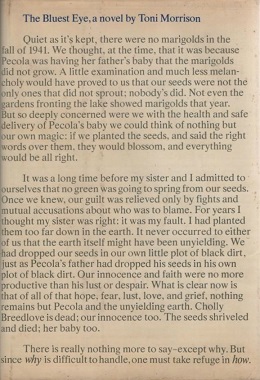
The Bluest Eye, published in 1970, is the first novel written by Toni Morrison. The novel takes place in Lorain, Ohio, and tells the story of a young African-American girl named Pecola who grew up following the Great Depression. Set in 1941, the story is about how she is consistently regarded as "ugly" due to her mannerisms and dark skin. As a result, she develops an inferiority complex, which fuels her desire for the blue eyes she equates with "whiteness".
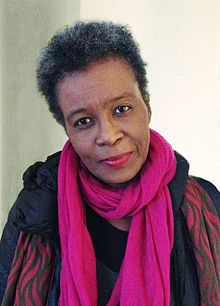
Claudia Rankine is an American poet, essayist, playwright and the editor of several anthologies. She is the author of five volumes of poetry, two plays and various essays.
France Winddance Twine is a Black and Native American sociologist, ethnographer, visual artist, and documentary filmmaker. Twine has conducted field research in Brazil, the UK, and the United States on race, racism, and anti-racism. She has published 11 books and more than 100 articles, review essays, and books on these topics.
Gather Together in My Name is a 1974 memoir by American writer and poet Maya Angelou. It is the second book in Angelou's series of seven autobiographies. Written three years after the publication of and beginning immediately following the events described in I Know Why the Caged Bird Sings, it follows Angelou, called Rita, from the ages of 17 to 19. The title is taken from the Bible, but also conveys how one Black female lived in the white-dominated society of the U.S. following World War II.
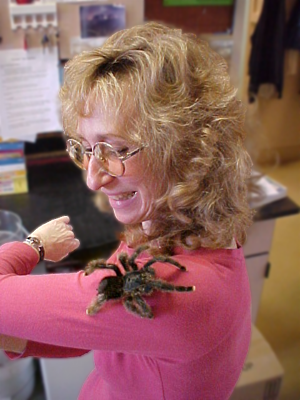
Sy Montgomery is an American naturalist, author and scriptwriter who writes for children as well as adults.

Citizen: An American Lyric is a 2014 book-length poem and a series of lyric essays by American poet Claudia Rankine. Citizen stretches the conventions of traditional lyric poetry by interweaving several forms of text and media into a collective portrait of racial relations in the United States. The book ranked as a New York Times Bestseller in 2015 and won several awards, including the 2014 National Book Critics Circle Award for Poetry, the 2015 NAACP Image Award for Outstanding Literary Work in Poetry, and the 2015 Forward Prize for Poetry Best Collection.
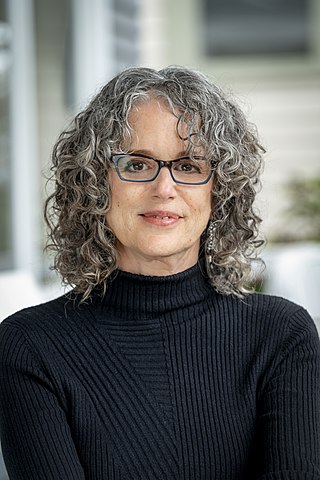
Robin Jeanne DiAngelo is an American author working in the fields of critical discourse analysis and whiteness studies. She formerly served as a tenured professor of multicultural education at Westfield State University and is currently an affiliate associate professor of education at the University of Washington. She is known for her work pertaining to "white fragility", an expression she coined in 2011 and explored further in a 2018 book entitled White Fragility: Why It's So Hard for White People to Talk About Racism.
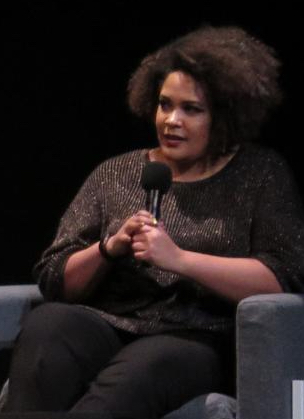
Ijeoma Oluo is an American writer. She is the author of So You Want to Talk About Race and has written for The Guardian,Jezebel, The Stranger, Medium, and The Establishment, where she was also an editor-at-large.

White Fragility: Why It's So Hard for White People to Talk About Racism is a 2018 book written by Robin DiAngelo about race relations in the United States. An academic with experience in diversity training, DiAngelo coined the term "white fragility" in 2011 to describe what she views as any defensive instincts or reactions that a white person experiences when questioned about race or made to consider their own race. In White Fragility, DiAngelo views racism in the United States as systemic and often perpetuated subconsciously by individuals. She recommends against viewing racism as committed intentionally by "bad people".
Ashley E. Jardina is an associate professor of Political Science at George Mason University and author.
White defensiveness is a term to describe defensive responses by white people to discussions of societal discrimination, structural racism, and white privilege. The term has been applied to characterize the responses of white people to portrayals of the Atlantic slave trade and European colonization, or scholarship on the legacy of those systems in modern society. Academics and historians have identified multiple forms of white defensiveness, including white denial, white diversion, and white fragility, the last of which was popularized by scholar Robin DiAngelo.
Karen is a term used as slang typically for a middle-class white American woman who is perceived as entitled or excessively demanding beyond the scope of what is considered to be normal behavior and decorum. The term is often portrayed in memes depicting middle-class white women who "use their white and class privilege to demand their own way". Depictions include demanding to "speak to the manager", being racist, or wearing a particular bob cut hairstyle. It was popularized in the aftermath of the Central Park birdwatching incident in 2020.
The talk is a colloquial expression for a conversation Black parents in the United States feel compelled to have with their children and teenagers about the dangers they face due to racism or unjust treatment from authority figures, law enforcement or other parties, and how to de-escalate them. The practice dates back generations and is often viewed as a rite of passage for Black children.
Aph Ko is an American writer, vegan activist, and digital media producer. She is the author of Racism as Zoological Witchcraft: A Guide to Getting Out (2019), co-author of Aphro-ism: Essays on Pop Culture, Feminism, and Black Veganism from Two Sisters (2017), and creator of the website Black Vegans Rock.

Brit(ish): On Race, Identity and Belonging is a 2018 book by the journalist Afua Hirsch. The book is part-memoir and discusses black history, culture and politics in the context of Britain, Senegal and Ghana. It received mixed critical reception.

Women Don't Owe You Pretty is a 2020 book by the British activist and illustrator Florence Given. On the topic of intersectional feminism, Given writes about relationships, body image and self-esteem for women. The book sold 100,000 copies within six months of publication and was listed on The Sunday Times' bestsellers list for twelve consecutive weeks, peaking at second place.
American reality television franchise The Bachelor has long been criticized for how it handles race. Industry journalists, academics, and critics have condemned the franchise for its lack of racial diversity, its portrayal of people of color, and its contestants' racist behaviors.
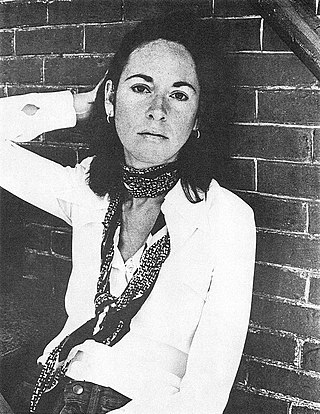
The 2020 Nobel Prize in Literature was awarded to the American poet Louise Glück (1943–2023) who the Swedish Academy members praised "for her unmistakable poetic voice that with austere beauty makes individual existence universal." The winner was announced on October 8, 2020, by Mats Malm, permanent secretary of the Swedish Academy. She is the 13th Nobel laureate in Literature from the United States after 2016 laureate Bob Dylan and 1993 laureate Toni Morrison.