The Usarp Mountains is a major Antarctic mountain range, lying westward of the Rennick Glacier and trending N-S for about 190 kilometres (118 mi). The feature is bounded to the north by Pryor Glacier and the Wilson Hills. Its important constituent parts include Welcome Mountain, Mount Van der Hoeven, Mount Weihaupt, Mount Stuart, Mount Lorius, Smith Bench, Mount Roberts, Pomerantz Tableland, Daniels Range, Emlen Peaks, Helliwell Hills and Morozumi Range.
The Black Rocks are a small group of rocks 0.5 miles (0.80 km) southeast of Framnaes Point in the north part of Stromness Bay, South Georgia. The name Blenheim Rocks has appeared for these rocks, but since about 1930 the name Black Rocks has been used more consistently.

Mount Sugartop is a prominent, partly snow-covered mountain, 2,325 m, standing 5 miles (8 km) northwest of Mount Paget in the Allardyce Range of South Georgia. The name "Sugarloaf Peak" has appeared on maps for this feature for many years, but the South Georgia Survey, following its 1951-52 surveying expedition, reported that the name Mount Sugartop is well established locally for this mountain. This latter name is approved on the basis of local usage.
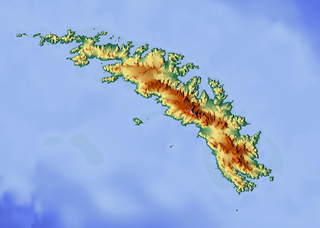
Graae Glacier is a glacier 2 miles (3 km) long on the north side of Mount Sabatier, flowing west-southwest to Trollhul in the south part of South Georgia. It was surveyed by the South Georgia Survey (SGS) in the period 1951–57, and named by the UK Antarctic Place-Names Committee for Morgens E.W. Graae of Denmark, who developed sledges for the SGS, 1953–54 and 1955–56.
Tanner Island is the westernmost and largest of the Pickersgill Islands, rising to 145m off the south coast of South Georgia. Named by United Kingdom Antarctic Place-Names Committee (UK-APC) for Dr. P.W.G. Tanner, a British Antarctic Survey (BAS) geologist who worked on the island during the 1975-76 field season.
Islet Point is a headland forming the east side of the entrance to Carlita Bay, Cumberland West Bay, on the north coast of South Georgia. The name appears to be first used on a 1929 British Admiralty chart and probably derives from the islet just off the point.
Ems Rock is a rock midway between Harrison Point and Busen Point in the south part of Stromness Bay, South Georgia. It was charted by Discovery Investigations personnel under Lieutenant Commander J.M. Chaplin in 1927 and 1929, and was named in 1957 by the UK Antarctic Place-Names Committee for the sailing vessel Ems, owned by the Tonsberg Hvalfangeri, Husvik, located at the head of Husvik Harbour in Stromness Bay.
König Glacier is a glacier, 3 nautical miles (6 km) long and 1.5 nautical miles (3 km) wide, flowing in a northerly direction from the north side of Neumayer Glacier to the head of Fortuna Bay, South Georgia. It was first surveyed in 1928–29 by a German expedition under Kohl-Larsen, who named it for Austrian mountaineer Felix König, who took part in the Second German Antarctic Expedition, 1911–12, under Wilhelm Filchner.
Camana Rock is a rock midway between Kelp Point and Harrison Point in the southern part of Stromness Bay, South Georgia. It was mapped by DI personnel under Lieutenant Commander J.M. Chaplin in 1927 and 1929, and named in 1957 by the UK Antarctic Place-Names Committee for the sailing vessel Camana, owned by Tonsberg Hvalfangeri of Husvik, located at the head of Husvik Harbor in Stromness Bay.
The Canopus Crags are a cluster of peaks of 3 nautical miles (6 km) extent, located between Vela Bluff and Carina Heights along the south side of Ryder Glacier, in Palmer Land. They were named by the UK Antarctic Place-Names Committee after the star Canopus in the constellation of Carina.
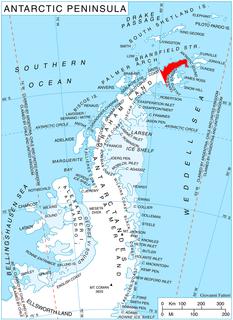
Cugnot Ice Piedmont is an ice piedmont in Trinity Peninsula, about 15 nautical miles (30 km) long and between 3 and 6 nautical miles wide, extending from Russell East Glacier to Eyrie Bay and bounded on the landward side by Louis Philippe Plateau. It was mapped from surveys by the Falkland Islands Dependencies Survey (1960–61), and named by the UK Antarctic Place-Names Committee for Nicolas-Joseph Cugnot, a French military engineer who designed and built the first full-sized vehicle propelled by its own engine (steam), in 1769.
Justa Peak is a peak, 495 metres (1,620 ft) high, lying southwest of Busen Point on the north coast of South Georgia. The name appears to be first used on a 1929 British Admiralty chart.
Jumbo Cove is a cove 0.5 nautical miles (1 km) southeast of Busen Point on the north coast of South Georgia. It was charted and named by Discovery Investigations personnel during the period 1926–30.
Middle Ground Rock is a submerged kelp-covered rock lying 1.5 nautical miles (3 km) east of Framnaes Point, in the middle of the entrance of Stromness Bay, South Georgia. The name appears to be first used on a 1952 British Admiralty chart.
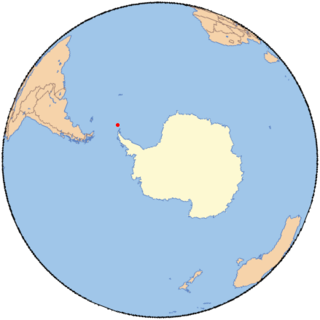
Meier Point is a point forming the west side of the entrance to Norway Bight on the south side of Coronation Island, in the South Orkney Islands off Antarctica. It was named on a chart by Captain Petter Sørlle, a Norwegian whaler who made a running survey of the South Orkney Islands in 1912–13. The Gosling Islands lie close to this point.
Humpback Rocks is a small group of rocks lying 0.25 nautical miles (0.5 km) north of Cape Saunders, off the north coast of South Georgia. The South Georgia Survey reported in 1951–52 that the descriptive name "Knolrokset" has been used for this feature by the whalers and sealers at South Georgia. An English form of the name, Humpback Rocks, was recommended by the UK Antarctic Place-Names Committee in 1954.
Teie Point is a point separating Mercer and Harpon Bays at the head of Cumberland West Bay, South Georgia. First mapped by the Swedish Antarctic Expedition, 1901–04, under Nordenskjold. Surveyed by the SGS in the period 1951-57, and named by the United Kingdom Antarctic Place-Names Committee (UK-APC) for the sailing vessel Teie, owned by Tonsberg Hvalfangeri, Husvik Harbor.
Kanin Point is a rocky point lying 2 nautical miles (4 km) west-southwest of Kelp Point on the south side of Husvik Harbor, in Stromness Bay, South Georgia. The descriptive name "Rocky Point" was given for this feature, probably by Discovery Investigations personnel who surveyed Husvik Harbor in 1928, but this name is used elsewhere in the Antarctic. The South Georgia Survey, 1951–52, reported that this feature is known at the Husvik whaling station as Kanin Point. The name presumably arose from one of several attempts made since 1872 to introduce rabbits into the island. Kanin Point is approved on the basis of local usage.
Tønsberg Point is the east extremity of a low rocky peninsula which projects into Stromness Bay, South Georgia, separating Stromness Harbor on the north from Husvik Harbor on the south. The name was in use as early as 1912 and derives from the Tønsberg Hvalfangeri, a Norwegian whaling company with worked at Husvik Harbor.
Kelp Bay is a small open bay close east-southeast of Doris Bay on the north coast of South Georgia. It is filled with kelp and there is no anchorage. The South Georgia Survey, 1951–52, reported that the descriptive name was well established locally.