
The London Midland and Scottish Railway (LMS) Jubilee Class is a class of steam locomotive designed for main line passenger work. 191 locomotives were built between 1934 and 1936. They were built concurrently with the LMS Stanier Class 5 4-6-0.

The valve gear of a steam engine is the mechanism that operates the inlet and exhaust valves to admit steam into the cylinder and allow exhaust steam to escape, respectively, at the correct points in the cycle. It can also serve as a reversing gear. It is sometimes referred to as the "motion".

The British Railways Standard Class 5MT4-6-0 was one of the 12 standard classes of steam locomotive built by British Railways in the 1950s. It was essentially a development of the LMS Stanier Class 5 4-6-0. A total of 172 were built between 1951 and 1957.
The Pennsylvania Railroad's class K5 was an experimental 4-6-2 "Pacific" type, built in 1929 to see if a larger Pacific than the standard K4s was worthwhile. Two prototypes were built, #5698 at the PRR's own Altoona Works, and #5699 by the Baldwin Locomotive Works. Although classified identically, the two locomotives differed in many aspects, as detailed below. They were both fitted with a much fatter boiler than the K4s, but dimensionally similar to those of the I1s 2-10-0 "Decapods". Most other dimensions were enlarged over the K4s as well; the exceptions being the 70 square feet (6.5 m2) grate area and the 80 in (2.032 m) drivers.

The London Midland and Scottish Railway Stanier Class 5 4-6-0, commonly known as the Black Five, is a class of 4-6-0 steam locomotives. It was introduced by William Stanier in 1934 and 842 were built between then and 1951. Several members of the class survived to the last day of steam on British Railways in 1968, and eighteen are preserved.

The Caprotti valve gear is a type of steam engine valve gear invented in the early 1920s by Italian architect and engineer Arturo Caprotti. It uses camshafts and poppet valves rather than the piston valves used in other valve gear. While basing his design on automotive valves, Caprotti made several significant departures from this design to adapt the valves for steam. Having agreed a joint-venture with Worcester-based engineering company Heenan & Froude from 1938, Heenan & Froude fully acquired Caprotti post-World War II in 1947.

The London Midland and Scottish Railway (LMS) Stanier Class 5 2-6-0 or Stanier Mogul is a class of 2-6-0 mixed traffic steam locomotive. Forty were built between October 1933 and March 1934.

The London, Midland and Scottish Railway (LMS) Class 2 Stanier 0-4-4T was a class of 10 light passenger locomotives built in 1932. Ostensibly designed under new Chief Mechanical Engineer (CME) William Stanier, they were in fact the last new design of the Midland Railway's school of engineering.
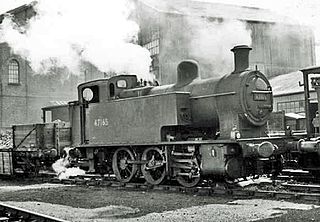
The London, Midland and Scottish Railway (LMS) Fowler Dock Tank was a 0-6-0T steam locomotive. Designed for shunting in docks, it had a short wheelbase in order for it to readily negotiate tight curves. The locomotives spent their entire lives painted in plain black.
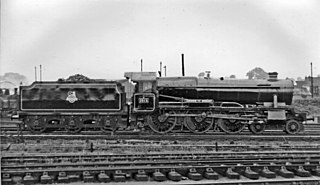
The Great Western Railway 1000 Class or County Class was a class of 4-6-0 steam locomotive. Thirty examples were built between 1945 and 1947, but all were withdrawn and scrapped in the early 1960s. No examples were preserved but a replica locomotive is under construction.
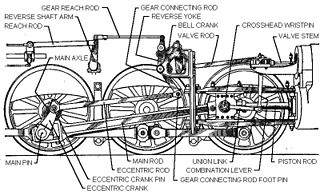
After about 1910 Baker valve gear was the main competitor to Walschaerts valve gear for steam locomotives in the United States. Strictly speaking it was not a valve gear but a variable expansion mechanism adapted to the Walschaerts layout replacing the expansion link and sliding die block. The Baker arrangement used more pivot bearings or pin joints, but avoided the die slip inherent to the expansion link, with the aim of lessening wear and the need for service; it could also facilitate longer valve travel.

The Stephenson valve gear or Stephenson link or shifting link is a simple design of valve gear that was widely used throughout the world for all kinds of steam engines. It is named after Robert Stephenson but was invented by his employees.
The Timken Roller Bearing Company was one of the first to introduce roller bearings for railroad cars. Railroad cars owned and operated by the Atchison, Topeka and Santa Fe Railway were some of the first to use roller bearings rather than "oil waste journal" boxes. Henry Timken, a German immigrant, invented an improved bearing and founded the company in 1899. It was later renamed The Timken Company.
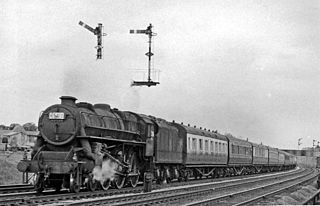
The last two of the 842 LMS Stanier Black Fives, numbers 44686 and 44687 were constructed by British Railways at Horwich Works in 1951. They were fitted with Caprotti valve gear, raised running plates without splashers, a double chimney and SKF roller bearings on all axles. Caprotti valve gear had previously been fitted to a batch of twenty Black Fives, nos. 44738-57, built in 1948. The valve gear on these was driven by one drive-line between the frames, driven from the leading coupled axle. Although these locomotives developed a great deal of power at high speeds and were free in coasting, acceleration at low speeds was poor. 44686 and 44687 were fitted with a modified form of valve gear, with an external shaft on each side, driven by a worm gear mounted on a flycrank attached to the driving axle. The British Caprotti valve gear was a new development of Caprotti valve gear by the Associated Locomotive Engineers, under the leadership of L.A. Daniels.

LMS Stanier Class 4P 3-Cylinder 2-6-4T is a class of steam locomotive designed for work over the London, Tilbury and Southend Railway route. All 37 were built in 1934 at Derby Works and were numbered 2500–2536. The third cylinder was provided to allow increased acceleration between the many stops on the L.T.&S.R. line. From 1935 the LMS switched to constructing a very similar, simpler, 2-cylinder design.
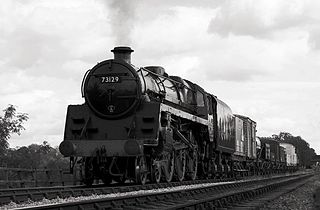
British Railways Standard Class 5 No. 73129 is a preserved British steam locomotive. It is the only surviving Standard Class 5 built by British Railways which was fitted with Caprotti valve gear.
GCR Class 9P was a design of four-cylinder steam locomotive of the 4-6-0 wheel arrangement built for hauling express passenger trains on the Great Central Railway in England. A total of six were built: one in 1917, and five in 1920. They were sometimes known as the Lord Faringdon class, from the name of the first one built.

The Ferrovie dello Stato Italiane Class 746 is a class of 2-8-2 'Mikado' steam locomotive. These were the biggest locomotives ever built by the Ferrovie dello Stato, even though not the fastest, which were the Class 691s.

A double chimney is a form of chimney for a steam locomotive, where the conventional single opening is duplicated, together with the blastpipe beneath it. Although the internal openings form two circles, the outside appearance is as a single elongated oval.
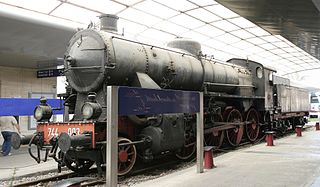
The Ferrovie dello Stato Class 744 is a class of 2-8-0 steam locomotives; they were the last orthodox steam locomotives built for the FS.


