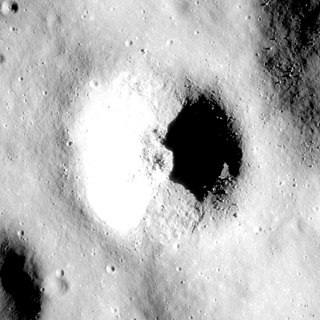
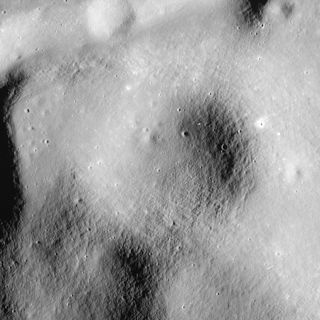
Apollo 15 panoramic camera image. The LM Falcon is visible as a dot casting a shadow to the left near the upper left corner. | |
| Coordinates | 26°08′N3°38′E / 26.13°N 3.64°E Coordinates: 26°08′N3°38′E / 26.13°N 3.64°E |
|---|---|
| Diameter | 150 m [1] |
| Eponym | Astronaut-named feature |
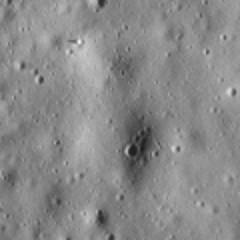
Last is a feature on Earth's Moon, a crater in the Hadley–Apennine region. Astronauts David Scott and James Irwin landed the Lunar Module Falcon on the northern edge of it in 1971, on the Apollo 15 mission.
The Moon is an astronomical body that orbits planet Earth and is Earth's only permanent natural satellite. It is the fifth-largest natural satellite in the Solar System, and the largest among planetary satellites relative to the size of the planet that it orbits. The Moon is after Jupiter's satellite Io the second-densest satellite in the Solar System among those whose densities are known.
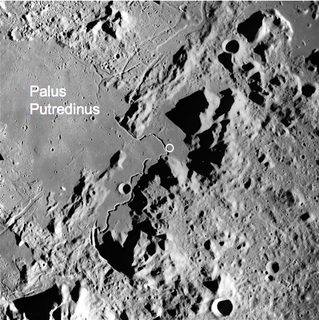
Hadley–Apennine is a region on the near side of Earth's Moon that served as the landing site for the American Apollo 15 mission, the fourth manned landing on the Moon and the first of the "J-missions", in July 1971. The site is located on the eastern edge of Mare Imbrium on a lava plain known as Palus Putredinis. Hadley-Apennine is bordered by the Montes Apenninus, a mountain range, and Hadley Rille, a meandering channel, on the east and west, respectively.

David Randolph Scott is a retired test pilot and NASA astronaut who was the seventh person to walk on the Moon. The commander of Apollo 15, Scott was selected as an astronaut as part of the third group in 1963. Scott flew three times in space, and is the only living commander of an Apollo mission that landed on the Moon and one of four surviving Moon walkers.
Last crater is located approximately 2 km east of Hadley Rille and approximately 1 km northwest of Index, the intended landing point.

Index is a feature on Earth's Moon, a crater in the Hadley–Apennine region. Astronauts David Scott and James Irwin landed the Lunar Module Falcon northwest of it in 1971, on the Apollo 15 mission, but they did not visit it. They intended to land closer to Index, but actually landed next to Last crater.
The name of the crater was formally adopted by the IAU in 1973. [1]
The International Astronomical Union is an international association of professional astronomers, at the PhD level and beyond, active in professional research and education in astronomy. Among other activities, it acts as the internationally recognized authority for assigning designations and names to celestial bodies and any surface features on them.
Aratus is a small lunar impact crater located on the highland to the south and east of the rugged Montes Apenninus range. It is a circular, cup-shaped crater with a relatively high albedo. It was named after Greek astronomer Aratus of Soli. To the east is the Mare Serenitatis, and to the southwest is the somewhat larger crater Conon. North-northeast of Aratus is the landing site of the Apollo 15 mission, just beyond Mons Hadley Delta.
Apollo is an enormous impact crater located in the southern hemisphere on the far side of the Moon. This formation dwarfs the large crater Oppenheimer that is located next to the western rim. The crater Barringer lies across the northern wall. To the southeast is the crater Anders, and Kleymenov is just to the east of the rim.
Santos-Dumont is a small lunar impact crater that lies in the northern end of the Montes Apenninus range at the eastern edge of the Mare Imbrium. It is located about 30 kilometers to the northeast of Mons Hadley, a mountain massif.
Dollond is a small lunar impact crater that is located in the central region of the Moon, to the north of the crater Abulfeda. It was named after British optician John Dollond. Due west of Dollond is Anděl. Dollond is circular and cone shaped, with a tiny floor at the midpoint of the sloping interior walls.
Mons Hadley is a massif in the northern portion of the Montes Apenninus, a range in the northern hemisphere of the Moon. It has a height of 4.2 km (14,000 ft) above the adjacent plain and a maximum diameter of 25 km at the base.
Julienne is a small, irregular depression that is located in Palus Putredinis, in the terrain to the southeast of the prominent crater Archimedes, and about 12 km west of the landing site of Apollo 15 at Hadley Rille.
Mons Hadley Delta (δ) is a massif in the northern portion of the Montes Apenninus, a range in the northern hemisphere of the Moon adjacent to Mare Imbrium. It has a height of 3.6 km above the plains to the north and west.
North Ray crater is a small crater in the Descartes Highlands of the Moon visited by the astronauts of Apollo 16. The name of the crater was formally adopted by the IAU in 1973. It is the largest crater sampled by astronauts during the Apollo program.
South Ray crater is a small crater in the Descartes Highlands of the Moon photographed from the lunar surface by the astronauts of Apollo 16. The name of the crater was formally adopted by the IAU in 1973.
Palmetto crater is a small crater in the Descartes Highlands of the Moon visited by the astronauts of Apollo 16. The name of the crater was formally adopted by the IAU in 1973.

Spur is a feature on Earth's Moon, a crater in the Hadley–Apennine region. Astronauts David Scott and James Irwin visited it in 1971, on the Apollo 15 mission, during EVA 2. Spur was designated Geology Station 7.

Earthlight is a feature on Earth's Moon, a crater in the Hadley–Apennine region. Astronauts David Scott and James Irwin drove past it on their rover in 1971, on the Apollo 15 mission, during EVA 2.

Dune is a feature on Earth's Moon, a crater in the Hadley–Apennine region. Astronauts David Scott and James Irwin visited the south rim of it in 1971, on the Apollo 15 mission, during EVA 2. The south rim of Dune was designated Geology Station 4 of the mission.
Flag crater is a small crater in the Descartes Highlands of the Moon visited by the astronauts of Apollo 16. The name of the crater was formally adopted by the IAU in 1973. Geology Station 1 is adjacent to Flag, at the much smaller Plum crater.

Elbow is a feature on Earth's Moon, a crater in the Hadley–Apennine region. Astronauts David Scott and James Irwin visited the east rim of it in 1971, on the Apollo 15 mission, during EVA 1. The east rim of Elbow was designated Geology Station 1 of the mission. Geology Station 2 was to the southwest of the crater, up the slope of Mons Hadley Delta.

Rhysling is a feature on Earth's Moon, a crater in the Hadley–Apennine region. Astronauts David Scott and James Irwin stopped near the west rim of it in 1971, on the Apollo 15 mission, during EVA 1. Geology Station 3 was about 125 meters west of Rhysling, and a single piece of vesicular basalt was collected there. The rock is sometimes called the seatbelt basalt.
North Complex is a feature on Earth's Moon, a group of hills in the Hadley–Apennine region. It was an intended destination for the astronauts of the Apollo 15 mission, but due to problems extracting a rock core near the landing site, there was not enough time to make the journey. The hills are thought to be volcanic in origin, but this remains unconfirmed because no samples were collected there.
St. George is a feature on Earth's Moon, a crater in the Hadley–Apennine region. Astronauts David Scott and James Irwin drove their rover onto what was suspected to be its ejecta blanket in 1971, on the Apollo 15 mission, during EVA 1. They collected samples to the northeast of the crater, at Geology Station 2 of the mission.
Bridge is a feature on Earth's Moon, a crater in the Hadley–Apennine region.