
St Ives is a seaside town, civil parish and port in Cornwall, England, United Kingdom. The town lies north of Penzance and west of Camborne on the coast of the Celtic Sea. In former times, it was commercially dependent on fishing. The decline in fishing, however, caused a shift in commercial emphasis, and the town is now primarily a popular seaside resort, notably achieving the title of Best UK Seaside Town from the British Travel Awards in both 2010 and 2011. St Ives was incorporated by Royal Charter in 1639. St Ives has become renowned for its number of artists. It was named best seaside town of 2007 by The Guardian newspaper.

Dame Jocelyn Barbara Hepworth was an English artist and sculptor. Her work exemplifies Modernism and in particular modern sculpture. Along with artists such as Ben Nicholson and Naum Gabo, Hepworth was a leading figure in the colony of artists who resided in St Ives during the Second World War.

Benjamin Lauder Nicholson, OM was an English painter of abstract compositions, landscapes, and still-life. He was one of the leading promoters of abstract art in England.
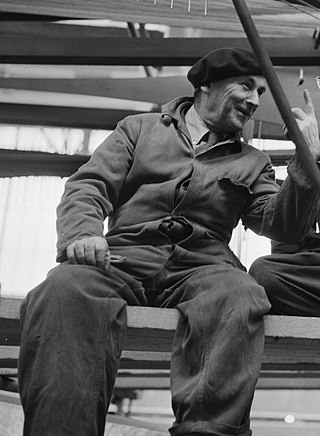
Naum Gabo, born Naum Neemia Pevsner was an influential sculptor, theorist, and key figure in Russia's post-Revolution avant-garde and the subsequent development of twentieth-century sculpture. His work combined geometric abstraction with a dynamic organization of form in small reliefs and constructions, monumental public sculpture and pioneering kinetic works that assimilated new materials such as nylon, wire, lucite and semi-transparent materials, glass and metal. Responding to the scientific and political revolutions of his age, Gabo led an eventful and peripatetic life, moving to Berlin, Paris, Oslo, Moscow, London, and finally the United States, and within the circles of the major avant-garde movements of the day, including Cubism, Futurism, Constructivism, the Bauhaus, de Stijl and the Abstraction-Création group. Two preoccupations, unique to Gabo, were his interest in representing negative space—"released from any closed volume" or mass—and time. He famously explored the former idea in his Linear Construction works (1942-1971)—used nylon filament to create voids or interior spaces as "concrete" as the elements of solid mass—and the latter in his pioneering work, Kinetic Sculpture (1920), often considered the first kinetic work of art.

Bernard Howell Leach was a British studio potter and art teacher. He is regarded as the "Father of British studio pottery".

Troika was an art pottery that operated in Cornwall from 1962 to 1983. It was founded by three people, Leslie Illsley, Jan Thompson and Benny Sirota who took over the Powell and Wells Pottery at Wheal Dream, where Sirota had previously worked as a decorator and driver. The name is from the Russian тройка, meaning "a set of three", or triumvirate.

Patrick Heron was a British abstract and figurative artist, critic, writer, and polemicist, who lived in Zennor, Cornwall.

Wilhelmina Barns-Graham CBE was one of the foremost British abstract artists, a member of the influential Penwith Society of Arts.
George Peter Lanyon was a British painter of landscapes leaning heavily towards abstraction. Lanyon was one of the most important artists to emerge in post-war Britain. Despite his early death at the age of forty-six he achieved a body of work that is amongst the most original and important reappraisals of modernism in painting to be found anywhere. Combining abstract values with radical ideas about landscape and the figure, Lanyon navigated a course from Constructivism through Abstract Expressionism to a style close to Pop. He also made constructions, pottery and collage.
Trevor Bell was an English Leeds-born artist and contemporary visual artist.
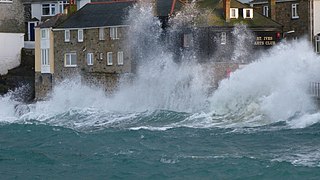
The St Ives School refers to a group of artists living and working in the Cornish town of St Ives. The term is often used to refer to the 20th century groups which sprung up after the First World War around such artists as Borlase Smart, however there was considerable artistic activity there from the late 19th Century onwards.
Denis Adeane Mitchell was an English abstract sculptor who worked mainly in bronze and wood. A prominent member of the St Ives group of artists, he worked as an assistant to Barbara Hepworth for many years.
Simon Hepworth Nicholson was a British painter and sculptor. He was the son of sculptor Barbara Hepworth and her second husband, artist Ben Nicholson.
Kate Nicholson was a British painter and the daughter of artist Ben Nicholson and his first wife, the artist Winifred Nicholson.
Kit Barker (1916–1988) was a British painter.
Paul Ludwig Horst Feiler was a German-born artist who was a prominent member of the St Ives School of art: he has pictures hanging in major art galleries across the world.
David Haughton (1924–1991) was a British artist associated with the St Ives movement. Many of his paintings, etchings and drawings feature aspects of the Cornish landscape, particularly the area around St Just.
Anna R. Findlay (1885-1968) was a British artist and printmaker. She was known for her elegant colour linocut and woodcut prints of mostly topographical scenes.

Brian Wall is a British-born American sculptor now living in California. His work consists mainly of abstract welded steel constructions, and his career stretches over six decades. He has had numerous solo shows, and his sculptures reside in many private and museum collections. He was a faculty member at the Central School of Art in London, and a professor of art at the University of California, Berkeley.
