| Li Wei the Magistrate II | |
|---|---|
Taiwan DVD cover | |
| Also known as | ''Li Wei the Magistrate 2 |
| Traditional | 李 衛 當 官II |
| Simplified | 李 卫 当 官II |
| Mandarin | Lǐ Wèi Dāng Guān 2 |
| Written by | Shang Zhifa |
| Directed by |
|
| Starring |
|
| Country of origin | China |
| Original language(s) | Mandarin |
| Chronology | |
| Preceded by | Li Wei the Magistrate (2001) |
| Followed by | Li Wei Resigns from Office (2005) |
| Related shows | Yongzheng Dynasty (1997) The Amateur Imperial Bodyguard (2010) |

Li Wei the Magistrate II is a 2004 Chinese television historical comedy-drama and the sequel to the 2001 hit-series Li Wei the Magistrate , again starring Xu Zheng as the titular official Li Wei. Xu also co-directed the series with Zhou Shidu.
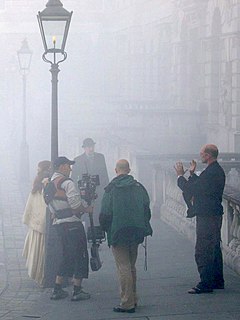
The term historical period drama refers to a work set in a past time period, usually used in the context of film and television. It is an informal crossover term that can apply to several genres and is often heard in the context of historical fiction and romances, adventure films, and swashbucklers. A period piece may be set in a vague or general era such as the Middle Ages or a specific period such as the Roaring Twenties. A religious work can qualify as period drama but not as historical drama.

Comedy-drama or dramedy, is a genre in film and in television works in which plot elements are a combination of comedy and drama. It is a subgenre of contemporary tragicomedy. Comedy-drama is especially found in television programs and is considered a "hybrid genre".

Li Wei the Magistrate, also known as Li Wei Becomes an Official, is a 2001 Chinese television historical comedy-drama starring Xu Zheng as a young Li Wei, an illiterate county magistrate who would become one of the most prominent officials during 18th-century Qing dynasty.
In the sequel, the Kangxi Emperor had died, and Li Wei became a high-ranking minister under Yongzheng Emperor (and no longer just a magistrate).

The Kangxi Emperor, personal name Xuanye, was the fourth emperor of the Qing dynasty, and the second Qing emperor to rule over China proper, from 1661 to 1722.

The Yongzheng Emperor, born Yinzhen, was the fifth emperor of the Manchu-led Qing dynasty and the third Qing emperor to rule over China proper. He reigned from 1723 to 1735. A hard-working ruler, the Yongzheng Emperor's main goal was to create an effective government at minimal expense. Like his father, the Kangxi Emperor, the Yongzheng Emperor used military force to preserve the dynasty's position. His reign was known for being despotic, efficient, and vigorous.
Filming began in August 2003 in Hengdian World Studios. [1] It was first broadcast in February 2004 locally in the Nanjing area. [2]
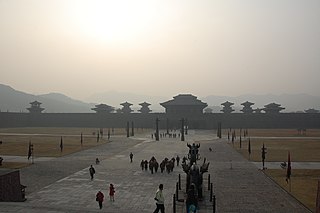
Hengdian World Studios is a film studio located in Hengdian, a Chinese town in the city of Dongyang, Jinhua, Zhejiang Province. It is the largest film studio in the world. The movie studio is operated by the privately owned Hengdian Group founded by Xu Wenrong. Sometimes called "Chinawood", Xu turned acres of farmland in central Zhejiang into one of the largest movie studios in Asia. Construction began in the mid-1990s and has been ongoing ever since with the possible recent addition of the replica of the Old Summer Palace. A film about extras working at the studio, I Am Somebody, was released in China in 2015.
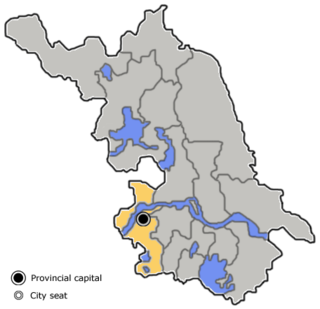
Nanjing, formerly romanized as Nanking and Nankin, is the capital of Jiangsu province of the People's Republic of China and the second largest city in the East China region, with an administrative area of 6,600 km2 (2,500 sq mi) and a total population of 8,270,500 as of 2016. The inner area of Nanjing enclosed by the city wall is Nanjing City (南京城), with an area of 55 km2 (21 sq mi), while the Nanjing Metropolitan Region includes surrounding cities and areas, covering over 60,000 km2 (23,000 sq mi), with a population of over 30 million.
It was followed by a 2005 sequel Li Wei Resigns from Office , starring Paul Chun as an older Li Wei.

Li Wei Resigns from Office is a 2005 Chinese television historical period drama and the last of the Li Wei trilogy, after Li Wei the Magistrate (2001) and Li Wei the Magistrate II (2004). It was written by Yuyue, the same writer as the 2001 series.
Paul Chun is a Hong Kong actor. He has appeared in more than 130 films and television series since 1949. In 1966, he appeared in The Sand Pebbles, an American film produced and directed by Robert Wise.

