
Hippoboscoidea is a superfamily of the Calyptratae. The flies in this superfamily are blood-feeding obligate parasites of their hosts. Four families are often placed here:
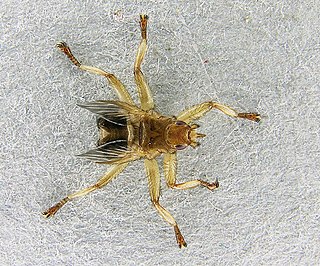
Hippoboscidae, the louse flies or keds, are obligate parasites of mammals and birds. In this family, the winged species can fly at least reasonably well, though others with vestigial or no wings are flightless and highly apomorphic. As usual in their superfamily Hippoboscoidea, most of the larval development takes place within the mother's body, and pupation occurs almost immediately.

Lipoptena is a genus of flies in the family Hippoboscidae, known as louse flies or keds
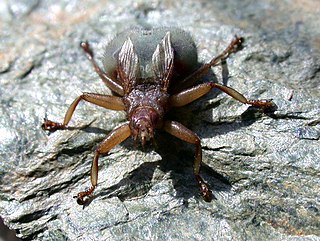
Crataerina is a genus of louse flies in the family Hippoboscidae. All are parasites of birds, feeding on the blood of various species of Apodidae (swifts) and Hirundinidae. The genus is sometimes spelled Craterina.
Hippoboscinae is a subfamily of the fly family Hippoboscidae. All are parasitic, and unlike some other members of the Hippoboscidae, all Hippoboscinae are winged species.
Lipoptena mazamae, the Neotropical deer ked, is a fly from the family Hippoboscidae. They are blood-feeding parasites of the white-tailed deer - Odocoileus virginianus in the southeastern United States and Central America, the red brocket deer - Mazama americana in Mexico to northern Argentina, and also an incidental parasite of domestic cattle, Cougars - Puma concolor, and man.
Neolipoptena ferrisi, or the Pacific deer ked, is a species of fly from the family Hippoboscidae. They are blood-feeding parasites of the mule deer - Odocoileus hemionus, the white-tailed deer - Odocoileus virginianus & The Pronghorn - Antilocapra americana. They are found from British Columbia, Canada, to Baja California, Mexico. and Australia.
Neolipoptena is a genus of flies in the family Hippoboscidae.

Hippobosca is a genus of flies in the family Hippoboscidae. There are seven known species. There are numerous synonyms.

Pseudolynchia canariensis, the pigeon louse fly or pigeon fly, is a species of biting fly in the family of louse flies, Hippoboscidae.
Microlynchia is a genus of biting flies in the family of louse flies, Hippoboscidae. There are four known species. All species are parasites of birds. Microlynchia differs from Pseudolynchia in the presence of minute ocelli and a differently shaped scutellum.
Ortholfersia is a genus of biting flies in the family of louse flies, Hippoboscidae. There are 4 known species. All species are parasites of macropods.
Struthiobosca is a genus of biting flies in the family of louse flies, Hippoboscidae. There is only one known species, Struthiobosca struthionis(Janson, 1889). It is a parasite of ostriches.
Phthona is a genus of biting flies in the family of louse flies, Hippoboscidae. There are 3 known species. All are parasite of falconets of the genus Microhierax.
Ornithophila are a genus of biting flies in the family of louse flies, Hippoboscidae. There are two known species. Both species are parasites of birds.
Ornithomyinae is a subfamily of the fly family Hippoboscidae. All are blood feeding parasites, for the most part on birds, though some have mammals as hosts.
Hippobosca longipennis, the dog fly, louse fly, or blind fly, is a blood-feeding parasite mostly infesting carnivores. The species name "longipennis" means "long wings". Its bites can be painful and result in skin irritation, it is an intermediate host for the canine and hyaenid filarial parasite Dipetalonema dracunculoides, "and it may also be a biological or mechanical vector for other pathogens".
Crataerina melbae is a species of biting fly in the family of louse flies Hippoboscidae. Its hosts are swift species including the Alpine, Pacific, Common and mottled swifts.
Aedes luteocephalus is an African species that is a demonstrated or suspected vector of several important arboviral diseases of humans. First described in 1907 as Stegomyia luteocephala, the species is currently classified in the genus Aedes, subgenus Stegomyia.

Ornithomya fringillina is a species of fly in the family Hippoboscidae. It is found in the Palearctic.


