Related Research Articles

Phytophthora is a genus of plant-damaging oomycetes, whose member species are capable of causing enormous economic losses on crops worldwide, as well as environmental damage in natural ecosystems. The cell wall of Phytophthora is made up of cellulose. The genus was first described by Heinrich Anton de Bary in 1875. Approximately 210 species have been described, although 100–500 undiscovered Phytophthora species are estimated to exist.

A plant canker is a small area of dead tissue, which grows slowly, often over years. Some cankers are of only minor consequence, but others are ultimately lethal and therefore can have major economic implications for agriculture and horticulture. Their causes include a wide range of organisms as fungi, bacteria, mycoplasmas and viruses. The majority of canker-causing organisms are bound to a unique host species or genus, but a few will attack other plants. Weather and animal damage can also cause stress to the plant resulting in cankers. Other causes of cankers is pruning when the bark is wet or using un-sterilized tools.
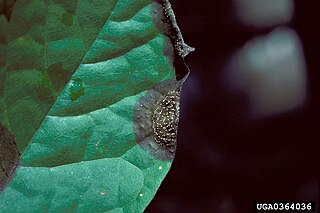
Colletotrichum acutatum is a plant pathogen and endophyte. It is the organism that causes the most destructive fungal disease, anthracnose, of lupin species worldwide. It also causes the disease postbloom fruit drop on many varieties of citrus, especially Valencia and navel oranges in Florida.

Colletotrichum coccodes is a plant pathogen, which causes anthracnose on tomato and black dot disease of potato. Fungi survive on crop debris and disease emergence is favored by warm temperatures and wet weather.

Glomerella cingulata is a fungal plant pathogen, being the name of the sexual stage (teleomorph) while the more commonly referred to asexual stage (anamorph) is called Colletotrichum gloeosporioides. For most of this article the pathogen will be referred to as C. gloeosporioides. This pathogen is a significant problem worldwide, causing anthracnose and fruit rotting diseases on hundreds of economically important hosts.
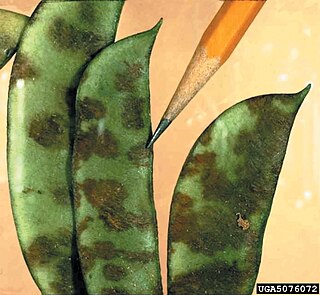
Colletotrichum is a genus of fungi that are symbionts to plants as endophytes or phytopathogens. Many of the species in this genus are plant pathogens, but some species may have a mutualistic relationship with hosts.
Cladosporium dominicanum is a fungus found in hypersaline environments. It has globoid conidia. It has also been found in plant material.
Cladosporium velox is a fungus found in hypersaline environments. It has globoid conidia. It has also been found in plant material.
Coniella is a fungus genus in the family Schizoparmeaceae, which contains 65 species recorded in the database Mycobank. This genus Coniella are reported as a typical plant pathogenic fungi for grape, eucalyptus and several plant. It mainly found in Europe, Asian, also South Africa. less report in American, only one paper published new spaces founded.
Ross Ewen Beever was a New Zealand geneticist and mycologist.

Glomerellales is an order of ascomycetous fungi within the subclass Hypocreomycetidae (Sordariomycetes). The order includes saprobes, endophytes and pathogens on plants, animals and other fungi with representatives found all over the world in varying habitats.
Aspergillus keveii is a species of fungus in the genus Aspergillus which has been isolated from soil from Las Palmas in Spain. It is from the Usti section. It has been reported to produce drimans, ophiobolins G and H, and nidulol.

Glomerellaceae is a monotypic family of fungi in the class Sordariomycetes that contains only one genus, Colletotrichum.
Hemibiotrophs are the spectrum of plant pathogens, including bacteria, oomycete and a group of plant pathogenic fungi that keep its host alive while establishing itself within the host tissue, taking up the nutrients with brief biotrophic-like phase. It then, in later stages of infection switches to a necrotrophic life-style, where it rampantly kills the host cells, deriving its nutrients from the dead tissues.

Colletotrichum fioriniae is a fungal plant pathogen and endophyte of fruits and foliage of many broadleaved plants worldwide. It causes diseases on agriculturally important crops, including anthracnose of strawberry, ripe rot of grapes, bitter rot of apple, anthracnose of peach, and anthracnose of blueberry. Its ecological role in the natural environment is less well understood, other than it is a common leaf endophyte of many temperate trees and shrubs and in some cases may function as an entomopathogen.
Bitter rot of apple is a fungal disease of apple fruit that is caused by several species in the Colletotrichum acutatum and Colletotrichum gloeosporioides species complexes. It is identified by sunken circular lesions with conical intrusions into the apple flesh that appear V-shaped when the apple is cut in half through the center of the lesion. It is one of the most devastating diseases of apple fruit in regions with warm wet weather.
References
- 1 2 3 4 5 Goss, Erica M.; Kendig, Amy E.; Adhikari, Ashish; Lane, Brett; Kortessis, Nicholas; Holt, Robert D.; Clay, Keith; Harmon, Philip F.; Flory, S. Luke (2020-08-25). "Disease in Invasive Plant Populations". Annual Review of Phytopathology . 58 (1). Annual Reviews: 97–117. doi:10.1146/annurev-phyto-010820-012757. ISSN 0066-4286. PMID 32516034. S2CID 219563975.
- 1 2 3 4 5 6 7 8 9 Slav, M.; Hoza, D.; Asănică, A.; University of Agronomic Sciences and Veterinary Medicine of Bucharest, Bucharest, Romania (2018). "Researches on the presence and agresivity of the blueberry root rot (Phytophthora cinnamomi) in a Dâmbovița county plantation". Journal of Horticulture, Forestry and Biotechnology . 22 (4): 7–12.
{{cite journal}}: CS1 maint: multiple names: authors list (link) ref.15 - 1 2 Polashock, James J.; Caruso, Frank L.; Averill, Anne L.; Schilder, Annemiek C., eds. (2017). Compendium of Blueberry, Cranberry, and Lingonberry Diseases and Pests, Second Edition. The American Phytopathological Society. doi:10.1094/9780890545386. ISBN 978-0-89054-538-6.
- 1 2 Dowling, Madeline; Peres, Natalia; Villani, Sara; Schnabel, Guido (2020). "Managing Colletotrichum on Fruit Crops: A "Complex" Challenge". Plant Disease. 104 (9): 2301–2316. doi: 10.1094/PDIS-11-19-2378-FE . ISSN 0191-2917. PMID 32689886. S2CID 219479598.
- ↑ Damm, U.; Cannon, P. F.; Woudenberg, J. H. C.; Crous, P. W. (2012). "The Colletotrichum acutatum species complex". Studies in Mycology. complex species or species complexes?. 73 (1): 37–113. doi:10.3114/sim0010. ISSN 0166-0616. PMC 458416 . PMID 23136458.
- ↑ Weir, B. S.; Johnston, P. R.; Damm, U. (2012). "The Colletotrichum gloeosporioides species complex". Studies in Mycology. complex species or species complexes?. 73 (1): 115–180. doi:10.3114/sim0011. ISSN 0166-0616. PMC 3458417 . PMID 23136459.