The name Kate has been used for three tropical cyclones in the Atlantic Ocean, eleven tropical cyclones in the western Pacific, and at least three in the Southern Hemisphere.
The name Gordon has been used for five tropical cyclones in the Atlantic Ocean since 1988, when it replaced the name Gilbert on the list of hurricane names.
The name Anita has been used for tropical cyclones in the Atlantic Ocean, the western Pacific Ocean, and the southwestern Indian Ocean.
The name Irma has been used for two tropical cyclones in the North Atlantic Ocean, one tropical cyclone in the South-West Indian Ocean, and sixteen tropical cyclones in the Western Pacific Ocean.
The name Glenda has been used for five tropical cyclones in the Eastern Pacific Ocean.

The 2006 Pacific typhoon season was a near-average season that produced a total of 23 named storms, 15 typhoons, and six super typhoons. The season ran throughout 2006, though most tropical cyclones typically develop between May and October. The season's first named storm, Chanchu, developed on May 9, while the season's last named storm, Trami, dissipated on December 20. Also, this season was more active, costly, and deadly than the previous season.

The 2001 Pacific typhoon season has no official bounds; it ran year-round in 2001, but most tropical cyclones tend to form in the northwestern Pacific Ocean between May and November. These dates conventionally delimit the period of each year when most tropical cyclones form in the northwestern Pacific Ocean.
The name Emma has been used for nine tropical cyclones in the northwest Pacific Ocean.
The name Agnes has been used for a total of sixteen tropical cyclones worldwide: one in the Atlantic Ocean, thirteen in the Western Pacific Ocean, one in the Southwest Indian Ocean, and one in the Southwestern Pacific Ocean.
The name Bilis has been used for two tropical cyclones in the northwestern Pacific Ocean. The name was submitted by the Philippines and means "speed" or "swiftness".
The name Gaemi has been used to name two tropical cyclones in the northwestern Pacific Ocean. In addition, the variant Kaemi was used in 2000 and 2006 before the spelling was corrected by the WMO Typhoon Committee. The name was submitted by South Korea and is a Korean word for ant.
The name Jebi has been used to name four tropical cyclones in the northwestern Pacific Ocean. In addition, the variant Chebi was used in 2001 and 2006 before the spelling was corrected by the WMO Typhoon Committee. The name was submitted by South Korea and is a Korean word for the barn swallow.
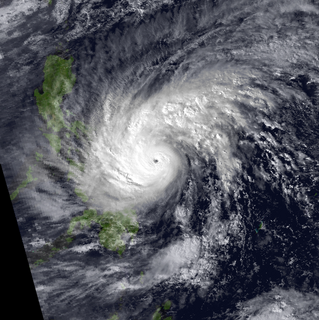
Typhoon Durian, known in the Philippines as Typhoon Reming, was a violent tropical cyclone that wreaked havoc in the Philippines in late November 2006, causing massive loss of life when mudflows from the Mayon Volcano buried many villages.

Typhoon Durian's meteorological history began with its origins as a tropical disturbance near Chuuk State on November 23, 2006, and lasted until its dissipation off the coast of Andhra Pradesh, India, on December 9. Durian formed as a tropical depression on November 25 near Chuuk State. Situated south of a ridge, the system tracked west-northwest over a region characterized by low wind shear and good upper-level divergence. Late on November 26, the depression intensified into a tropical storm and was named Durian. Steady strengthening took place over the following two days as the system approached the Philippines. After attaining typhoon status on November 29, Durian underwent a period of rapid intensification, culminating with it attaining peak winds of 195 km/h (120 mph) and a barometric pressure of 915 mbar. Durian brushed the southern coast of the Catanduanes at this intensity, where a record gust of 320 km/h (200 mph) was observed.
The name Reming has been used in the Philippines by PAGASA in the Western Pacific. Reming as a name has been retired by PAGASA.

Typhoon Durian, known in the Philippines as Typhoon Reming, caused heavy damage across the island nation in November 2006. On November 30, 2006, Durian became the fourth typhoon equivalent to a Category 4 on the Saffir-Simpson scale to strike the Philippine island of Luzon, having earlier brushed the offshore Catanduanes. The storm crossed the country, but damage was heaviest in southeastern Luzon, particularly around the Mayon Volcano in the Bicol region. Intense rainfall affecting the volcano, estimated at around 600 mm (24 in), caused deadly lahars, or volcanic landslides. Six nearby villages were nearly destroyed, with thousands of homes washed away in minutes.
Typhoon Mangkhut has been used to name two tropical cyclones in the northwestern Pacific Ocean. The name was submitted by Thailand, and refers to a mangosteen. This was also the name that replaced Durian after this storm.
The name Sally has been used for nine tropical cyclones in the Western Pacific Ocean and at least three tropical cyclones in the Southern Hemisphere. The name Sally also appears in one of the naming lists for the Atlantic, but has never been used.
This page is based on this
Wikipedia article Text is available under the
CC BY-SA 4.0 license; additional terms may apply.
Images, videos and audio are available under their respective licenses.
