Contemporary groups, collectively termed Hindu reform movements, reform Hinduism, Neo-Hinduism, or Hindu revivalism, strive to introduce regeneration and reform to Hinduism, both in a religious or spiritual and in a societal sense. The movements started appearing during the Bengali Renaissance.

The Kerala model of development refers to the economic practices adopted by the Indian state of Kerala. It is characterised by results showing strong social indicators when compared to the rest of the country such as high literacy and life expectancy rates, highly improved access to healthcare, and low infant mortality and birth rates. Despite having a lower per capita income, the state is sometimes compared, to developed countries. These achievements along with the factors responsible for such achievements have been considered characteristic results of the Kerala model. Academic literature discusses the primary factors underlying the success of the Kerala model as its decentralization efforts, the political mobilization of the poor, and the active involvement of civil society organizations in the planning and implementation of development policies.

Ayyankali, referred to by followers as Mahatma, was a prominent social reformer who worked for the advancement of deprived untouchable people in the princely state of Travancore. His efforts influenced many changes that improved the social well-being of those people, who are today often referred to as Dalits.
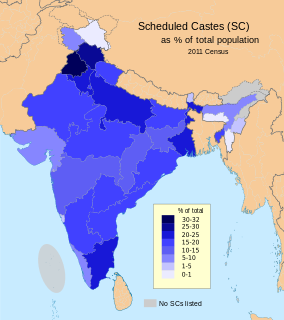
The Scheduled Castes (SCs) and Scheduled Tribes (STs) are officially designated groups of people and among the most disadvantaged socio-economic groups in India. The terms are recognized in the Constitution of India and the groups are designated in one or other of the categories. For much of the period of British rule in the Indian subcontinent, they were known as the Depressed Classes.
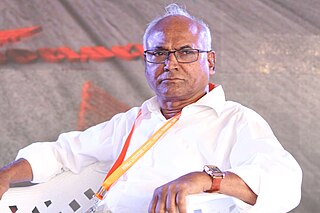
Kancha Ilaiah Shepherd is an Indian political theorist, writer and a Dalit rights activist. He writes in both English and Telugu languages. His main domain of study and activism is the annihilation of caste.

The Pulayar, IPA: [pulɐjɐr], is a caste group mostly found in the southern part of india, forming one of the main social groups in modern-day Kerala and Karnataka as well as in historical Tamil Nadu or Tamilakam.

Kumbalathuparambu Ayyappan, better identified as Sahodaran Ayyappan, was a social reformer, thinker, rationalist, journalist, and politician from Kerala, India. A vocal follower of Sree Narayana Guru, he was associated with a number of events related to the Kerala reformation movement and was the organizer of Misra Bhojanam in Cherai in 1917. He founded Sahodara Sangam, and the journal Sahodaran and was the founder editor of the magazine Yukthivadhi.
Venganoor is an area within the Trivandrum City of Kerala, India, which is situated 13 km south of the city. It is known as the birthplace of Ayyankali, the great Harijan leader of Kerala. Venganoor is located near Vizhinjam where an international trans-shipment port is being build. Venganoor is one of the border divisions of Thiruvananthapuram corporation.

Mahatma Gandhi Road is the most important north–south road in Thiruvananthapuram City situated in the state of Kerala, India. The road starts from the busy place of East Fort and ends in the Museum Road. The road is maintained by the Thiruvananthapuram Corporation.
Paul Chirakkarode was a noted Malayalam- and English-language novelist, short story writer, biographer, essayist, thinker, social critic, orator and human rights activist. It was through his literary interventions that the miserable and subhuman life of the downtrodden people of Kerala was exposed before the world of letters in an aesthetic manner. The author has been considered one of the pioneers of Dalit Literary Movement in India.

Kaviyoor Murali was an Indian dalit activist, writer and Folklore Research Person from Kerala state.

Papilio Buddha is a 2013 Indian film written and directed by Jayan K. Cherian. The film focuses on the atrocities committed against Dalits, women and the environment. It features S. P. Sreekumar, David Briggs and Saritha Sunil while Padmapriya, Prakash Bare and Thampy Antony play supporting roles. Kerala-based environmentalist Kallen Pokkudan appears in another important role in the film which also cast 150 Adivasis. The film was completely shot from Wayanad in Kerala and the cinematography was done by M J Radhakrishnan. The story deals with discrimination against landless Dalits and the politics of suppression of their struggle against the upper castes and other powerful elements locally.

Poykayil Sreekumara Gurudevan, known as Poykayil Appachan alias Poykayil Kumara Guru Devan, was a dalit activist, poet and the founder of the socio-religious movement Prathyaksha Raksha Daiva Sabha. His father was Kandan and mother Lachi. His original name was Kumaran.
The Sadhujana Paripalana Sangham (SJPS) was established in 1907 by social reformer Ayyankali to campaign for education for Dalits in Kerala with the support of government of Travancore, British India., first starting Sadananda villasam Venganoor, next SJPS
Kallumala Samaram is an agitation or social revolution by Pulayar community that took place at Perinad and nearby villages such as Cherumoodu, Kanjavely etc. in, Kollam district on 24 October 1915.
The Reformation movement in Kerala refers to a socio-cultural movement that began towards the end of 19th century and led to large scale changes in the social outlook of the southern Indian state of Kerala.
Bhim Sena or Bheem Sena or Akhil Bhartiya Bhim Sena, abbreviated as ABBS, lit."All India Ambedkar Army", is an Ambedkarite social organization working for rights of Scheduled Castes, Scheduled Tribes, Other Backward Classes and religious minorities in India currently under national president, Nawab Satpal Tanwar. It works for protecting the Indian Constitution and reservation. The organisation is named after B. R. Ambedkar. Seema Chauhan is PRO of Bhim Sena.
M. R. Renukumar is a poet who writes in Malayalam. He is also a short story writer, biographer, essayist, translator and painter. He is a recipient of the 2019 Kerala Sahitya Akademi Award for Poetry.

M. Geethanandan is an Indian social activist working on political and economic issues faced by tribals and dalits in the state of Kerala, India. He co-founded the Adivasi Gothra Mahasabha along with C.K. Janu and others. He has been involved in organising several protests and struggles of Adivasis (tribes) and Dalits, notably the Muthanga agitation, an incident of police firing on the Adivasis in the Muthanga village of Wayanad district, Kerala.

N. K. Jose from Kerala, India is a Historian and President of the Kerala History Congress known for his studies in Dalit and Christian history. Author of over 140 history and social history books, he was given the title Dalit Bandhu by Dalit organizations in 1990 in recognition of his contributions to Dalit studies and Dalit history.
