Manomohan Bose | |
|---|---|
 Manomohan Bose | |
| Born | 17 July, 1831 |
| Died | 4 February, 1912 (Age 80) |
| Occupation(s) | Journalist, poet, and playwright |
| Known for | Poetry, Literature |
Manomohan Bose was a Bengali journalist, poet, and playwright. [1]
Manomohan Bose | |
|---|---|
| Manomohan Bose | |
| Born | 17 July, 1831 |
| Died | 4 February, 1912 (Age 80) |
| Occupation(s) | Journalist, poet, and playwright |
| Known for | Poetry, Literature |
Manomohan Bose was a Bengali journalist, poet, and playwright. [1]
Bose was born in 1831 in Nishchintapur, Jessore District, Bengal Presidency, British India at his maternal Uncle's house.[ citation needed ] He belonged to the famous Bose family of Chhota Jagulia, North 24 Parganas District of present-day West Bengal. [2] He studied at the Sanskrit school in Jessore and Hare School in Calcutta. He then went onto to study at the Scottish Church College. He was inspired to write by Ishwar Chandra Gupta. [3]
Bose wrote for Ishwar Chandra Gupta's Sambad Prabhakar.[ citation needed ] His writings were also published in Akshay Kumar Datta's Tattvabodhini. He wrote in and edited Madhyastha in 1872 and Sambad Bibhakar in 1852. He wrote a number of plays based on history and mythology. His plays were nationalist in nature. He supported the Hindu Mela, a nationalist organization. In 1896 he was the Vice-President of Bangiya Sahitya Parishad. [3]
Bose died in 1912. [3]

Bankim Chandra Chattopadhyay was an Indian Bengali novelist, poet, essayist and journalist. He was the author of the 1882 Bengali language novel Anandamath, which is one of the landmarks of modern Bengali and Indian literature. He was the composer of Vande Mataram, written in highly Sanskritised Bengali, personifying India as a mother goddess and inspiring activists during the Indian Independence Movement. Chattopadhayay wrote fourteen novels and many serious, serio-comic, satirical, scientific and critical treatises in Bengali. He is known as Sahitya Samrat in Bengali.
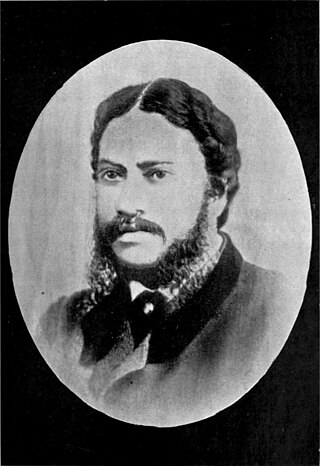
Michael Madhusudan Dutt was a Bengali poet and playwright. He is considered one of the pioneers of Bengali literature.
Bengali Brahmos are those who adhere to Brahmoism, the philosophy of Brahmo Samaj which was founded by Raja Rammohan Roy. A recent publication describes the disproportionate influence of Brahmos on India's development post-19th Century as unparalleled in recent times.

Ishwar Chandra Bandyopadhyay, popularly known as Ishwar Chandra Vidyasagar, was an Indian educator and social reformer of the nineteenth century. His efforts to simplify and modernise Bengali prose were significant. He also rationalised and simplified the Bengali alphabet and type, which had remained unchanged since Charles Wilkins and Panchanan Karmakar had cut the first (wooden) Bengali type in 1780.

Anushilan Samiti was an Indian fitness club, which was actually used as an underground society for anti-British revolutionaries. In the first quarter of the 20th century it supported revolutionary violence as the means for ending British rule in India. The organisation arose from a conglomeration of local youth groups and gyms (akhara) in Bengal in 1902. It had two prominent, somewhat independent, arms in East and West Bengal, Dhaka Anushilan Samiti, and the Jugantar group.

Dinesh Chandra Gupta or Dinesh Gupta was an Indian revolutionary against British rule in India, who is noted for launching an attack on the Secretariat Building - the Writers' Building in the Dalhousie square in Calcutta, along with Badal Gupta and Benoy Basu.
Jugantar or Yugantar was one of the two main secret revolutionary trends operating in Bengal for Indian independence. This association, like Anushilan Samiti, started in the guise of a suburban health and fitness club while secretly nurturing revolutionaries. Several Jugantar members were arrested, hanged, or deported for life to the Cellular Jail in Andaman and many of them joined the Communist Consolidation in the Cellular Jail.

Khidirpur or Kidderpore is a neighbourhood of South Kolkata in Kolkata district in the Indian state of West Bengal.

Ishwar Chandra Gupta was a Bengali poet and writer. Gupta was born in Kanchrapara, in Bengal.

Prabhat Kumar Mukhopadhyay was a Bengali writer. He was born at Dhatrigram in present-day Purba Bardhaman district, West Bengal at his maternal uncle's house. His native place was Gurap in Hooghly district, West Bengal.
Sambad Prabhakar was a Bengali daily newspaper founded by Ishwar Chandra Gupta. It began as a weekly newspaper in 1831 and became a daily eight years later in 1839. It was the first Bengali daily newspaper. Sambad Prabhakar covered news on India and abroad and put forward its views on religion, politics, society, and literature. It was influential in the Bengali language and in building public sentiment leading to the indigo revolt.

Rajnarayan Basu (1826–1899) was an Indian writer and intellectual of the Bengal Renaissance. He was born in Boral in 24 Parganas and studied at the Hare School and Hindu College, in Kolkata, Bengal. A monotheist at heart, Basu converted to the Brahmoism sect at the age of twenty. After retiring, he was given the honorary title of Rishi or sage. He was one of the best known prose writers in Bengali in the nineteenth century, writing often for the Tattwabodhini Patrika, a premier Brahmo journal. Due to his defence of Brahmoism, he was given the title "Grandfather of Indian Nationalism".

Peary Chand Mitra was an Indian writer, journalist, cultural activist and entrepreneur. His pseudonym was Tek Chand Thakur. He was a member of Henry Derozio's Young Bengal group, who played a leading role in the Bengal renaissance with the introduction of simple Bengali prose. His Alaler Gharer Dulal pioneered the novel in the Bengali language, leading to a tradition taken up by Bankim Chandra Chatterjee and others. Mitra died on 23 November 1883 in Kolkata.

Romesh Chunder Dutt was an Indian civil servant, economic historian, translator of Ramayana and Mahabharata. He was one of the prominent proponents of Indian economic nationalism.

Pathuriaghata is a neighbourhood of North Kolkata in Kolkata district, in the Indian state of West Bengal. It is one of the oldest residential areas in what was Sutanuti. Once the abode of the Bengali rich, the neighbourhood and its surrounding areas are now dominated by Marwaris. Even in the 21st century the area is replete with colonnaded mansions.
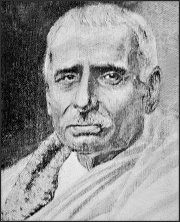
Hara Prasad Shastri, also known as Hara Prasad Bhattacharya, was an Indian academic, Sanskrit scholar, archivist, and historian of Bengali literature. He is most known for discovering the Charyapada, the earliest known examples of Bengali literature.
Abinash Chandra Bhattacharyya was a radical Indian nationalist in the movement for Indian independence who played a role in the Indo-German Conspiracy of World War I. Born in Chunta in the district of Tripura, India, Bhattacharya became involved with the works of the Anushilan Samiti in his youth.
Raja Sir Radhakanta Deb Bahadur KCSI was a scholar and a leader of the Calcutta conservative Hindu society, son of Gopimohan Deb of Shovabazar Raj who was the adopted son and heir of Maharaja Nabakrishna Deb of Shovabazar Raj.
Ashrafuddin Ahmad Chowdhury was a Bengali politician who had served as general secretary of the Congress Party's Bengal branch, member of the East Bengal Legislative Assembly and later as the education minister of Pakistan. He was an advocate of Huseyn Shaheed Suhrawardy's United Bengal proposal.

The 49th Bengalee Regiment, also known as The 49th Bengalee, 49th Bengal Infantry, Bengali Double Company, Bengali Platoon and Bangali Paltan, was a military unit of the British Indian Army raised during World War I with Lt. S. G. Taylor as the Regiment Commander. In the beginning of the First World War, the army began to recruit many soldiers, non-combatants, and skilled and unskilled laborers from Bengal. In middle 1916, the British government decided to create a regiment of Bengali soldiers. At first, it was called Bengali Double Company. These double companies, each consisting of 228 soldiers, were integrated into the British Indian Army. The Bengali Double Company raised the first Bengali battalion on 26 June 1917. It was named The 49th Bengalee Regiment or briefly The 49th Bengalee. It was disbanded in 1920.
| International | |
|---|---|
| National | |
