The Xiluodu Dam is an arch dam on the Jinsha River, i.e. the upper course of the Yangtze in China. It is located near the town of Xiluodu in Yongshan County of Yunnan Province but the dam straddles into Leibo County of Sichuan Province on the opposite side of the river. The primary purpose of the dam is hydroelectric power generation and its power station has an installed capacity of 13,860 MW. Additionally, the dam provides for flood control, silt control and its regulated water releases are intended to improve navigation downstream. Construction on the dam and power station began in 2005 and the first generator was commissioned in 2013, the last in 2014. It is operated by China Yangtze Power and is currently the third-largest power station with the fourth-tallest dam in the world.

The Ertan Dam is an arch dam on the Yalong River, a tributary of the Yangtze River in Sichuan Province, southwest China.

The Shuangjiangkou Dam, also referred to as Shuang Jiang Kou, is an embankment dam currently being constructed on the Dadu River in Sichuan Province, China. When completed, the 312-metre-tall (1,024 ft) dam will be the tallest dam in the world. Preliminary construction began in 2008 and the entire project was expected to be complete in 2018. By April 2011, over 200,000,000 m3 (261,590,124 cu yd) of material had been excavated from the construction site. In March 2013, China's Ministry of Environmental Protection approved construction on the dam's superstructure and associated facilities. The government acknowledged that the dam would have negative impacts on the environment but that developers were working to mitigate them. The dam is being built by the Guodian Group at a cost of US$4.02 billion. The entire construction period is expected to last 10 years.
The Dagangshan Dam is an arch dam on the Dadu River in Shimian County, Ya'an, Sichuan Province, China. The dam houses a hydroelectric power station with 4 x 650 MW generators for a total installed capacity of 2,600 MW. Construction on the dam began in 2008 and the power plant in 2010. The first two generators were commissioned on 2 September 2015, and the entire project was completed in 2016.

The Changheba Dam is a concrete rock-filled embankment dam on the Dadu River near Kangding in Sichuan Province, China. Initial construction on the dam began in 2006, before it was officially approved in December 2010 and impounded in 2016. Its power station was fully operational in December 2017. In July 2009, a landslide at the construction site killed four people while causing damage and temporarily blocking the river.
The Houziyan Dam(Chinese: 猴子岩水电站) is an under construction embankment dam on the Dadu River in Danba County, Sichuan province, China. When completed, the dam will be 223.5 m (733 ft) tall and withhold a reservoir with a normal capacity of 662,000,000 m3 (536,692 acre⋅ft). It will also support a power station with a 1,700 MW capacity; containing 4 x 425 MW generators.
The Tingzikou Dam is a gravity dam on the Jialing River downstream of Guangyuan in Cangxi County, Sichuan province, China. The purposes of the dam is flood control, irrigation, hydroelectric power production and navigation. The dam supports a 1,100 MW power station and a 500-ton ship lift. The project was approved in October 2009 and after being shelved for 50 years. Construction began soon thereafter and the river was closed-off in January 2010. The dam began to impound its reservoir in May 2013 and the first generator went online in August. On 20 March 2014 the third generator was commissioned and the fourth and final on 29 April 2014.
The Jinping-I Dam also known as the Jinping-I Hydropower Station or Jinping 1st Cascade, is a tall arch dam on the Jinping Bend of the Yalong River in Liangshan, Sichuan, China. Construction on the project began in 2005 and was completed in 2014. Its power station has a 3,600 MW capacity to produce between 16 and 18 TW·h annually. Supplying the power station is a reservoir created by the 305-meter-tall arch dam, the tallest in the world. The project's objective is to supply energy for expanding industrialization and urbanization, improve flood protection, and prevent erosion.
The Jinping-II Dam, also known as the Jinping-II Hydropower Station, is a gravity dam on the Jinping Bend of the Yalong River in Sichuan, China. Construction on the project began in 2007 and it was complete in 2014. Its hydroelectric power station has a 4,800 MW installed capacity.
The Hohhot Pumped Storage Power Station, also known by Huhehaote, is located 20 kilometres (12 mi) north of Hohhot in Inner Mongolia, China. It uses the pumped-storage hydroelectric method to generate electricity. The plant has an installed capacity of 1,224 megawatts (1,641,000 hp). Construction began in 2005 and the first generator was commissioned on 20 November 2014. The second generator was commissioned on 26 December 2014 and the final two were commissioned in June 2015.
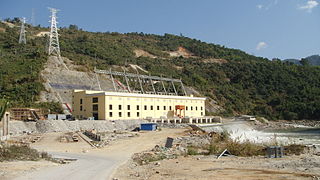
The Shweli I Dam is a gravity dam on the Shweli River about 23 kilometres (14 mi) southwest of Namhkam in Shan State, Burma. The primary purpose of the dam is hydroelectric power generation and it supports a 600 megawatts (800,000 hp)power station. Water from the dam's reservoir is diverted through a 5.1 kilometres (3.2 mi) long headrace tunnel to the power station downstream. The drop in elevation affords a hydraulic head of 299 metres (981 ft). Construction on the dam began in 2002 and the river was diverted on 10 December 2006. On 5 September 2008, the first generator was commissioned and the last of the six was commissioned in April 2009. The dam and power station was constructed under the build–operate–transfer method and cost US$756.2 million. It is owned and operated by the Shweli River-I Power Station Co. The Shweli II and Shweli III Dams are planned downstream.
The Kajiwa Dam is a concrete-face rock-fill dam on the Muli River near Kajiwa in Muli Tibetan Autonomous County, Sichuan Province, China. Preliminary construction on the dam began in 2008 and construction on the 452.4 MW power station began in August 2011. The dam began to impound its reservoir in December 2014. The first 110 MW unit was commissioned on 16 March 2015. The power station was expected to be fully operational by the end of 2015. To operate, water from the dam is sent to a power station about 6 km (3.7 mi) downstream.
The Lizhou Dam is a arch dam on the Muli River in Muli Tibetan Autonomous County, Sichuan Province, China. The primary purpose of the dam is hydroelectric power generation and when commissioned it will support a 355 MW power station. Water from the dam will be sent to a power station about 14.5 km (9.0 mi) to the southeast. The difference in elevation between the reservoir and power station will afford a hydraulic head of 177 m (581 ft). Preliminary construction on the project began in 2009 and the superstructures were approved in 2011. Pouring of roller-compacted concrete for the dam began in 2012. The dam began to impound its reservoir in December 2015.
The Qiaoqi Dam is a rock-fill embankment dam on the Baoxinghe River in Baoxing County of Sichuan Province, China. The primary purpose of the dam is hydroelectric power generation. Construction on the project began in October 2002 and its 240 MW power station was commissioned in 2007. Water from the reservoir is diverted south to the power station via a 18.676 km (11.605 mi) long head-race tunnel and penstock. The power station is located on the north bank of the main stem Baoxing River. The drop in elevation between the reservoir and power station afford a hydraulic head of about 550 m (1,800 ft).
The Pankou Dam is a concrete-face rock-fill dam on the Du River about 74 km (46 mi) southwest of Shiyan in Zhushan County of Hubei Province, China. The purpose of the dam is hydroelectric power production and flood control. It supports a 513 MW power station located at its base. At a normal reservoir elevation of 355 m (1,165 ft), the reservoir withholds 1,970,000,000 m3 (1,597,105 acre⋅ft) of water. However, it can hold up to 2,338,000,000 m3 (1,895,447 acre⋅ft) in the event of a flood. Construction on the dam began in May 2008 and its generators were commissioned in 2012.
The Yingzidu Dam is a concrete-face rock-fill dam on the Sancha River, a tributary of the Wu River, in Pingba County of Guizhou Province, China. The purpose of the dam is hydroelectric power production and flood control. It supports a 360 MW power station located just downstream. At a normal elevation of 1,086 m (3,563 ft) the reservoir withholds 455,000,000 m3 (369,000 acre⋅ft) but it can hold up to 531,000,000 m3 (430,000 acre⋅ft) in the event of a flood. The spillway on the dam can also discharge up to 8,386 m3/s (296,100 cu ft/s) of water. Construction on the dam began on 8 November 2000 and on 10 April 2003 it began to impound its reservoir. On 22 May of the same year the first generator was commissioned, the second in August. By June 2004, the project was complete.
The Sinanjiang Dam is a concrete-face rock-fill dam on the Sinan River, a tributary of the Lixian River, in Mojiang Hani Autonomous County of Yunnan Province, China. The primary purpose of the dam is hydroelectric power production and it supports a 201 MW power station. Construction began in October 2003 and the river was diverted around the dam site on 5 February 2005. All three generators were commissioned in 2008. To produce power, water from the reservoir is diverted around a bend in the river through a 10.3 km (6.4 mi) long headrace tunnel which connects to the power station via a penstock. The power station contains three 67 MW Francis turbine-generators.

The Madushan Dam is a gravity dam on the Honghe (Red) River in Honghe Hani and Yi Autonomous Prefecture of Yunnan Province.