Related Research Articles

Radon is a chemical element with the symbol Rn and atomic number 86. It is a radioactive, colourless, odourless, tasteless noble gas. It occurs naturally in minute quantities as an intermediate step in the normal radioactive decay chains through which thorium and uranium slowly decay into various short-lived radioactive elements and lead. Radon itself is the immediate decay product of radium. Its most stable isotope, 222Rn, has a half-life of only 3.8 days, making it one of the rarest elements. Since thorium and uranium are two of the most common radioactive elements on Earth, while also having three isotopes with half-lives on the order of several billion years, radon will be present on Earth long into the future despite its short half-life. The decay of radon produces many other short-lived nuclides, known as "radon daughters", ending at stable isotopes of lead.
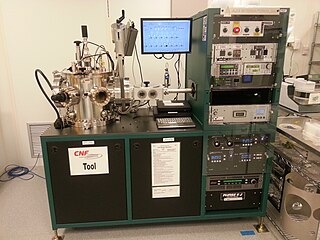
In physics, sputtering is a phenomenon in which microscopic particles of a solid material are ejected from its surface, after the material is itself bombarded by energetic particles of a plasma or gas. It occurs naturally in outer space, and can be an unwelcome source of wear in precision components. However, the fact that it can be made to act on extremely fine layers of material is utilised in science and industry—there, it is used to perform precise etching, carry out analytical techniques, and deposit thin film layers in the manufacture of optical coatings, semiconductor devices and nanotechnology products. It is a physical vapor deposition technique.

Robert Frederick Christy was a Canadian-American theoretical physicist and later astrophysicist who was one of the last surviving people to have worked on the Manhattan Project during World War II. He briefly served as acting president of California Institute of Technology (Caltech).
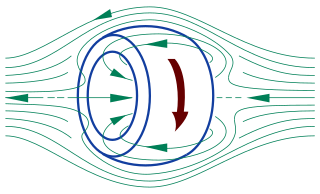
A field-reversed configuration (FRC) is a type of plasma device studied as a means of producing nuclear fusion. It confines a plasma on closed magnetic field lines without a central penetration. In an FRC, the plasma has the form of a self-stable torus, similar to a smoke ring.

Bogdan Castle Maglich was a Serbian experimental nuclear physicist and the leading advocate of a purported non-radioactive aneutronic fusion energy source. Maglich built four models of Migma, devices producing fusion of deuterium atoms in colliding ion beams.

Ishfaq Ahmad KhanSI, HI, NI, FPAS, was a Pakistani nuclear physicist, emeritus professor of high-energy physics at the National Centre for Physics, and former science advisor to the Government of Pakistan.

Marvin Leonard "Murph" Goldberger was an American theoretical physicist and former president of the California Institute of Technology.
Charles Kittel was an American physicist. He was a professor at University of California, Berkeley from 1951 and was professor emeritus from 1978 until his death.
Stopping and Range of Ions in Matter (SRIM) is a group of computer programs which calculate interactions between ions and matter; the core of SRIM is a program called Transport of Ions in Matter (TRIM). SRIM is popular in the ion implantation research and technology community, and also used widely in other branches of radiation material science.
Hugh David Politzer is an American theoretical physicist and the Richard Chace Tolman Professor of Theoretical Physics at the California Institute of Technology. He shared the 2004 Nobel Prize in Physics with David Gross and Frank Wilczek for their discovery of asymptotic freedom in quantum chromodynamics.
The following outline is provided as an overview of, and topical guide to, applied physics:
Harry Suhl was a German-American physicist who specialized in statistical mechanics, non-equilibrium thermodynamics, and solid-state physics, and in particular superconductivity. Various phenomena in his field of work have been named after him, such as the Suhl instability, Suhl–Nakamura interaction and Abrikosov–Suhl resonance. He died in March 2020 at the age of 97.
James (Jim) P. Eisenstein is the Frank J. Roshek Professor of Physics and Applied Physics at the physics department of California Institute of Technology.
The James Franck Institute of the University of Chicago conducts interdisciplinary research in physics, chemistry and materials science. Scientists at the institute include those interested in condensed matter physics, physical chemistry, materials chemistry, atomic, molecular, and optical (AMO) physics, geophysics, and biophysics.
Hartmut Zohm is a German plasma physicist who is known for his work on the ASDEX Upgrade machine. He received the 2014 John Dawson Award and the 2016 Hannes Alfvén Prize for successfully demonstrating that neoclassical tearing modes in tokamaks can be stabilized by electron cyclotron resonance heating, which is an important design consideration for pushing the performance limit of the ITER.
Richard Allan Ferrell (1926–2005) was an American theoretical physicist, specializing in condensed matter physics and statistical physics.
Felix Hans Boehm was a Swiss-American experimental physicist, known for his research on weak interactions, parity violation, and neutrino physics.
Harald Anton Enge was a Norwegian-American experimental nuclear physicist and inventor of instrumentation used in nuclear physics. He is known for the Enge split-pole spectrograph, which became a standard instrument of nuclear physics research.
Eric George Adelberger is an American experimental nuclear physicist and gravitational metrologist.
Harold Matthew Spinka Jr. was an American physicist, specializing in experimental particle physics.
References
- ↑ Who's who in America (2011 ed.). Marquis Who's Who. 2010.
- ↑ Mark H Shapiro. "VITA" (PDF). Archived from the original (PDF) on 2010-06-10.
- ↑ Shapiro, M. H.; Tombrello, T. A. (1990-07-02). "Simulation of cluster impacts on metallic surfaces" (PDF). Physical Review Letters. 65 (1): 92–95. Bibcode:1990PhRvL..65...92S. doi:10.1103/PhysRevLett.65.92. ISSN 0031-9007. PMID 10042180.
- ↑ Behrisch, Rainer; Eckstein, Wolfgang (2007). Sputtering by Particle Bombardment: Experiments and Computer Calculations from Threshold to MeV Energies. Springer Science & Business Media. p. 222. ISBN 978-3-540-44500-5.
- ↑ Gnaser, Hubert (1999). Low-energy Ion Irradiation of Solid Surfaces. Springer tracts in modern physics. Vol. 146. Springer. ISBN 978-3-540-65007-2.
- ↑ Karolewski, Marcus (2005-12-03). "KALYPSO: Software for Simulation of Atomic Collisions at Surfaces (ver2.1)" (PDF).
- ↑ Melvin, J.D.; Shapiro, M.H.; Copping, N.A. (July 1978). "An automated radon-thoron monitor for earthquake prediction research". Nuclear Instruments and Methods. 153 (1): 239–251. Bibcode:1978NucIM.153..239M. doi:10.1016/0029-554x(78)90644-4. ISSN 0029-554X.
- ↑ Thomas, Donald (1988). "Geochemical precursors to seismic activity". Pure and Applied Geophysics. 126 (2–4): 241–266. Bibcode:1988PApGe.126..241T. doi:10.1007/bf00878998. hdl: 10125/30467 . S2CID 54009208.
- ↑ "Sniffing for Oil and Earthquakes". Gulf Oil Magazine. 1982. Retrieved 2019-09-20– via ETI-Geochemistry.com.
- ↑ "American Physical Society Membership Directory" . aps.org.
- ↑ Shapiro, Dr. Mark H. (2014-06-22). "The Irascible Professor" . Retrieved 2019-09-20.