Related Research Articles

Biotechnology is the integration of natural sciences and engineering sciences in order to achieve the application of organisms, cells, parts thereof and molecular analogues for products and services. The term biotechnology was first used by Károly Ereky in 1919, meaning the production of products from raw materials with the aid of living organisms.

A genetically modified organism (GMO) is any organism whose genetic material has been altered using genetic engineering techniques. The exact definition of a genetically modified organism and what constitutes genetic engineering varies, with the most common being an organism altered in a way that "does not occur naturally by mating and/or natural recombination". A wide variety of organisms have been genetically modified (GM), from animals to plants and microorganisms. Genes have been transferred within the same species, across species, and even across kingdoms. New genes can be introduced, or endogenous genes can be enhanced, altered, or knocked out.
Genetic engineering, also called genetic modification or genetic manipulation, is the modification and manipulation of an organism's genes using technology. It is a set of technologies used to change the genetic makeup of cells, including the transfer of genes within and across species boundaries to produce improved or novel organisms. New DNA is obtained by either isolating and copying the genetic material of interest using recombinant DNA methods or by artificially synthesising the DNA. A construct is usually created and used to insert this DNA into the host organism. The first recombinant DNA molecule was made by Paul Berg in 1972 by combining DNA from the monkey virus SV40 with the lambda virus. As well as inserting genes, the process can be used to remove, or "knock out", genes. The new DNA can be inserted randomly, or targeted to a specific part of the genome.
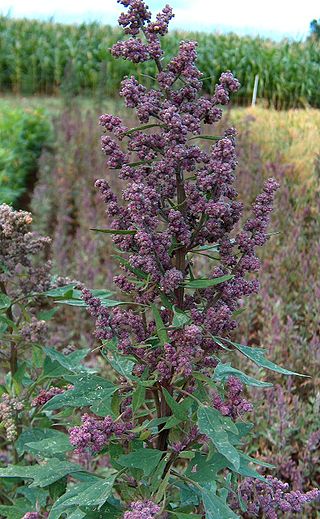
Quinoa is a flowering plant in the amaranth family. It is a herbaceous annual plant grown as a crop primarily for its edible seeds; the seeds are rich in protein, dietary fiber, B vitamins, and dietary minerals in amounts greater than in many grains. Quinoa is not a grass, but rather a pseudocereal botanically related to spinach and amaranth, and originated in the Andean region of northwestern South America. It was first used to feed livestock 5,200–7,000 years ago, and for human consumption 3,000–4,000 years ago in the Lake Titicaca basin of Peru and Bolivia.
Genetically modified foods, also known as genetically engineered foods, or bioengineered foods are foods produced from organisms that have had changes introduced into their DNA using the methods of genetic engineering. Genetic engineering techniques allow for the introduction of new traits as well as greater control over traits when compared to previous methods, such as selective breeding and mutation breeding.
Genetically modified crops are plants used in agriculture, the DNA of which has been modified using genetic engineering methods. Plant genomes can be engineered by physical methods or by use of Agrobacterium for the delivery of sequences hosted in T-DNA binary vectors. In most cases, the aim is to introduce a new trait to the plant which does not occur naturally in the species. Examples in food crops include resistance to certain pests, diseases, environmental conditions, reduction of spoilage, resistance to chemical treatments, or improving the nutrient profile of the crop. Examples in non-food crops include production of pharmaceutical agents, biofuels, and other industrially useful goods, as well as for bioremediation.
Since the advent of genetic engineering in the 1970s, concerns have been raised about the dangers of the technology. Laws, regulations, and treaties were created in the years following to contain genetically modified organisms and prevent their escape. Nevertheless, there are several examples of failure to keep GM crops separate from conventional ones.
Genetically modified food controversies are disputes over the use of foods and other goods derived from genetically modified crops instead of conventional crops, and other uses of genetic engineering in food production. The disputes involve consumers, farmers, biotechnology companies, governmental regulators, non-governmental organizations, and scientists. The key areas of controversy related to genetically modified food are whether such food should be labeled, the role of government regulators, the objectivity of scientific research and publication, the effect of genetically modified crops on health and the environment, the effect on pesticide resistance, the impact of such crops for farmers, and the role of the crops in feeding the world population. In addition, products derived from GMO organisms play a role in the production of ethanol fuels and pharmaceuticals.

Plant genetics is the study of genes, genetic variation, and heredity specifically in plants. It is generally considered a field of biology and botany, but intersects frequently with many other life sciences and is strongly linked with the study of information systems. Plant genetics is similar in many ways to animal genetics but differs in a few key areas.

Genetically modified rice are rice strains that have been genetically modified. Rice plants have been modified to increase micronutrients such as vitamin A, accelerate photosynthesis, tolerate herbicides, resist pests, increase grain size, generate nutrients, flavors or produce human proteins.
A genetically modified soybean is a soybean that has had DNA introduced into it using genetic engineering techniques. In 1996, the first genetically modified soybean was introduced to the U.S. by Monsanto. In 2014, 90.7 million hectares of GM soybeans were planted worldwide, this is almost 82% of the total soybeans cultivation area.
The genetically modified brinjal is a suite of transgenic brinjals created by inserting a crystal protein gene (Cry1Ac) from the soil bacterium Bacillus thuringiensis into the genome of various brinjal cultivars. The insertion of the gene, along with other genetic elements such as promoters, terminators and an antibiotic resistance marker gene into the brinjal plant is accomplished using Agrobacterium-mediated genetic transformation. The Bt brinjal has been developed to give resistance against lepidopteron insects, in particular the Brinjal Fruit and Shoot Borer (FSB) by forming pores in the digestive system. Mahyco, an Indian seed company based in Jalna, Maharashtra, has developed the Bt brinjal.
Genetically modified canola is a genetically modified crop. The first strain, Roundup Ready canola, was developed by Monsanto for tolerance to glyphosate, the active ingredient in the commonly used herbicide Roundup.

A genetically modified tomato, or transgenic tomato, is a tomato that has had its genes modified, using genetic engineering. The first trial genetically modified food was a tomato engineered to have a longer shelf life, which was on the market briefly beginning on May 21, 1994. The first direct consumption tomato was approved in Japan in 2021. Primary work is focused on developing tomatoes with new traits like increased resistance to pests or environmental stresses. Other projects aim to enrich tomatoes with substances that may offer health benefits or be more nutritious. As well as aiming to produce novel crops, scientists produce genetically modified tomatoes to understand the function of genes naturally present in tomatoes.
The regulation of genetic engineering varies widely by country. Countries such as the United States, Canada, Lebanon and Egypt use substantial equivalence as the starting point when assessing safety, while many countries such as those in the European Union, Brazil and China authorize GMO cultivation on a case-by-case basis. Many countries allow the import of GM food with authorization, but either do not allow its cultivation or have provisions for cultivation, but no GM products are yet produced. Most countries that do not allow for GMO cultivation do permit research. Most (85%) of the world's GMO crops are grown in the Americas. One of the key issues concerning regulators is whether GM products should be labeled. Labeling of GMO products in the marketplace is required in 64 countries. Labeling can be mandatory up to a threshold GM content level or voluntary. A study investigating voluntary labeling in South Africa found that 31% of products labeled as GMO-free had a GM content above 1.0%. In Canada and the USA labeling of GM food is voluntary, while in Europe all food or feed which contains greater than 0.9% of approved GMOs must be labelled.
Genetic engineering is the science of manipulating genetic material of an organism. The first artificial genetic modification accomplished using biotechnology was transgenesis, the process of transferring genes from one organism to another, first accomplished by Herbert Boyer and Stanley Cohen in 1973. It was the result of a series of advancements in techniques that allowed the direct modification of the genome. Important advances included the discovery of restriction enzymes and DNA ligases, the ability to design plasmids and technologies like polymerase chain reaction and sequencing. Transformation of the DNA into a host organism was accomplished with the invention of biolistics, Agrobacterium-mediated recombination and microinjection. The first genetically modified animal was a mouse created in 1974 by Rudolf Jaenisch. In 1976 the technology was commercialised, with the advent of genetically modified bacteria that produced somatostatin, followed by insulin in 1978. In 1983 an antibiotic resistant gene was inserted into tobacco, leading to the first genetically engineered plant. Advances followed that allowed scientists to manipulate and add genes to a variety of different organisms and induce a range of different effects. Plants were first commercialized with virus resistant tobacco released in China in 1992. The first genetically modified food was the Flavr Savr tomato marketed in 1994. By 2010, 29 countries had planted commercialized biotech crops. In 2000 a paper published in Science introduced golden rice, the first food developed with increased nutrient value.

The March Against Monsanto is an international grassroots movement and protest against Monsanto, a producer of genetically modified organisms (GMOs) and Roundup, a glyphosate-based herbicide. The movement was founded by Tami Canal in response to the failure of California Proposition 37, a ballot initiative which would have required labeling food products made from GMOs. Advocates support mandatory labeling laws for food made from GMOs.

Kevin M. Folta is a professor of the horticultural sciences department at the University of Florida. From 2007 to 2010 he helped lead the project to sequence the strawberry genome, and continues to research photomorphogenesis in plants and compounds responsible for flavor in strawberries. Folta has been active as a science communicator since 2002, especially relating to biotechnology. He has faced controversy over what his critics say are his industry connections. In 2017 he was elected as a fellow of the Committee for Skeptical Inquiry.
GMO conspiracy theories are conspiracy theories related to the production and sale of genetically modified crops and genetically modified food. These conspiracy theories include claims that agribusinesses, especially Monsanto, have suppressed data showing that GMOs cause harm, deliberately cause food shortages to promote the use of GM food, or have co-opted government agencies such as the United States Food and Drug Administration or scientific societies such as the American Association for the Advancement of Science. Critics charge that GMO conspiracy theories are largely promulgated by those opposing the production and sale of GMOs, and instances of unsubstantiated conspiracy theories have lately occurred in the context of public health issues that are mostly unrelated to GMOs, including the 2015–16 Zika virus outbreak and concerns over food safety at Chipotle Mexican Grill.
Biotechnology risk is a form of existential risk that could come from biological sources, such as genetically engineered biological agents. The origin of such a high-consequence pathogen could be a deliberate release, an accidental release, or a naturally occurring event.
References
- ↑ Butler, Declan (5 February 2015). "Saudi university backs slow road to modernization". Nature News. 518 (7537): 18–19. doi: 10.1038/518018a . PMID 25652976.
- 1 2 "Mark Tester". King Abdullah University of Science and Technology. Retrieved 21 May 2017.
- 1 2 "Mark Tester CV" (PDF). Retrieved 21 May 2017.
- ↑ "Interview with Mark Tester". Trends in Plant Science. 21 (10): 805–806. October 2016. doi:10.1016/j.tplants.2016.08.004.
- ↑ Zhang, Cici (8 February 2017). "The quinoa genome could help scientists get it out of the health food aisle". Popular Science. Retrieved 21 May 2017.
- ↑ "Scientists closer to developing salt-tolerant crops". University of Adelaide. 8 July 2009. Retrieved 21 May 2017.
- ↑ Condon, Michael (19 October 2011). "Scientists debate genetically modified food". ABC Rural. Retrieved 21 May 2017.
- ↑ Tester, Mark (8 July 2009). "GM crops are another tool in the struggle against poverty". The Guardian. Retrieved 21 May 2017.
- ↑ Leonard, Tom (5 June 2002). "GM foods plot a myth, says critic of TV show". The Daily Telegraph. Retrieved 21 May 2017.
