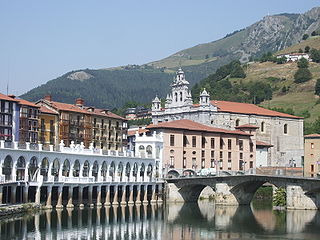
Tolosa is a town and municipality in the Basque province of Gipuzkoa, in northern Spain. It is located in the valley of the river Oria, next by Uzturre, a local mountain topped by a white cross.
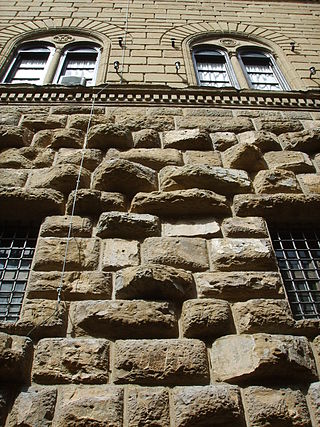
Rustication is a range of masonry techniques used in classical architecture giving visible surfaces a finish texture that contrasts with smooth, squared-block masonry called ashlar. The visible face of each individual block is cut back around the edges to make its size and placing very clear. In addition the central part of the face of each block may be given a deliberately rough or patterned surface.
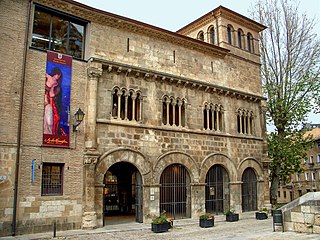
The Palacio de los Reyes de Navarra, also called the Palacio de los Duques de Granada de Ega, is a historical building in Estella, Navarre, Spain; it is the Romanesque former royal palace of the Kings and Queens of Navarre from the late 12th century to the mid-15th. In the twentieth century the building, which had fallen into disrepair, was restored and in 1991 converted into the Museo Gustavo de Maeztu, housing the work of the painter Gustavo de Maeztu y Whitney and open to the public. The building is important in the history of architecture in Navarre, since it is the only civil building extant from the Romanesque period. In 1931, it was declared a national monument by the Spanish government.

The Palace of the Kings of Navarre of Olite or Royal Palace of Olite is a castle-palace in the town of Olite, in Navarre, Spain. It was one of the seats of the Court of the Kingdom of Navarre, since the reign of Charles III "the Noble" until its conquest by Castile (1512).
Surely there is no king with a more beautiful castle or palace and with so many gilded rooms (...) it could not say or even could imagine how magnificent and sumptuous is this palace (...)
Anleo is one of eight parishes in Navia, a municipality within the province and autonomous community of Asturias, in northern Spain.
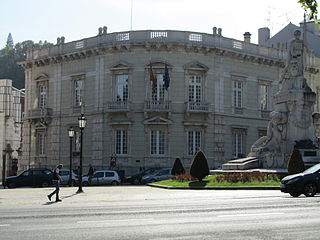
The Palacete Mayer is a Portuguese eclectical residence situated in the civil parish of Santo António, municipality of Lisbon. In the 20th century, it was acquired by the Spanish government and became the Embassy of Spain in Portugal.
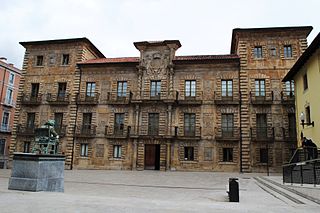
Camposagrado Palace is a baroque-style palace located in Avilés in Asturias, Spain. It was constructed on the site of a medieval building and used by the family of the Marquises of Camposagrado until the nineteenth century when it became a military barracks. In the twentieth century, the property was partially used for commercial purposes, but after acquisition and restoration by the City Council of Avilés, it became the School of Art for the Principality of Asturias.

Díaz Inguanzo Palace is located in the parish of Berodia, in the municipality of Cabrales, in Asturias, Spain. The palace is in a valley, near the Iglesia de Sta. María Magdalena and a few hundred meters from the town.

Palazzo dei Convertendi is a reconstructed Renaissance palace in Rome. It originally faced the Piazza Scossacavalli, but was demolished and rebuilt along the north side of Via della Conciliazione, the wide avenue constructed between 1936 and 1950, which links St Peter's Basilica and the Vatican City to the centre of Rome. The palace is famous as the last home of the painter Raphael, who died there in 1520.

The Convent of Santo António da Cidade is a former-convent and public library in the civil parish of Bonfim, in the municipality of Porto, in the Portuguese district of the same name.

The Palace of Milà i Aragó, also known as the palace of the marquises of Albaida, is regarded as the most emblematic building of the town of Albaida, Valencian Community, Spain. It is considered a Place of Cultural Interest. Nowadays, in its interior there is a tourist office and the Museu Internacional de Titelles d'Albaida.

The Flour factory San José, located in Toledo (Spain), is a clear example of the industrial architecture of the late 19th century.
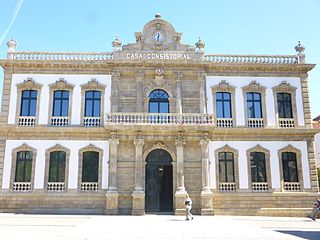
The Pontevedra City Hall in Pontevedra, Spain, is the seat of the city council of this Galician city. It is located at the eastern end of the Alameda de Pontevedra, on the edge of the old town. To the west it opens onto the pedestrian España Square.

The Palace of Mugartegui, or Palace of the Counts of Fefiñáns in Pontevedra, Spain, is a Baroque pazo dating from the 18th century. It currently houses the headquarters of the Regulatory Council of the Rías Baixas Designation of Origin.

The Palace of the Deputation of Pontevedra, in Pontevedra, Spain, is the seat of the Provincial Deputation of Pontevedra, the provincial government of the province of Pontevedra. It is located between the Alameda de Pontevedra and the Palm Trees Park.

The building of the former Pontevedra Normal School of Pontevedra, in Pontevedra, Spain, is an eclectic building from the end of the 19th century that was the headquarters of the teacher training college of this Galician city. It is located on the Gran Vía de Montero Ríos, between the Alameda de Pontevedra and the Palm Trees Park.

The Post and Telecommunications Palace of Pontevedra is a building between Oliva and García Camba streets, in the heart of the commercial and financial centre of Pontevedra, Spain. Since its construction, it has been the main headquarters of Correos in the city and in the province of Pontevedra. In front of its main façade there is an olive tree which gave its name to the Olive Street.

The Gobierno Civil de Pontevedra, currently Subdelegación del Gobierno de Pontevedra, is an official building located in Pontevedra, Galicia (Spain). It has served since its construction as the government delegation office representing the Spanish state in the province of Pontevedra.

The Marquis of Riestra's mansion is an eclectic building with art Nouveau elements from the late 19th century located at 30 Michelena Street in Pontevedra, Spain. It currently houses the main central administrative services of the City Council of Pontevedra.

The Gran Vía de Montero Ríos is an avenue in Pontevedra (Spain) located in the city centre, in the 19th century bourgeois area. It is one of the most emblematic avenues in Pontevedra.

