Distributism is an economic theory asserting that the world's productive assets should be widely owned rather than concentrated. Developed in the late 19th and early 20th centuries, distributism was based upon Catholic social teaching principles, especially those of Pope Leo XIII in his encyclical Rerum novarum (1891) and Pope Pius XI in Quadragesimo anno (1931). It has influenced Anglo Christian Democratic movements, and has been recognized as one of many influences on the social market economy.

Christian democracy is an ideology inspired by Christian social teaching to respond to the challenges of contemporary society and politics.
Subsidiarity is a principle of social organization that holds that social and political issues should be dealt with at the most immediate or local level that is consistent with their resolution. The Oxford English Dictionary defines subsidiarity as "the principle that a central authority should have a subsidiary function, performing only those tasks which cannot be performed at a more local level". The concept is applicable in the fields of government, political science, neuropsychology, cybernetics, management and in military command. The OED adds that the term "subsidiarity" in English follows the early German usage of "Subsidiarität". More distantly, it is derived from the Latin verb subsidio, and the related noun subsidium.
Quadragesimo anno is an encyclical issued by Pope Pius XI on 15 May 1931, 40 years after Leo XIII's encyclical Rerum novarum, further developing Catholic social teaching. Unlike Leo XIII, who addressed the condition of workers, Pius XI discusses the ethical implications of the social and economic order. He describes the major dangers for human freedom and dignity arising from unrestrained capitalism, from socialism, and from communism as practised in Russia. He also calls for the reconstruction of the social order based on the principles of solidarity and subsidiarity.
Tilburg University is a Catholic research university specializing in the social and behavioral sciences, economics, law, business sciences, theology and humanities, located in Tilburg in the southern part of the Netherlands.

Alan Stuart Blinder is an American economics professor at Princeton University and is listed among the most influential economists in the world. He is a leading macro-economist, politically liberal, and a champion of Keynesian economics and policies.
Catholic social teaching (CST) is an area of Catholic doctrine which is concerned with human dignity and the common good in society. It addresses oppression, the role of the state, subsidiarity, social organization, social justice, and wealth distribution. CST's foundations are considered to have been laid by Pope Leo XIII's 1891 encyclical, Rerum novarum, which advocated distributism. Its roots can be traced to Catholic theologians such as Thomas Aquinas and Augustine of Hippo. CST is also derived from the Bible and cultures of the ancient Near East.

Solidarity or solidarism is an awareness of shared interests, objectives, standards, and sympathies creating a psychological sense of unity of groups or classes. Solidarity does not reject individuals and sees individuals as the basis of society. It refers to the ties in a society that bind people together as one. The term is generally employed in sociology and the other social sciences, as well as in philosophy and bioethics. It is a significant concept in Catholic social teaching and in Christian democratic political ideology. Although closely related to the concept of charity, solidarity aspires to change whole systems, not merely to help individuals.
Götz Briefs was a Catholic social theorist, social ethicist, social philosopher and political economist, who together with Gustav Gundlach, SJ influenced the social teachings of Pope Pius XI.

Jean Tirole is a French economist who is currently a professor of economics at Toulouse 1 Capitole University. He focuses on industrial organization, game theory, banking and finance, and psychology. In particular, he focuses on the regulation of economic activity in a way that does not hinder innovation while maintaining fair rules.
Solidarism or solidarist can refer to:
The Tinbergen Institute is a joint institute for research and education in economics, econometrics and finance of the VU University Amsterdam, the University of Amsterdam, and the Erasmus University Rotterdam. The institute was founded in 1987 and is named after the Dutch economist Jan Tinbergen, a Nobel Prize-winning professor at the Erasmus University Rotterdam.
E.J.J. Schenk is a Dutch professor emeritus of economics and fellow of the Tjalling C. Koopmans Research Institute at Utrecht University’s School (NE) of Economics (USE) of which he was founding director. He was a Crown-appointed independent member of the Social and Economic Council SER of the Netherlands from 2010 until 2018. With other financial economics specialists, and help of Triodos Bank, he founded the Sustainable Finance Lab in 2011.
Subsidiarity is an organizing principle that matters ought to be handled by the smallest, lowest or least centralized competent authority. Political decisions should be taken at a local level if possible, rather than by a central authority. The Oxford English Dictionary defines subsidiarity as the idea that a central authority should have a subsidiary function, performing only those tasks which cannot be performed effectively at a more immediate or local level.

Christian corporatism is a societal, economic, or a modern political application of the Christian doctrine of Paul of Tarsus in I Corinthians 12:12-31 where Paul speaks of an organic form of politics and society where all people and components are functionally united, like the human body.

The Vancouver School of Economics is a school of the University of British Columbia located in Vancouver, BC, Canada. The school ranks as one of the top 25 in the world and top in Canada. The school exhibits research activity and offers undergraduate and graduate degrees.
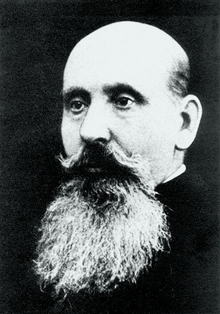
Heinrich Pesch, S.J. was a German Roman Catholic ethicist and economist of the Solidarist school. His major work, Lehrbuch der Nationalökonomie, is generally regarded as a source for Pope Pius XI's social encyclical Quadragesimo anno.
Adrianus Herman Josef (Ad) Kolnaar is a Dutch economist, and Emeritus Professor at Tilburg University.
Wilhelmus Gijsbertus Henri (Wim) van Hulst was a Dutch business economist who was Emeritus Professor Business Economics at the Tilburg University.

Marcel Alfons Gilbert van Meerhaeghe was a Belgian economist, professor, publicist and columnist.


