Related Research Articles

The Catepanateof Italy was a province of the Byzantine Empire, comprising mainland Italy south of a line drawn from Monte Gargano to the Gulf of Salerno. Amalfi and Naples, although north of that line, maintained allegiance to Constantinople through the catepan. The Italian region of Capitanata derives its name from the Catepanate.
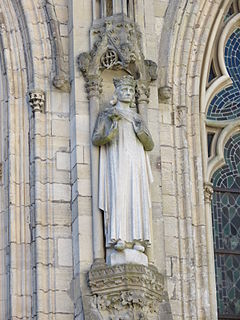
Drogo of Hauteville was the second Count of Apulia and Calabria (1046–51) in southern Italy. Initially he was only the leader of those Normans in the service of Prince Guaimar IV of Salerno, but after 1047 he was a territorial prince owing fealty directly to the Emperor.
Argyrus was a Lombard nobleman and Byzantine general, son of the Lombard hero Melus. He was born in Bari.
Michael Dokeianos, erroneously called Doukeianos by some modern writers, was a Byzantine nobleman and military leader, who married into the Komnenos family. He was active in Sicily under George Maniakes before going to Southern Italy as Catepan of Italy in 1040–41. He was recalled after being twice defeated in battle during the Lombard-Norman revolt of 1041, a decisive moment in the eventual Norman conquest of southern Italy. He is next recorded in 1050, fighting against a Pecheneg raid in Thrace. He was captured during battle but managed to maim the Pecheneg leader, after which he was put to death and mutilated.
Exaugustus Boiοannes, son of the famous Basil Boioannes, was also a catepan of Italy, from 1041 to 1042. He replaced Michael Dokeianos after the latter's disgrace in defeat at Montemaggiore on May 4. Boioannes did not have the levies and reinforcements that Doukeianos had had at his command. He arrived only with a Varangian contingent. Boioannes decided on trying to isolate the Lombard rebels in Melfi by camping near Montepeloso.
John Kourkouas was the Byzantine catepan of Italy from 1008 to his death. Belonging to the Kourkouas family, he was of Armenian descent.
Pardos was the catepan of Italy briefly in 1042 following the short term of George Maniakes.
Eustathios Palatinos was the catepan of Italy from the autumn of 1045 to September 1046. The primary source for his term of office is the chronicle of Lupus, a fellow protospatharius.
Christopher or Christophoros Burgaris was the short-tenured successor of the famous Basil Boiannes as catepan of Italy.

Pothos Argyros or Argyrus was a Byzantine commander, who served as the catepan of Italy during the eventful years of 1029 to 1031.
Michael Protospatharios was the Byzantine catepan of Italy from 1031 to 1033. He was sent to Bari after his predecessor, Pothos Argyrus, was killed in battle with the Saracens who took Cassano allo Ionio in Calabria. Michael was high and lofty official in the imperial court of Constantinople. He held several high-ranking titles. At the height of his career, his full title was: ἐπὶ τῶν οἰκιακῶν, κατεπάνω Ἰταλίας, κριτὴς τοῦ βήλου καί τοῦ ἱπποδρόμου, that is, "Chamberlain, catepan of Italy, and kritēs of the vēlon and the Hippodrome". The kritēs was probably an officer in charge of processing requests for the audience of the emperor. Michael arrived in Italy early in 1032 with a new army, composed not only of recruits from the West or the auxiliaries, but also from the elite troops of Asia Minor and Syria. It is unknown what became of this grand army, however, as Michael was replaced in 1033 by Constantinos Opos.
Basil III Theodorokanos or Theodorocanus was the Byzantine Catepan of Italy from February to the Spring of 1043. He was a patrician and a former companion in arms of George Maniakes when he was appointed to go to Apulia and Calabria and put down the revolts of Maniakes and of Argyrus in 1042. In February 1043, he landed at Bari. Argyrus and his Normans tried to surround Otranto, but the catepan's fleet blocked them. Maniakes, however, debarked for Dyrrhachium with his army. Argyrus eventually made peace with the Greeks and Theodorokanos was replaced by Eustathios Palatinos. Subsequently, he commanded the Byzantine fleet against the Rus' raid in July 1043.
John Raphael or Rafayl was the catepan of Italy from September to December 1046 AD. He replaced the catepan Eustathios Palatinos and arrived with an army of Varangian auxiliaries in Bari.
Miriarcha is the name given in the Chronicon breve normannicum to the Byzantine general who led the defence of the Catapanate of Italy in 1060–1062. The anonymous chronicler has, however, misinterpreted the Greek title merarches as a name. The actual name of the general is unknown, and since the rank of merarches is not otherwise clearly attested in southern Italy his exact function is not known either. Probably the office was immediately below that of the catapan.
Sirianus was the Byzantine catapan of Italy, the second appointed by the Emperor Constantine X Doukas. He arrived in Bari, the seat of the catapanate, in 1061 or 1062, replacing Marules, who had been appointed the previous year. Constantine was the last emperor who took an interest in recovering ground in Italy, but Sirianus was on the defensive against the Norman state and recovered no territory. According to the annals of Lupus Protospatharius, the Norman duke Robert Guiscard captured Oria and Brindisi in the year of his appointment and Taranto in the following year. He was succeeded in 1064 by Abulchares.

The Norman conquest of southern Italy lasted from 999 to 1139, involving many battles and independent conquerors. In 1130 these territories in southern Italy united as the Kingdom of Sicily, which included the island of Sicily; the southern third of the Italian Peninsula ; the archipelago of Malta; and parts of North Africa.
The siege of Bari took place 1068–71, during the Middle Ages, when Norman forces, under the command of Robert Guiscard, laid siege to the city of Bari, a major stronghold of the Byzantines in Italy and the capital of the Catepanate of Italy, starting from 5 August 1068. Bari was captured on 16 April 1071 when Robert Guiscard entered the city, ending over five centuries of Byzantine presence in Southern Italy.

The Roman Catholic Archdiocese of Bari-Bitonto is Metropolitan Latin rite archbishopric in the administrative Bari province, Puglia (Apulia) region, southeastern Italy, created in 1986, when the historical diocese of Bitonto was subsumed in the Archdiocese of Bari.
Abulchares was a Byzantine general of Arab origin who served as the catepan of Italy from 1064 until his death. The chief sources for his catapanate are Skylitzes Continuatus and Anonymi Barensis Chronicon. Skylitzes Continuatus records that Abulchares was also duke (doux) of Dyrrhachium across the Adriatic, but this is chronologically impossible, since Perenos is recorded as duke at this time.
Argyritzos was one of the leading citizens of Bari during the final years of Byzantine rule. He held the rank of protospatharios under the empire. His father was named Ioannakes.
References
- 1 2 3 Vera von Falkenhausen, Untersuchungen über die byzantinische Herrschaft in Süditalien vom 9. bis ins 11. Jahrhundert (O. Harrassowitz, 1967), p. 94, notes that the rare name Marules is attested from the 10th century.
- 1 2 André Guillou, "Production and Profits in the Byzantine Province of Italy (Tenth to Eleventh Centuries): An Expanding Society", Dumbarton Oaks Papers28 (1974), p. 108. doi : 10.2307/1291356.
- ↑ William J. Churchill, The Annales Barenses and the Annales Lupi Protospatharii: Critical Edition and Commentary, PhD dissertation (University of Toronto, 1979), p. 312.
- ↑ Ferdinand Chalandon, Histoire de la domination normande en Italie et en Sicile: Tome premier (Paris : Alphonse Picard, 1907), pp. 174–176.
- 1 2 3 Jules Gay, L'Italie méridionale et l'empire Byzantin (New York: Burt Franklin, 1904), p. 526.
- ↑ Ludovico Antonio Muratori (ed.), Rerum Italicarum scriptores, vol. V. (Milan, 1724), p. 152: Mill. LXI. Ind. XIIII. ... Et Maruli Catapanus vênit in Bari.
| Preceded by Argyros | Catepan of Italy 1060/1061 | Succeeded by Sirianus |