Related Research Articles
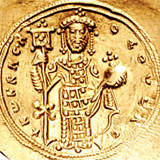
Constantine X Doukas or Dukas, Latinised as Ducas was Byzantine Emperor from 1059 to 1067. He was the founder and first ruling member of the short-lived Doukid dynasty. During his reign, the Normans took over much of the remaining Byzantine territories in Italy while in the Balkans the Hungarians occupied Belgrade. He also suffered defeats against the Seljuk sultan Alp Arslan.

The Catepanateof Italy was a province of the Byzantine Empire, comprising mainland Italy south of a line drawn from Monte Gargano to the Gulf of Salerno. Amalfi and Naples, although north of that line, maintained allegiance to Constantinople through the catepan. The Italian region of Capitanata derives its name from the Catepanate.

Constantine Bodin was the ruler of Duklja, from 1081 to 1101, succeeding his father, Mihailo Vojislavljević. Born in peaceful times, when the Southern Slavs were subjects of the Byzantine Empire, his father was in 1072 approached by Bulgarian nobility, who sought aid in their revolt against the Byzantines; Mihailo sent them Bodin, who was crowned Bulgarian Tsar under the name Petar III joined the short-lived revolt, being captured the following year after initial success. He was freed in 1078, and upon the death of his father in 1081 he succeeded the throne. Having renewed his acknowledgement of Byzantine overlordship, he soon sided with their enemies, the Normans, which resulted in a Byzantine invasion and his capture. Although he quickly had himself freed, his reputation and influence waned. He was pushed aside by one of his governors, Vukan in Raška, who continued the struggle against the Byzantines.

Basil Boioannes, called Bugiano in Italian, was the Byzantine catapan of Italy and one of the greatest Byzantine generals of his time. His accomplishments enabled the Empire to reestablish itself as a major force in southern Italy after centuries of decline. Yet, the Norman adventurers introduced into the power structure of the Mezzogiorno would be the eventual beneficiaries.
Michael Dokeianos, erroneously called Doukeianos by some modern writers, was a Byzantine nobleman and military leader, who married into the Komnenos family. He was active in Sicily under George Maniakes before going to Southern Italy as Catepan of Italy in 1040–41. He was recalled after being twice defeated in battle during the Lombard-Norman revolt of 1041, a decisive moment in the eventual Norman conquest of southern Italy. He is next recorded in 1050, fighting against a Pecheneg raid in Thrace. He was captured during battle but managed to maim the Pecheneg leader, after which he was put to death and mutilated.

The history of Islam in Sicily and Southern Italy began with the first Arab settlement in Sicily, at Mazara, which was captured in 827. The subsequent rule of Sicily and Malta started in the 10th century. Islamic rule over all Sicily began in 902, and the Emirate of Sicily lasted from 831 until 1061. Though Sicily was the primary Muslim stronghold in Italy, some temporary footholds, the most substantial of which was the port city of Bari, were established on the mainland peninsula, especially in mainland Southern Italy, though Muslim raids, mainly those of Muhammad I Abu 'l-Abbas, reached as far north as Naples, Rome and the northern region of Piedmont. The Muslim raids were part of a larger struggle for power in Italy and Europe, with Christian Byzantine, Frankish, Norman and local Italian forces also competing for control. Muslims were sometimes sought as allies by various Christian factions against other factions.
Miriarcha is the name given in the Chronicon breve normannicum to the Byzantine general who led the defence of the Catapanate of Italy in 1060–1062. The anonymous chronicler has, however, misinterpreted the Greek title merarches as a name. The actual name of the general is unknown, and since the rank of merarches is not otherwise clearly attested in southern Italy his exact function is not known either. Probably the office was immediately below that of the catapan.
Marules was the Byzantine catepan of Italy in 1060/1061. Appointed by the Emperor Constantine X, he arrived in Bari between 1 September 1060 and 31 August 1061, according to the Anonymous Chronicle of Bari. He was the first catepan appointed after Argyros left Italy in 1058. He had been preceded in 1060 by a merarches, but the latter's offensive against the Normans had peaked before his arrival and he adopted a defensive posture.

The Norman conquest of southern Italy lasted from 999 to 1139, involving many battles and independent conquerors. In 1130, the territories in southern Italy united as the Kingdom of Sicily, which included the island of Sicily, the southern third of the Italian Peninsula, the archipelago of Malta, and parts of North Africa.
Nikephoros Karantenos, Latinized as Nicephorus Carantenus, was a Byzantine general known for fighting against the Bulgarians in the Balkans and the Normans in Italy. The main sources for his life is the continuator of John Skylitzes, Lupus Protospatharius, and the Anonymi Barensis Chronicon.
The siege of Bari took place 1068–71, during the Middle Ages, when Norman forces, under the command of Robert Guiscard, laid siege to the city of Bari, a major stronghold of the Byzantines in Italy and the capital of the Catepanate of Italy, starting from 5 August 1068. Bari was captured on 16 April 1071 when Robert Guiscard entered the city, ending over five centuries of Byzantine presence in Southern Italy.
The 1020s was a decade of the Julian Calendar which began on January 1, 1020, and ended on December 31, 1029.

A number of wars between the Normans and the Byzantine Empire were fought from c. 1040 until 1185, when the last Norman invasion of the Byzantine Empire was defeated. At the end of the conflict, neither the Normans nor the Byzantines could boast much power; by the mid-13th century exhaustive fighting with other powers had weakened both, leading to the Byzantines losing Asia Minor to the Ottoman Empire in the 14th century, and the Normans losing Sicily to the Hohenstaufen, who in turn were succeeded by the Angevins.

The Emirate of Bari was a short-lived Islamic state ruled by Berbers. It was ruled from the south Italian city of Bari from 847 to 871. It was the most lasting episode in the history of Islam in peninsular southern Italy.

The Roman Catholic Archdiocese of Bari-Bitonto is Metropolitan Latin rite archbishopric in the administrative Bari province, Puglia (Apulia) region, southeastern Italy, created in 1986, when the historical diocese of Bitonto was subsumed in the Archdiocese of Bari.
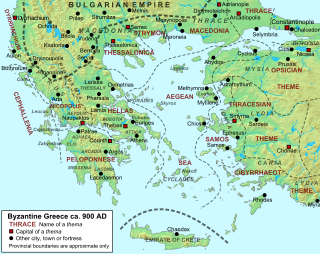
The Theme of Cephallenia or Cephalonia was a Byzantine theme located in western Greece, comprising the Ionian Islands, and extant from the 8th century until partially conquered by the Kingdom of Sicily in 1185.

The Byzantine Empire was ruled by emperors of the Doukas dynasty between 1059 and 1081. There are six emperors and co-emperors of this period: the dynasty's founder, Emperor Constantine X Doukas, his brother John Doukas, katepano and later Caesar, Romanos IV Diogenes, Constantine's son Michael VII Doukas, Michael's son and co-emperor Constantine Doukas, and finally Nikephoros III Botaneiates, who claimed descent from the Phokas family.
Abulchares was a Byzantine general of Arab origin who served as the catepan of Italy from 1064 until his death. The chief sources for his catapanate are Skylitzes Continuatus and Anonymi Barensis Chronicon. Skylitzes Continuatus records that Abulchares was also duke (doux) of Dyrrhachium across the Adriatic, but this is chronologically impossible, since Perenos is recorded as duke at this time.
Bisantius Guirdeliku was a noble citizen of Bari, then the capital of the Byzantine catepanate of Italy. He held the rank of patrikios. During the siege of Bari (1068–71) by the Normans, he led the faction opposed to surrender until he was assassinated by his rival, Argirizzo, in 1070. His nickname is known from the anonymous Annales Barenses and the chronicle of Lupus Protospatharius.
Argyritzos was one of the leading citizens of Bari during the final years of Byzantine rule. He held the rank of protospatharios under the empire. His father was named Ioannakes.
References
- ↑ Jules Gay, L'Italie méridionale et l'empire Byzantin (New York: Burt Franklin, 1904), p. 526.
- ↑ William J. Churchill, The Annales Barenses and the Annales Lupi Protospatharii: Critical Edition and Commentary, PhD dissertation (University of Toronto, 1979), pp. 144–145.
- 1 2 3 Vera von Falkenhausen, Untersuchungen über die byzantinische Herrschaft in Süditalien vom 9. bis ins 11. Jahrhundert (O. Harrassowitz, 1967), p. 94.
- ↑ Ludovico Antonio Muratori (ed.), Rerum Italicarum scriptores, vol. V. (Milan, 1724), p. 152: Mill. LXII. Ind. XV. ... Et Siriano venit Catap. in Bari..
| Preceded by Marules | Catepan of Italy 1061/1062 | Succeeded by Abulchares |