

The Master of Flora was a French painter, associated with the School of Fontainebleau, who was active in the middle of the 16th century.
The Master of Flora was a French painter, associated with the School of Fontainebleau, who was active in the middle of the 16th century.
The notname, "Master of Flora", is used to designate a still unclearly defined artistic personality, first proposed by the art historian Charles Sterling and later expanded upon by Sylvie Béguin , involving a corpus of related works in the style of the School of Fontainebleau. The term is derived from a painting that is now in the collection of the Fine Arts Museums of San Francisco, previously identified as Flora, but now reclassified as a "Venus".
Several more paintings have been added to the unknown Master's potential opus, including a "Birth of Amor/Cupid" (Metropolitan Museum of Art), "Charity" (Louvre Museum) and two versions of the "Birth of Adonis", one at the Pushkin Museum and the other at the Norton Simon Museum, although the latter has also been ascribed to Jean Cousin the Younger. There is an "Artemisia" that has also been credited to a follower of Ambroise Dubois. A copy of "Concert", painted by Francesco Primaticcio (Le Primatice), in the ballroom of the Château de Fontainebleau, is now attributed to the Master of Flora and indicates that he may have worked under his direction. [1]
All of the works so far attributed feature female figures with elongated bodies, long fingers, and feet with upturned toes.
Several drawings have also been proposed as possible candidates for his work: a "Cephalus and Procris" (Morgan Library), [2] an "Annunciation" (Albertina), and an "Apollo and the Muses" (Louvre). In 1578, he may have been commissioned by Count Antoine III de Clermont to complete a work begun by someone else years before. [3]
Several candidates for being the Master have been suggested; Jean Cousin the Younger, whose life and works are poorly documented, and other artists who worked with Le Primatrice or Nicolo dell'Abate, such as Giulio Camillo dell'Abate (Nicolo's son) and Ruggiero de Ruggieri, another artist about whom little is known.
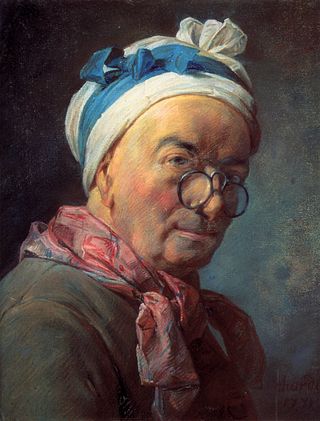
Jean Siméon Chardin was an 18th-century French painter. He is considered a master of still life, and is also noted for his genre paintings which depict kitchen maids, children, and domestic activities. Carefully balanced composition, soft diffusion of light, and granular impasto characterize his work.

The Louvre, or the Louvre Museum, is a national art museum in Paris, France, and one of the most famous museums in the world. It is located on the Right Bank of the Seine in the city's 1st arrondissement and home to some of the most canonical works of Western art, including the Mona Lisa,Venus de Milo, and Winged Victory. The museum is housed in the Louvre Palace, originally built in the late 12th to 13th century under Philip II. Remnants of the Medieval Louvre fortress are visible in the basement of the museum. Due to urban expansion, the fortress eventually lost its defensive function, and in 1546 Francis I converted it into the primary residence of the French kings.

Palace of Fontainebleau, located 55 kilometers southeast of the center of Paris, in the commune of Fontainebleau, is one of the largest French royal châteaux. It served as a hunting lodge and summer residence for many of the French monarchs, including Louis VII, Francis I, Henry II, Louis-Philippe, Napoleon I, and Napoleon III. Though the monarchs only resided there for a few months of the year, they gradually transformed it into a genuine palace, filled with art and decoration. It became a national museum in 1927 and was designated a UNESCO World Heritage Site in 1981 for its unique architecture and historical importance.

The School of Fontainbleau refers to two periods of artistic production in France during the late French Renaissance centered on the royal Palace of Fontainebleau that were crucial in forming Northern Mannerism, and represent the first major production of Italian Mannerist art in France.

Francesco Primaticcio was an Italian Mannerist painter, architect and sculptor who spent most of his career in France.

Niccolò dell'Abbate, sometimes Nicolò and Abate was a Mannerist Italian painter in fresco and oils. He was of the Emilian school, and was part of the team of artists called the School of Fontainebleau that introduced the Italian Renaissance to France. He may be found indexed under either "Niccolò" or "Abbate", though the former is more correct.
Michel Laclotte was a French art historian and museum director, specialising in 14th and 15th century Italian and French painting.

Antoine Caron (1521–1599) was a French master glassmaker, illustrator, Northern Mannerist painter and a product of the School of Fontainebleau.

Northern Mannerism is the form of Mannerism found in the visual arts north of the Alps in the 16th and early 17th centuries. Styles largely derived from Italian Mannerism were found in the Netherlands and elsewhere from around the mid-century, especially Mannerist ornament in architecture; this article concentrates on those times and places where Northern Mannerism generated its most original and distinctive work.
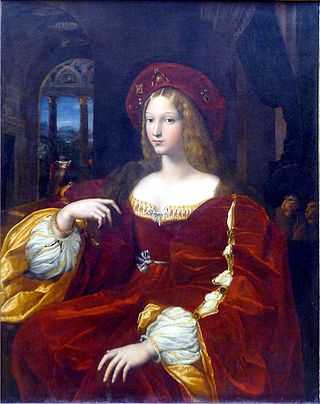
Portrait of Doña Isabel de Requesens y Enríquez de Cardona-Anglesola is an oil painting dated circa 1518 that was formerly believed to depict Giovanna d'Aragona. It has been variously ascribed to Raphael, Giulio Romano, or the school of Raphael; it is now usually taken to have been executed by Giulio Romano based on a sketch by Raphael and then altered by Raphael. The painting is now in the Louvre Museum in Lens.
Bertrand Jestaz, 2 February 1939 in Fontainebleau, is a French art historian, specialized in French and Italian Renaissance and in French classical art.

Auguste-Xavier Leprince was a French artist and painter who attained celebrity at the age of seventeen. His patrons included the Duchesse de Berry, Charles X, and Alexandre du Sommerard. He was also a teacher; in his twenties he established his own atelier in Paris, with pupils including his two younger brothers, Robert-Léopold and Pierre-Gustave, as well as Eugène Lepoittevin and Nicolas Alexandre Barbier. His meteoric career came to an abrupt end and his "brilliant promise was cut short by his premature death at the age of twenty-seven."

Marie Frédéric Eugène de Reiset was a French art collector, art historian and curator. He served as curator of the department of prints and drawings at the Louvre and as director-general of France's Musées Nationaux.
Diana the Huntress is an oil-on-canvas painting by an anonymous artist of the School of Fontainebleau. Painted in about 1550, it is a mythical representation of Diane de Poitiers, the mistress of King Henry II, in the guise of the goddess Diana. It is in the Louvre, which acquired it in 1840.

Le Bain de Diane is a French 1550s painting attributed to François Clouet, located in the Musée des Beaux-Arts, Rouen. According to Eckhardt Knab, writing in The Dictionary of Art, it is an example of an allegorical landscape and refers to the marriage of Francis II and Mary Stuart, who is depicted as Diana in the painting. It reveals the influence of Rosso Fiorentino, Francesco Primaticcio, and Nicolo dell'Abate, but tempers the overdrawn Mannerist bodily forms of these artists from the first School of Fontainebleau, while the landscape reflects the influence of Giorgione and the early Titian.
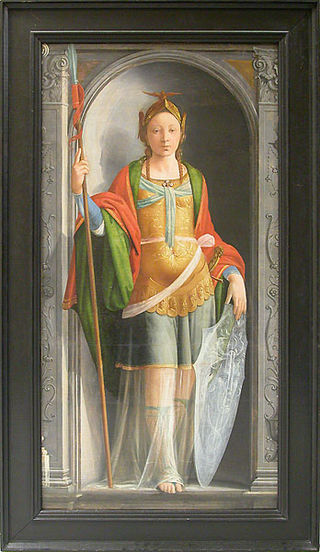
Minerva is an oil-on-panel painting created c. 1490–1495 by the Italian Renaissance painter Fra Bartolomeo, now in the Louvre in Paris. It forms a pair with Porcia (Uffizi).

Bacchus, Venus and Cupid is a 1531–1532 oil-on-canvas painting attributed to the Italian Mannerist painter Rosso Fiorentino, now in the National Museum of History and Art in Luxembourg.

The Pastoral Concert or Le Concert Champêtre is an oil painting of c. 1509 attributed to the Italian Renaissance master Titian. It was previously attributed to his fellow Venetian and contemporary Giorgione. It is located in the Musée du Louvre in Paris.

The Massacres of the Triumvirate is a 1566 oil on canvas painting by Antoine Caron, now in the Louvre Museum.
Philippe Millereau was a French Mannerist painter of the late 16th and early 17th centuries, active during the reign of Henri IV, and assimilated to the Second School of Fontainebleau, of which he remained a relatively minor figure; he was clearly influenced by Toussaint Dubreuil, but also by Italian artists such as Nicolò dell'Abbate, and Flemish painters. Art historians see him as a "petit maître" of this period.
 Media related to Master of Flora at Wikimedia Commons
| International | |
|---|---|
| National | |
| Artists | |
| People | |
