
Early Netherlandish painting, is the body of work by artists active in the Burgundian and Habsburg Netherlands during the 15th- and 16th-century Northern Renaissance period, once known as the Flemish Primitives. It flourished especially in the cities of Bruges, Ghent, Mechelen, Leuven, Tournai and Brussels, all in present-day Belgium. The period begins approximately with Robert Campin and Jan van Eyck in the 1420s and lasts at least until the death of Gerard David in 1523, although many scholars extend it to the start of the Dutch Revolt in 1566 or 1568–Max J. Friedländer's acclaimed surveys run through Pieter Bruegel the Elder. Early Netherlandish painting coincides with the Early and High Italian Renaissance, but the early period is seen as an independent artistic evolution, separate from the Renaissance humanism that characterised developments in Italy. Beginning in the 1490s, as increasing numbers of Netherlandish and other Northern painters traveled to Italy, Renaissance ideals and painting styles were incorporated into northern painting. As a result, Early Netherlandish painters are often categorised as belonging to both the Northern Renaissance and the Late or International Gothic.

Pinturicchio, or Pintoricchio, also known as Benetto di Biagio or Sordicchio, was an Italian painter during the Renaissance. He acquired his nickname because of his small stature and he used it to sign some of his artworks that were created during the fifteenth and sixteenth centuries.

The Dominican Church, also known as the Church of St. Maria Rotunda, is an early Baroque parish church and minor basilica in the historic center of Vienna, Austria. It is the third church built on the same site in the course of time.
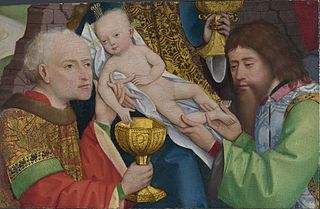
The Master of Liesborn was a Westphalian painter, of the fifteenth century, who remains anonymous.

The Master of the Playing Cards was the first major master in the history of printmaking. He was a German engraver, and probably also a painter, active in southwestern Germany – probably in Alsace, from the 1430s to the 1450s, who has been called "the first personality in the history of engraving."

Bartolomé Bermejo was a Spanish painter who adopted Flemish painting techniques and conventions. Born in Cordoba, he is known for his work in the Crown of Aragon, including the Principality of Catalonia and the Kingdom of Valencia. His real name was Bartolomé de Cárdenas: the name Bermejo, which means auburn in Spanish, possibly relates to his hair colour. Bermejo may relate also to his name, Cardenas; Cardeno means purplish.
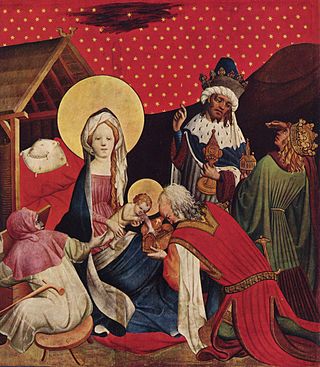
Master Francke O.P. was a North German Gothic painter and Dominican friar, born ca. 1380 in the Lower Rhine region or possibly Zutphen in the Netherlands, who died ca. 1440, probably in Hamburg, where he was based at the end of his known career. He is called "Fratre Francone Zutphanico" in one document. He may have trained as an illuminator and painter in France or the Netherlands, and later worked in Münster, before joining in St John's Priory in Hamburg by 1424 at the latest.
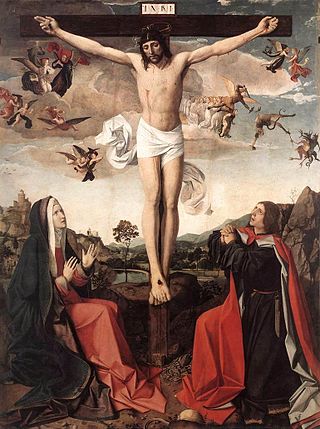
Josse Lieferinxe was a South Netherlandish painter, formerly known by the pseudonym the Master of St. Sebastian.

Conrad von Soest, also Konrad in modern texts, or in Middle High German Conrad van Sost or "von Soyst", was the most significant Westphalian artist and painted in the so-called soft style of International Gothic. He played a leading role in the introduction of this International Courtly Style to Northern Germany around 1390 and influenced German and Northern European painting into the late 15th century. He was the master of a thriving workshop and was accepted into the social circle of the cosmopolitan patrician elite of Dortmund. Dortmund was then a leading and very prosperous member of the influential Hanseatic League.

The Master of the Saint Bartholomew Altarpiece was an Early Netherlandish painter active in Germany, mostly Cologne, between 1475/1480 and 1510. Despite his anonymity, he is one of the most recognizable artists of the early Renaissance period in German art.

The Master of the Tucher Altarpiece was a German painter active in Nuremberg. His name is derived from a painting which has been in that city's Frauenkirche since the early 19th century; this has been known as the Tucher Altarpiece at least since 1615, in which year it was moved from its initial location, to another church in the same city. This move, and the accompanying restoration of the painting, was done under the auspices of the Tucher family, from whom it received its name.

The Coronation of the Virgin is a painting of the Coronation of the Virgin by the Italian Renaissance master Filippo Lippi, in the Uffizi, Florence.

In art history, a Notname is an invented name given to an artist whose identity has been lost. The practice arose from the need to give such artists and their typically untitled, or generically titled works, an acceptable if unsatisfactory grouping, avoiding confusion when cataloging. The phrases provisional name, name of convenience and emergency names are sometimes used to describe anonymous masters; nonce name was at one time used.

The notname Master of the Aachen Altar is given to an anonymous late gothic painter active in Cologne between 1495 and 1520 or 1480 and 1520, named for his master work, the Aachen Altar triptych owned by the Aachen Cathedral Treasury. Along with the Master of St Severin and the Master of the legend of St. Ursula he is part of a group of painters who were active in Cologne at the beginning of the sixteenth century and were Cologne's last significant practitioners of late gothic painting.

St Martin Dividing his Cloak is a painting by the Flemish painter Anthony van Dyck dated around 1618, which is an altarpiece in the Sint-Martinuskerk in Zaventem, Belgium. The painting portrays the story of Saint Martin sharing his cloak with a beggar. This early work of van Dyck was painted when he was strongly influenced by Rubens's style.
CasparIsenmann was a Gothic painter from Alsace. As the municipal painter of his hometown Colmar and the creator of a major altarpiece for the prestigious St Martin's Church, he was an important representative of the Upper Rhenish school of painting of the mid-15th century and a probable master of Martin Schongauer.

The Adoration of the Kings by the Early Netherlandish painter Gerard David is a painting in oil on panel, probably from after 1515, now in the National Gallery in London. The painted surface measures some 60 by 59.2 centimetres, and the panel is about 2 centimetres (0.79 in) larger in both dimensions. The panel comes from a dismantled altarpiece from which one other panel appears to survive, the Lamentation that is also in the National Gallery.

Scenes from the Life and Martyrdom of Saints Catherine and Clement are panels, painted on both sides, with depictions from the life of Saints Catherine and Clement on the inside and grisaille paintings on the outside. They are located in the Saint Peter's Church in Leuven, Belgium. They are the work of the Leuven painter Jan Rombouts the Elder and his workshop and likely created sometime between 1525 and 1535. The dimensions of the panels are about 167 cm high and 70 cm in width. It is not known whether the panels were originally attached to a central painted panel or to a sculpted retable.

The Master of the Legend of Saint Bruno is the "notname" of an anonymous Gothic painter who was active in Cologne in the late 15th century. He is best known for the cycle of paintings on canvas produced for Cologne Charterhouse after which he is named.
The Votive Painting from Šopka (1530) is the work of an anonymous disciple of Lucas Cranach the Elder, who worked in north-west Bohemia and is referred to by the initials with which he signed his paintings as Master IW. The painting was discovered at the end of the 19th century in the parish church, formerly the Augustinian Monastery Church of St. Laurence in Šopka and is exhibited in the Gallery and Museum of the Litoměřice Diocese.


