
Dubbing is a post-production process used in filmmaking and video production, often in concert with sound design, in which additional or supplementary recordings (doubles) are lip-synced and "mixed" with original production sound to create the finished soundtrack.

Sesame Street is an American educational children's television series that combines live-action, sketch comedy, animation and puppetry. It is produced by Sesame Workshop and was created by Joan Ganz Cooney and Lloyd Morrisett. It is known for its images communicated through the use of Jim Henson's Muppets, and includes short films, with humor and cultural references. It premiered on November 10, 1969, to positive reviews, some controversy, and high viewership. It has aired on the United States national public television provider PBS since its debut, with its first run moving to premium channel HBO on January 16, 2016, then its sister streaming service Max in 2020.

Sesame Workshop, Inc. (SW), originally known as the Children's Television Workshop, Inc. (CTW), is an American nonprofit organization that has been responsible for the production of several educational children's programs—including its first and best-known, Sesame Street—that have been televised internationally. Television producer Joan Ganz Cooney and foundation executive Lloyd Morrisett developed the idea to form an organization to produce Sesame Street, a television series which would help children, especially those from low-income families, prepare for school. They spent two years, from 1966 to 1968, researching, developing, and raising money for the new series. Cooney was named as the Workshop's first executive director, which was termed "one of the most important television developments of the decade."

Herman Raymond Walston was an American actor and comedian. Walston started his career on Broadway earning the Tony Award for Best Actor in a Musical for his performance as Mr. Applegate in Damn Yankees (1956).

In contemporary education, mathematics education—known in Europe as the didactics or pedagogy of mathematics—is the practice of teaching, learning, and carrying out scholarly research into the transfer of mathematical knowledge.
A television pilot in United Kingdom and United States television, is a standalone episode of a television series that is used to sell a show to a television network or other distributor. A pilot is created to be a testing ground to gauge whether a series will be successful. It is, therefore, a test episode for the intended television series, an early step in the series development, much like pilot studies serve as precursors to the start of larger activity.
Public-access television is traditionally a form of non-commercial mass media where the general public can create content television programming which is narrowcast through cable television specialty channels. Public-access television was created in the United States between 1969 and 1971 by the Federal Communications Commission (FCC), under Chairman Dean Burch, based on pioneering work and advocacy of George Stoney, Red Burns, and Sidney Dean.
Cyberchase is an animated science fantasy children's television series that airs on PBS Kids. The series centers around three children from Earth: Jackie, Matt and Inez, who are brought into Cyberspace, a digital universe, in order to protect it from the villainous Hacker. They are able to foil Hacker's schemes by means of problem-solving skills in conjunction with basic math, environmental science and wellness. In Cyberspace, they meet Digit, a "cybird" who helps them on their missions.

Blue's Clues is an American live-action/animated interactive educational children's television series, created by Angela C. Santomero, Todd Kessler, and Traci Paige Johnson, that premiered on Nickelodeon's Nick Jr. block on September 8, 1996, and concluded its run on August 6, 2006, with a total of six seasons and 143 episodes. The original host of the show was Steve Burns, who left in 2002 and was replaced by Donovan Patton for the rest of the series. The show follows an animated blue-spotted dog named Blue as she leaves a trail of clues/paw prints for the host and the viewers to figure out her plans for the day.
Achievement gaps in the United States are observed, persistent disparities in measures of educational performance among subgroups of U.S. students, especially groups defined by socioeconomic status (SES), race/ethnicity and gender. The achievement gap can be observed through a variety of measures, including standardized test scores, grade point average, dropout rates, college enrollment, and college completion rates. The gap in achievement between lower income students and higher income students exists in all nations and it has been studied extensively in the U.S. and other countries, including the U.K. Various other gaps between groups exist around the globe as well.

A girl is a young female human, usually a child or an adolescent. When a girl becomes an adult, she is generally referred to as a woman. However, the term girl is also used for other meanings, including young woman, and is sometimes used as a synonym for daughter or girlfriend regardless of age. In certain contexts, the usage of the term girl for an adult woman may be considered derogatory. Girl may also be a term of endearment used by an adult, usually a woman, to designate adult female friends. Girl also appears in compounds like showgirl, cowgirl, and schoolgirl.

Television in Israel refers to television broadcasting services in the State of Israel, inaugurated on March 24, 1966. Initially, there was one state-owned channel, operated jointly by the Israel Broadcasting Authority and the Israeli Educational Television. In 1986, a second state-regulated channel was launched. This channel became a state-regulated commercial channel in 1993. An additional commercial channel was introduced in 2002, followed by the introduction of three commercial niche channels: an Israeli Russian-speaking channel, a channel of Israeli popular music and an Arabic-speaking channel. Colour transmissions were introduced gradually around 1977 and 1979. Multichannel cable television service became available to subscribers gradually since 1989, although illegal cable TV stations were present in the big cities during the 1980s. Satellite-based multichannel service has been available since 2000.
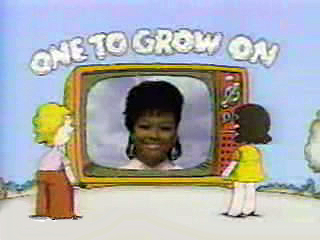
One to Grow On is an educational public service announcement that broadcast during NBC's Saturday morning line-up from 1983 to 1989, when the network ran cartoons. The name is taken from the custom of putting an extra candle on a birthday cake as "one to grow on". One to Grow On focused on ethical and personal safety dilemmas and attempted to teach viewers how to solve them. The public service announcement appeared immediately after the end credits of NBC cartoons, such as ABC did with Schoolhouse Rock! and CBS with In the News.
Mathematical anxiety, also known as math phobia, is a feeling of tension and anxiety that interferes with the manipulation of numbers and the solving of mathematical problems in daily life and academic situations.

Television is a popular form of entertainment in Mexico, with mass entertainment playing an important role in creating a national, unified culture. The telenovelas are very traditional in Mexico and are translated to many languages and seen all over the world with renowned names like Lucero, Thalía, Verónica Castro, Itati, Leticia Calderón and Victoria Ruffo.

Dangerous Mind is a 2006 Taiwanese television series starring River Huang, Guang Yun, Lee Lieh, Jack Kao, Cai Can-De and James Wen. It is adapted from the novel of the same name by Taiwanese writer Hou Wen Yung. The series focuses on the conflicts among teachers, students, and the parents during the Taiwanese educational reform from the students' aspects.

Sex differences in education are a type of sex discrimination in the education system affecting both men and women during and after their educational experiences. Men are more likely to be literate on a global average, although higher literacy scores for women are prevalent in many countries. Women are more likely to achieve a tertiary education degree compared to men of the same age. Men tended to receive more education than women in the past, but the gender gap in education has reversed in recent decades in most Western countries and many non-Western countries.

A telenovela is a type of a television serial drama or soap opera produced primarily in Latin America. The word combines tele and novela. Similar drama genres around the world include diziler (Turkey), serial (India), teleserye (Philippines), lakorn (Thailand), téléroman, K-drama, J-drama (Japan), C-drama (China) and sinetron (Indonesia).

SciGirls is an American live-action/animated children's television series that premiered on February 11, 2010 on PBS Kids Go!. It has a mix of live-action and animated segments. It is produced by Twin Cities PBS and builds on the "real kids doing real science" approach of DragonflyTV.

Francisco el Matemático, also known as Francisco el Matemático: Clase 2004 for the sixth season, is a Colombian teen drama television series produced and broadcast by RCN Televisión between May 1999 to October 2004. The series revolves around Francisco, a young math teacher who must deal with the personal problems of his high school students. The series is considered one of the most watched productions of Colombian television, together with Padres e hijos. After its resounding success, in 2004, Pedro Damián of Televisa produces a Mexican version of the series with the title of Clase 406.


