Related Research Articles

BNSF Railway is the largest freight railroad in the United States. One of six North American Class I railroads, BNSF has 36,000 employees, 33,400 miles (53,800 km) of track in 28 states, and over 8,000 locomotives. It has three transcontinental routes that provide rail connections between the western and eastern United States. BNSF trains traveled over 169 million miles in 2010, more than any other North American railroad.

The Southwest Chief is a long-distance passenger train operated by Amtrak on a 2,265-mile (3,645 km) route between Chicago and Los Angeles through the Midwest and Southwest via Kansas City, Albuquerque, and Flagstaff mostly on the BNSF's Southern Transcon, but branches off between Albuquerque and Kansas City via the Topeka, La Junta, Raton, and Glorieta Subdivision. Amtrak bills the route as one of its most scenic, with views of the Painted Desert and the Red Cliffs of Sedona, as well as the plains of Illinois, Missouri, Kansas, and Colorado.

Los Angeles Union Station is the main train station in Los Angeles, California, and the largest passenger rail terminal in the Western United States. It opened in May 1939 as the Los Angeles Union Passenger Terminal, replacing La Grande Station and Central Station.

The Atchison, Topeka and Santa Fe Railway, often referred to as the Santa Fe or AT&SF, was one of the largest Class 1 railroads in the United States between 1859 and 1996.

Dearborn Station was, beginning in the late 1800s, one of six intercity train stations serving downtown Chicago, Illinois. It remained in operation until May 1, 1971. Built in 1883, it is located at Dearborn and Polk Streets, to the south of the Loop, adjacent to Printers Row. The station was owned by the Chicago & Western Indiana Railroad, which itself was owned by the companies operating over its line. The station building headhouse now houses office, retail, and entertainment spaces, and its trackage yard, behind the headhouse, was redeveloped into part of the Dearborn Park neighborhood.

The Surf Line is a railroad line that runs from San Diego to Orange County along California's Pacific coast. It was so named because much of the line is near the Pacific Ocean, within less than 100 feet (30 m) in some places. It is the second busiest passenger rail corridor in the United States after the Northeast Corridor.

The Chicago and Western Indiana Railroad was the owner of Dearborn Station in Chicago and the trackage leading to it. It was owned equally by five of the railroads using it to reach the terminal, and kept those companies from needing their own lines into the city. With the closure of Dearborn Station in 1971 and the Calumet steel mills in 1985, the railroad was gradually downgraded until 1994 when it became a subsidiary of the Union Pacific Corporation.

The Sydney tramway network served the inner suburbs of Sydney, Australia, from 1879 until 1961. In its heyday, it was the largest in Australia, the second largest in the Commonwealth of Nations, and one of the largest in the world. The network was heavily worked, with about 1,600 cars in service at any one time at its peak during the 1930s . Patronage peaked in 1945 at 405 million passenger journeys. Its maximum street trackage totalled 291 km in 1923.

The California Southern Railroad was a subsidiary railroad of the Atchison, Topeka and Santa Fe Railway in Southern California. It was organized July 10, 1880, and chartered on October 23, 1880, to build a rail connection between what has become the city of Barstow and San Diego, California.

The San Bernardino Santa Fe Depot is a Mission Revival Style passenger rail terminal in San Bernardino, California, United States. It has been the primary station for the city, serving Amtrak today, and the Santa Fe and Union Pacific Railroads in the past. Until the mid-20th century, the Southern Pacific Railroad had a station 3/4 of a mile away. It currently serves one Amtrak and two Metrolink lines. The depot is a historical landmark listed on the National Register of Historic Places as Atchison, Topeka and Santa Fe Railway Passenger and Freight Depot.

The General Manuel Belgrano Railway (FCGMB), named after the Argentine politician and military leader Manuel Belgrano, is a 1,000 mmmetre gauge railway and the longest of the Argentine system. It was one of the six State-owned Argentine railway companies formed after President Juan Perón's nationalisation of the railway network in 1948.

Crossing the Kansas River in Kansas City, Kansas, United States, the Highline Bridge is rare example of a double-tracked, double-deck railroad bridge designed for carrying railroad traffic on both levels. The bridge is owned and operated by the Kansas City Terminal Railway (KCTR) and provides access between the extensive rail yards on both sides of the river in the Argentine and Armourdale neighborhoods in Kansas City, Kansas, and other rail yards in Kansas City, Missouri.

The Southern Transcon is a main line of the BNSF Railway comprising 11 subdivisions between Southern California and Chicago, Illinois. Completed in its current alignment in 1908 by the Atchison, Topeka and Santa Fe Railway, when it opened the Belen Cutoff in New Mexico and bypassed the steep grades of Raton Pass, it now serves as a mostly double-tracked intermodal corridor.

Galesburg Santa Fe Station was a railway station in the west central Illinois town of Galesburg. The station was along the Atchison, Topeka and Santa Fe Railway's main line and served trains such as the Super Chief and El Captain. After Amtrak took over intercity rail in the United States, it was served by trains such as the Lone Star (1971–1979) and the Southwest Chief (1971–1996).

Ash Fork Station is a former railway station of the Atchison, Topeka and Santa Fe Railway, located in Ash Fork, Yavapai County, Arizona. The large and "grand" Harvey House Escalante Hotel and restaurant were part of the station complex.
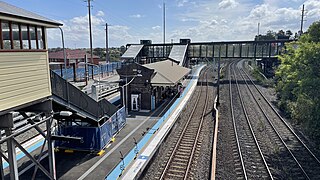
The Bankstown railway line is a suburban railway which traverses the Inner West and Canterbury-Bankstown areas of Sydney. West of Bankstown it is used by T6 Lidcombe & Bankstown services, while east of Bankstown it is temporarily closed to facilitate conversion for its future use by M1 North West & Bankstown services.

The California Zephyr is a long-distance passenger train operated by Amtrak between Chicago and the San Francisco Bay Area, via Omaha, Denver, Salt Lake City, and Reno. At 2,438 miles (3,924 km), it is Amtrak's longest daily route, and second-longest overall after the Texas Eagle's triweekly continuation from San Antonio to Los Angeles, with travel time between the termini taking approximately 511⁄2 hours. Amtrak claims the route as one of its most scenic, with views of the upper Colorado River valley in the Rocky Mountains, and the Sierra Nevada. The modern train is the second iteration of a train named California Zephyr; the original train was privately operated and ran on a different route through Nevada and California.

The Illinois Northern Railroad was an industrial switching railroad serving Chicago's southwest side. From their yard at 26th St. and Western Ave. the line went southwest to the Santa Fe Railway's Corwith Yard, connecting with most major area railroads and serving on-line customers on the way. They also leased and switched track east of their yard. Incorporated in 1901, it was merged into the Santa Fe Railway in 1975.

The Chicago and Illinois Western Railroad was an industrial switching railroad serving the west side of Chicago and southwest Cook County. From a connection with a now defunct north–south railroad line near 31st Blvd. and Western Ave. it went west along 33rd St. to Cicero. Just before Cicero Ave. it turned south and roughly paralleled Cicero Ave. to the Chicago Sanitary and Ship Canal. At the canal it turned west and paralleled the canal and then the Des Plaines River to Hodgkins. Incorporated in 1903, it was merged into the Illinois Central Gulf Railroad in 1984. In 2020 a short segment is used by the Canadian National Railway and the Cicero Central Railroad.
References
- ↑ "Former McCook station" (Map). Google Maps . Retrieved 13 July 2019.
- ↑ "Santa Fe Railway 1946: Chicago to Kansas City". Along Your Way. Retrieved 13 July 2019.
- ↑ "Other West / Southwest Suburban Junctions". Chicago Area Rail Junctions. Retrieved 13 July 2019.


