Related Research Articles
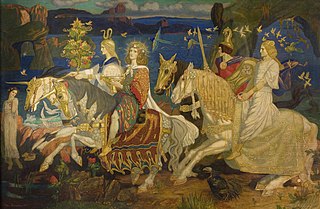
Irish mythology is the body of myths native to the island of Ireland. It was originally passed down orally in the prehistoric era, being part of ancient Celtic religion. Many myths were later written down in the early medieval era by Christian scribes, who modified and Christianized them to some extent. This body of myths is the largest and best preserved of all the branches of Celtic mythology. The tales and themes continued to be developed over time, and the oral tradition continued in Irish folklore alongside the written tradition, but the main themes and characters remained largely consistent.

The Khanty, also known in older literature as Ostyaks are a Ugric Indigenous people, living in Khanty–Mansi Autonomous Okrug, a region historically known as "Yugra" in Russia, together with the Mansi. In the autonomous okrug, the Khanty and Mansi languages are given co-official status with Russian. In the 2021 Census, 31,467 persons identified themselves as Khanty. Of those, 30,242 were resident in Tyumen Oblast, of whom 19,568 were living in Khanty-Mansi Autonomous Okrug and 9,985—in Yamalo-Nenets Autonomous Okrug. 495 were residents of neighbouring Tomsk Oblast, and 109 lived in Sverdlovsk Oblast.
Finnish mythology is a commonly applied description of the folklore of Finnish paganism, of which a modern revival is practiced by a small percentage of the Finnish people. It has many features shared with Estonian and other Finnic mythologies, but also shares some similarities with neighbouring Baltic, Slavic and, to a lesser extent, Norse mythologies.
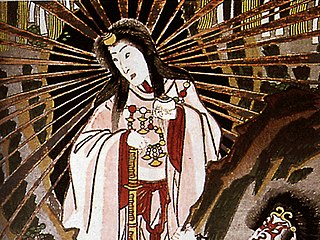
Japanese mythology is a collection of traditional stories, folktales, and beliefs that emerged in the islands of the Japanese archipelago. Shinto, traditions are the cornerstones of Japanese mythology. The history of thousands of years of contact with Chinese and Indian myths are also key influences in Japanese religious belief.

Nizhnevartovsk is a city in Khanty-Mansi Autonomous Okrug–Yugra, Russia. Since the 1960s, the Western Siberian oil boom led to Nizhnevartovsk's rapid growth from a small settlement to a city due to its location beside the Samotlor oil field along the right bank of the Ob River, 30 kilometers (19 mi) from the border with Tomsk Oblast, and the presence of the petroleum industry has made it one of the wealthiest cities in Russia.
Yukar are Ainu sagas that form a long rich tradition of oral literature. In older periods, the epics were performed by both men and women; during the 19th and early 20th centuries, when Ainu culture was in decline, women were generally the most skillful performers. Traditional tales describe floating worlds with Ainu mosir, or the land of the humans, resting on the back of a fish whose movements cause earthquakes.
Finnish paganism is the indigenous pagan religion in Finland and Karelia prior to Christianisation. It was a polytheistic religion, worshipping a number of different deities. The principal god was the god of thunder and the sky, Ukko; other important gods included Jumo (Jumala), Ahti, and Tapio. Jumala was a sky god; today, the word "Jumala" refers to all gods in general. Ahti was a god of the sea, waters and fish. Tapio was the god of forests and hunting.
Georgian mythology refers to the mythology of pre-Christian Georgians, an indigenous Caucasian ethnic group native to Georgia and the South Caucasus.The mythology of the Kartvelian peoples is believed by many scholars to have formed part of the religions of the kingdoms of Diauehi, Colchis and Iberia.

Philippine mythology encompasses a rich tapestry of narratives and epics rooted in the indigenous Philippine folk religions. These diverse ethnic faiths, distinct from one another, collectively contribute to the body of stories that make up this mythological tradition. Drawing inspiration from various sources, Philippine mythology exhibits both commonalities and influences from Indonesian, Hindu, Muslim, Shinto, Buddhist, and Christian traditions,

Burkhanism or Ak Jang is an indigenist new religious movement that flourished among the Altai people of Russia's Altai Republic between 1904 and the 1930s. The Russian Empire was suspicious of the movement's potential to stir up native unrest and perhaps involve outside powers. The Soviet Union ultimately suppressed it for fear of its potential to unify Siberian Turkic peoples under a common nationalism.

Yugra or Iuhra was a collective name for lands and peoples in the region to the east of the northern Ural Mountains, in the Russian annals of the 12th–17th centuries. During this period the region was inhabited by the Khanty and Mansi peoples. Yugra was also the source for the name of the Ugric language family.

Būta Kōlā, also referred to as Daiva Kōlā or Daiva Nēmā, is a shamanistic dance performance prevalent among the Hindus of Tulu Nadu and parts of Malenadu of Karnataka and Kasargod in northern Kerala, India. The dance is highly stylized and performed as part of 'Bhootaradhane' or worship of the local deities worshipped by the Tulu speaking population. It has influenced Yakshagana folk theatre. Būta kōlā is closely related to Theyyam of North Malabar region.

The West Siberian Laika or WSL, is a breed of spitz–type hunting dog. Russian publications indicate that the term West Siberian Laika loosely applied to hunting dogs originating with the Mansi and Khanty people in Ural and West Siberia, but there were no standards or registrations of WSL as such until 1930. Then WWII disrupted it for a while, but systematic breeding with registrations resumed after the war ended, in 1946. This was the time the breed began taking modern shape. Before that hunters only knew of Mansi Laika and Khanty Laika. In early 1960 many hunters in Ural still preferred the term Mansi Laika, when speaking of West Siberian Laika. In Russian language, the term Laika originated from the word layat that means to bark. The word Laika simply means barker. Any hunting Laika is a bark pointer. It is a versatile dog depending on use and environment, but in certain parts of the country they have become more specialized.

Benjamin Radford is an American writer, investigator, and skeptic. He has authored, coauthored or contributed to over twenty books and written over a thousand articles and columns on a wide variety of topics including urban legends, unexplained mysteries, the paranormal, critical thinking, mass hysteria, and media literacy. His book, Mysterious New Mexico: Miracles, Magic, and Monsters in the Land of Enchantment, was published in the summer of 2014 and is a scientific investigation of famous legends and folklore in the state of New Mexico. In 2016 Radford published Bad Clowns, a 2017 IPPY bronze award winner, and he is regarded as an expert on the bad clowns phenomenon.
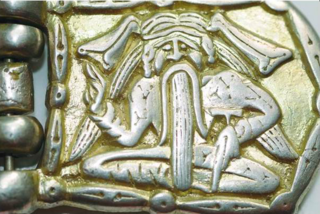
Hungarian mythology includes the myths, legends, folk tales, fairy tales and gods of the Hungarians, also known as the Magyarok.

Tibetan mythology refers to the traditional as well as the religious stories that have been passed down by the Tibetan people. Tibetan mythology consists mainly of national mythology stemming from the Tibetan culture as well as religious mythology from both Tibetan Buddhism and Bön Religion. These myths are often passed down orally, through rituals or through traditional art like sculptures or cave paintings. They also feature a variety of different creatures ranging from gods to spirits to monsters play a significant role in Tibetan mythology with some of these myths have broken into mainstream Western media, with the most notable one being the Abominable Snowman – the Yeti.

Greek mythology is the body of myths originally told by the ancient Greeks, and a genre of ancient Greek folklore, today absorbed alongside Roman mythology into the broader designation of classical mythology. These stories concern the ancient Greek religion's view of the origin and nature of the world; the lives and activities of deities, heroes, and mythological creatures; and the origins and significance of the ancient Greeks' cult and ritual practices. Modern scholars study the myths to shed light on the religious and political institutions of ancient Greece, and to better understand the nature of myth-making itself.

Bantu mythology is the system of beliefs and legends of the Bantu people of Africa. Although Bantu peoples account for several hundred different ethnic groups, there is a high degree of homogeneity in Bantu cultures and customs, just as in Bantu languages. Many Bantu cultures traditionally believed in a supreme god whose name is a variation of Nyambe/Nzambe.

Permian bronze casts – Permic and Western Siberian animal style cult cast figurines – were the predominant form of Finnic toreutics of the 3rd–12th centuries CE. It was spread throughout a large area of forests of the north-eastern Urals and western Siberia from the basins of the Kama and Vyatka to the Ob. In the Middle Ages, these territories were inhabited mostly by the Ugrian tribes, ancestors of the present day Hungarians and Ob-Ugrians – the Khanty and the Mansi people. Their style is referred to as the "Permian animal style".
Lower mythology is a sphere of mythological representations relating to characters who have no divine status, demons and spirits, as opposed to higher gods and the official cult. This opposition is particularly pronounced in world religions.
References
- 1 2 Arthur Hatto (2 February 2017). The World of the Khanty Epic Hero-Princes: An Exploration of a Siberian Oral Tradition. Cambridge University Press. pp. 243–. ISBN 978-1-107-10321-4.
- 1 2 Marjorie Mandelstam Balzer (21 November 1999). The Tenacity of Ethnicity: A Siberian Saga in Global Perspective. Princeton University Press. ISBN 0-691-00673-3.
- ↑ "THE MANSIS". www.eki.ee. The Red Book of the Peoples of the Russian Empire.
- ↑ Benjamin Radford (2014). "Discovery's Mountain of Mystery Mongering: The Mass Murdering Yeti - CSI". www.csicop.org.
