E-government is the use of technological communications devices, such as computers and the Internet, to provide public services to citizens and other persons in a country or region. E-government offers new opportunities for more direct and convenient citizen access to government and for government provision of services directly to citizens.
E-services are services which make use of information and communication technologies (ICTs). The three main components of e-services are:
- service provider;
- service receiver; and
- the channels of service delivery.
Mobile government, ormGovernment refers to collection of services as the strategic use of government services and applications which are only possible using cellular/mobile telephones, laptop computers, personal digital assistants (PDAs) and wireless internet infrastructure.

The Centre for Development of Advanced Computing (C-DAC) is an Indian autonomous scientific society, operating under the Ministry of Electronics and Information Technology.

UC Browser is a web browser developed by mobile internet company UCWeb, a subsidiary of the Alibaba Group. It was the most popular mobile browser in India and Indonesia, and the second most popular one in China as of 2017. Its world-wide browser share as of May 2022 is 0.86% overall according to StatCounter.
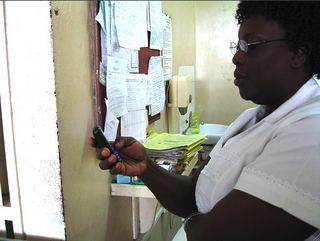
mHealth is an abbreviation for mobile health, a term used for the practice of medicine and public health supported by mobile devices. The term is most commonly used in reference to using mobile communication devices, such as mobile phones, tablet computers and personal digital assistants (PDAs), and wearable devices such as smart watches, for health services, information, and data collection. The mHealth field has emerged as a sub-segment of eHealth, the use of information and communication technology (ICT), such as computers, mobile phones, communications satellite, patient monitors, etc., for health services and information. mHealth applications include the use of mobile devices in collecting community and clinical health data, delivery/sharing of healthcare information for practitioners, researchers and patients, real-time monitoring of patient vital signs, the direct provision of care as well as training and collaboration of health workers.

The National e-Governance Plan (NeGP) is an initiative of the Government of India to make all government services available to the citizens of India via electronic media. NeGP was formulated by the Department of Electronics and Information Technology (DeitY) and Department of Administrative Reforms and Public Grievances (DARPG). The Government approved the National e-Governance Plan, consisting of 27 "Mission Mode Projects" (MMPs) and 8 components, on 18 May 2006. This is an enabler of Digital India initiative, and UMANG in turn is an enabler of NeGP.

India.gov.in is the Indian government’s web portal for citizens. It presents information resources and online services from government sources, accessible from a single point. It is also known as the National Portal of India.
The Institute for Development & Research in Banking Technology (IDRBT) is an engineering training institution exclusively focused on banking technology. Established by the Reserve Bank of India (RBI) in 1996, the institution works at the intersection of banking and technology. It is located in Hyderabad, India.

Common Service Centres (CSC) are physical facilities for delivering Government of India e-Services to rural and remote locations where availability of computers and Internet was negligible or mostly absent. They are multiple-services-single-point model for providing facilities for multiple transactions at a single geographical location.
Microsoft mobile services are a set of proprietary mobile services created specifically for mobile devices, they are typically offered through mobile applications and mobile browser for Windows Phone, | platforms, BREW, and Java. Microsoft's mobile services are typically connected with a Microsoft account and often come preinstalled on Microsoft's own mobile operating systems while they are offered via various means for other platforms. Microsoft started to develop for mobile computing platforms with the launch of Windows CE in 1996 and later added Microsoft's Pocket Office suite to their Handheld PC line of PDAs in April 2000. From December 2014 to June 2015, Microsoft made a number of corporate acquisitions, buying several of the top applications listed in Google Play and the App Store including Acompli, Sunrise Calendar, Datazen, Wunderlist, Echo Notification Lockscreen, and MileIQ.
Nimbuzz was a proprietary cross-platform instant messaging and voice-over-IP provider and aggregator for smartphones, tablets and personal computers developed by Kuraakani Online Private Limited, with the origins of its technology dating back to the early 2000s. As of March 2013, Nimbuzz had 150 million users in 200 countries. By April 2014, Nimbuzz was growing by more than 210,000 new registrations per day. In October 2014, now with over 200 million users, New Call acquired 70% of Nimbuzz, valuing the app at $250 million. Under CEO Vikas Saxena's leadership from March 2015, the Nimbuzz suite of applications enabled users to enjoy free calls, instant messaging, social-network games, file sharing, and social networking on their mobile device. In addition, Nimbuzz offered discounted calling rates to most countries in the world. The platform processed more than a billion call minutes and in excess of 100 billion messages a month.

MyGov is a citizen engagement platform launched by the Government of India on 26 July 2014 to promote the active participation of Indian citizens in their country's governance and development. It is aimed at creating a common platform for Indian citizens to "crowdsource governance ideas from citizens". Its users discuss and contribute to various government projects and plans. It also allows users to upload documents in various formats. The website is hosted and managed by the National Informatics Centre (NIC). Prime Minister Narendra Modi stated that the aim was to reduce the long gap developed between the electorate and the Executive after being elected.

Digital India is a campaign launched by the Government of India to ensure that the Government's services are made available to citizens electronically through improved online infrastructure and by increasing Internet connectivity or making the country digitally empowered in the field of technology. The initiative includes plans to connect rural areas with high-speed internet networks. It consists of three core components: the development of secure and stable digital infrastructure, delivering government services digitally, and universal digital literacy.
DigiLocker is an Indian digitization online service provided by Ministry of Electronics and Information Technology (MeitY), Government of India under its Digital India initiative. DigiLocker provides an account in cloud to every Aadhaar holder to access authentic documents/certificates such as driving license, vehicle registration, academic mark sheet in digital format from the original issuers of these certificates. It also provides 1GB storage space to each account to upload scanned copies of legacy documents.

Thiruvananthapuram City Police Mobile App, also known as TCP app, or UR Safe(TM) (previously known as iSafe), is the official mobile application for the citizens and public by the Thiruvananthapuram City Police in Kerala, India. The mobile application is developed by UST, a digital technology services company. The ‘UR Safe’ feature of the app helps people, especially women, to send instant alerts to the police control room by using the Panic Button or by a long press of volume rocker (down) key of their mobile phones and police to arrive at the location.
Unified Mobile Application for New-age Governance (UMANG) is a mobile app, a Digital India initiative of Ministry of Electronics and Information Technology, by the Government of India for access to central and state government services. The app supports 13 Indian languages and is available for Android, iOS and Windows.

T App Folio is an integrated app for government to citizen provided by Government of Telangana in India. The service, as a part of Mee Seva 2.0, an integrated app that provides services like Mee Seva services, RTA services, fee payments and bill payment services etc. It is available in Telugu and English.
Microsoft Kaizala is a secure messaging and work management software application for collaboration among users inside and outside of organizations, including the ability to send and receive instant messages, coordinate tasks, and submit invoices. It was launched in India in 2017, thereafter expanded to 28 countries, and was launched globally in April 2019 as part of the Office 365 package. It is available internationally, except in a few countries as a free Android, iOS, and web application. Kai zala is a Marathi phrase that means "What happened?"

Aarogya Setu is an Indian COVID-19 "contact tracing, syndromic mapping and self-assessment" digital service, primarily a mobile app, developed by the National Informatics Centre under the Ministry of Electronics and Information Technology (MeitY). The app reached more than 100 million installs in 40 days. On 26 May, amid growing privacy and security concerns, the source code of the app was made public.
