Apocerea is a genus of moths in the subfamily Arctiinae described by Harrison Gray Dyar Jr. in 1905. It contains the species Apocerea sobria, described by William Schaus in 1905, which is found in French Guiana.

Ericeia is a genus of moths in the family Erebidae. The genus was erected by Francis Walker in 1858.

Mocis is a genus of moths in the family Erebidae. The genus was erected by Jacob Hübner in 1823.

Dysstroma is a genus of moths in the family Geometridae erected by Jacob Hübner in 1825.

Mocis alterna, the bean looper, is a species of moth of the family Erebidae first described by Francis Walker in 1858. It is found in the Australian state of Queensland.

Mocis disseverans, the yellow mocis moth, is a moth of the family Erebidae. It is found in the Caribbean and parts of the southern United States, including Mississippi, Florida and Texas.
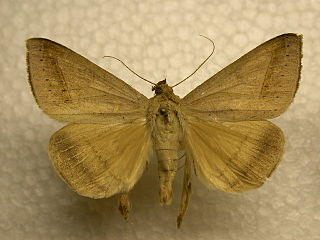
Mocis marcida, the withered mocis, is a species of moth of the family Erebidae. It is found from the coast of North Carolina to Florida, west to Texas, rarely straying northward as far as New York.

Mocis repanda, the striped grass looper, is a species of moth of the family Erebidae. It was described by Johan Christian Fabricius in 1794. It is found in Central America and the Caribbean, including Cuba, the Dominican Republic, Guadeloupe, Guatemala, Jamaica, Puerto Rico and Saint Thomas. Strays can be found in the United States, up to southern Texas as well as subtropical Africa south of the Sahara, including the islands of the Indian Ocean.
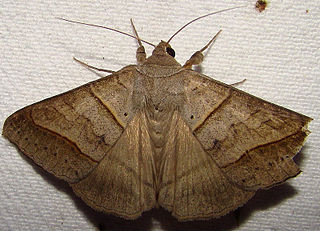
Mocis texana, the Texas mocis, is a species of moth of the family Erebidae. It is found in eastern North America, from southern Ontario, south to Florida, west to Texas to Minnesota.
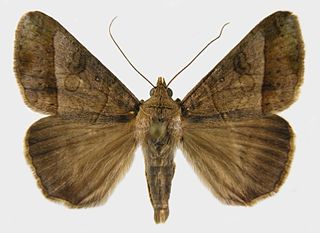
Mocis latipes, the small mocis moth or striped grass looper, is a species of moth of the family Erebidae. It is found from North America (from southern Ontario and Quebec to Florida, west to Arizona, north to Minnesota and south through Central to South America.
Mocis mayeri is a moth of the family Erebidae first described by Jean Baptiste Boisduval in 1833. It has a wide range in Africa, which includes Cameroon, Cape Verde, the Comoros, the Democratic Republic of the Congo, Eritrea, Ghana, Kenya, Réunion, Madagascar, Malawi, Mauritius, Mozambique, Nigeria, Senegal, the Seychelles, Sierra Leone, South Africa, Sudan, Tanzania, the Gambia, Uganda, Zambia and Zimbabwe. It is also found in Saudi Arabia and Yemen.
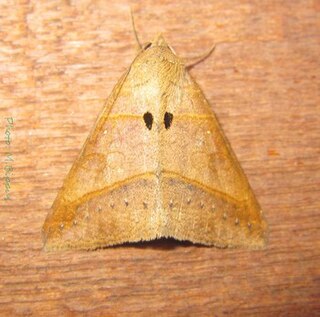
Mocis conveniens, the pale brown lines, is a moth of the family Erebidae.
Halone sobria is a moth of the subfamily Arctiinae. It was described by Francis Walker in 1854. It is found in Australia.
Mocis dolosa is a species of moth of the family Erebidae. It is found in China, Japan (Honshu) and Taiwan.
Mocis guenei is a species of moth of the family Erebidae. It is found in Surinam.
Mocis xylomiges is a species of moth of the family Erebidae. It is found in Indonesia.
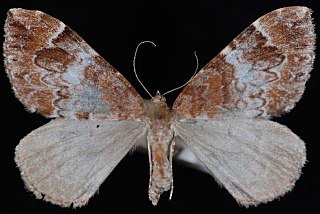
Dysstroma sobria, the 10-spotted rhododendron moth, is a species of geometrid moth in the family Geometridae. It is found in North America.

