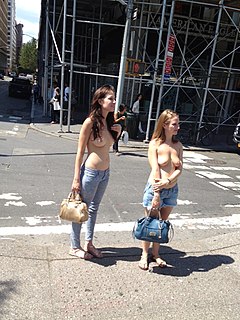
The nipple is a raised region of tissue on the surface of the breast from which, in females, milk leaves the breast through the lactiferous ducts to breastfeed an infant. The milk can flow through the nipple passively or it can be ejected by smooth muscle contractions that occur along with the ductal system. Male mammals also have nipples but without the same level of function, and often surrounded by body hair.

Indecent exposure is the deliberate public exposure by a person of a portion of their body in a manner contrary to local standards of appropriate behavior. Laws and social attitudes regarding indecent exposure vary significantly in different countries. It ranges from outright prohibition of the exposure of any body parts other than the hands or face to prohibition of exposure of certain body parts, such as the genital area, buttocks or breasts.
Page 3, or Page Three, is a British newspaper convention of publishing a large image of a topless female glamour model on the third page of mainstream red top tabloids. The Sun introduced the feature in November 1970, which boosted its readership and prompted competing tabloids—including The Daily Mirror, TheSunday People, and TheDaily Star—to begin featuring topless models on their own third pages. Well-known Page 3 models included Linda Lusardi, Samantha Fox, Debee Ashby, Maria Whittaker, Katie Price, Keeley Hazell, and Jakki Degg.

A stripper or exotic dancer is a person whose occupation involves performing striptease in a public adult entertainment venue such as a strip club. At times, a stripper may be hired to perform at private events.
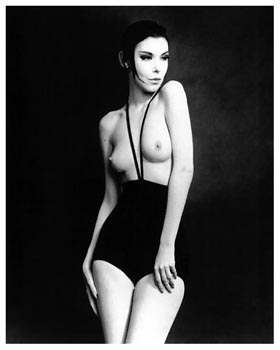
The monokini was designed by Rudi Gernreich in 1964, consisting of only a brief, close-fitting bottom and two thin straps; it was the first women's topless swimsuit. His revolutionary and controversial design included a bottom that "extended from the midriff to the upper thigh" and was "held up by shoestring laces that make a halter around the neck." Some credit Gernreich's design with initiating, or describe it as a symbol of, the sexual revolution.

Toplessness refers to the state in which a woman's breasts, including her areolas and nipples, are exposed, especially in a public place or in a visual medium. The male equivalent is known as barechestedness.
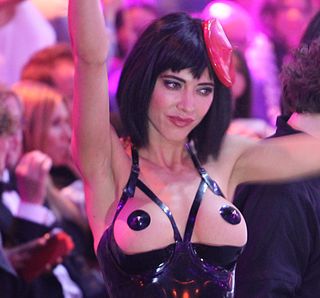
Pasties are patches that cover a person's nipples and areolae, typically self-adhesive or affixed with adhesive. They are usually worn in pairs. They originated as part of burlesque shows, allowing dancers to perform fully topless without exposing the nipples in order to provide a commercial form of bare-breasted entertainment. Pasties are also, at times, used while sunbathing, worn by strippers and showgirls, or as a form of protest during women's rights events such as Go Topless Day. In some cases this is to avoid potential prosecution under indecency laws.

Sherry Glaser is an American actress, noted for her performance in the off-Broadway solo show Family Secrets about a Jewish family in California.
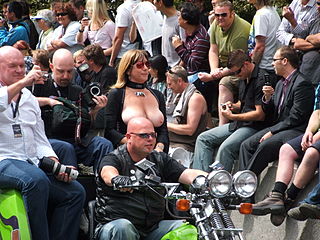
Boobs on Bikes is a mostly annual parade of topless men and women riding on motorcycles through large New Zealand cities.
The legal status of striptease varies considerably among different countries and the various jurisdictions of the United States. Striptease is considered a form of public nudity and subject to changing legal and cultural attitudes on moral and decency grounds. Some countries do not have any restrictions on performances of striptease. In some countries, public nudity is outlawed directly, while in other countries it may be suppressed or regulated indirectly through devices such as restrictions on venues through planning laws, or licensing regulations, or liquor licensing and other restrictions.

Femen is a Ukrainian radical feminist activist group whose goal is to protect women's rights. The organization became internationally known for organizing controversial topless protests against sex tourism, religious institutions, sexism, homophobia, and other social, national, and international topics. Founded in Ukraine, the group is now based in France. Femen describes its ideology as being "sextremism, atheism and feminism".
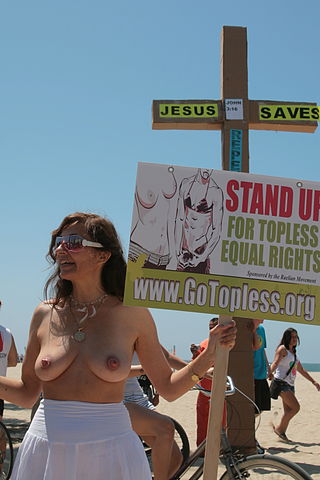
Go Topless Day is an annual event held in the United States and Canada to support the right of women to go topless in public on gender-equality grounds. In states where women have that right, topfreedom laws are celebrated, and protests are held in states where topless women are prohibited.

The Outdoor Co-ed Topless Pulp Fiction Appreciation Society was a group of several dozen women and a few men that had, since August 17, 2011, organized regular gatherings around New York City, meeting to read and discuss books in public while topless. The primary objective of the group, besides enjoying the sun and book reading, was to create awareness that New York law allows toplessness in public and to change social attitudes to the exposure of women's breasts. The group's blog had reported that there had been no harassment of the participants by the police and very rarely by the public.
In Canada, topfreedom has primarily been an attempt to combat the interpretation of indecency laws that considered a woman's breasts to be indecent, and therefore their exhibition in public an offence. In British Columbia, it is a historical issue dating back to the 1930s and the public protests against the materialistic lifestyle held by the radical religious sect of the Freedomites, whose pacifist beliefs led to their exodus from Russia to Canada at the end of the 19th century. The Svobodniki became famous for their public nudity: primarily for their nude marches in public and the acts of arson committed also in the nude.

Holly Van Voast is an American artist, photographer, videographer, painter, and perceived topless activist mostly known for her topless appearances in public and in front of celebrities. These events tested New York City courts' interpretation of legal precedent from New York State, asserting that, on the basis of gender equality, women as well as men can walk topless in public.
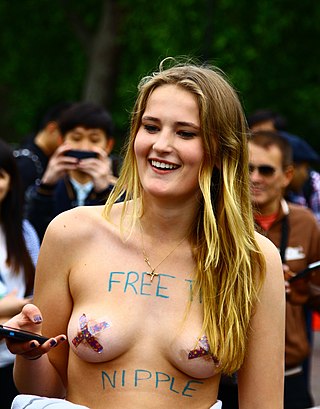
Free the Nipple is a topfreedom campaign created in 2012 during pre-production of a 2014 film of the same name. The campaign highlights the general convention of allowing men to appear topless in public while considering it sexual or indecent for women to do the same and asserts that this difference is discriminatory, contravening women's rights. The campaign argues that it should be legally and culturally acceptable for women to bare their nipples in public.

Paulette Leaphart is an American woman who gained national attention through her self-advocacy as a breast cancer survivor and 1,000 mile walk for awareness.
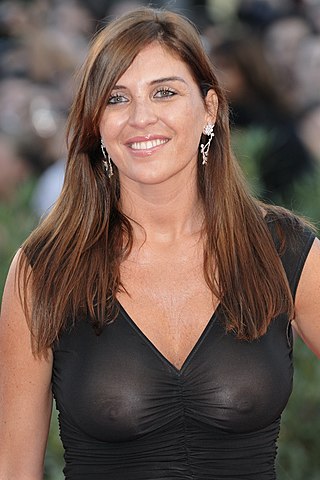
In Western society, since the 1960s, there has been a slow but steady trend towards bralessness among a number of women, especially millennials, who have expressed opposition to and are giving up wearing bras. In 2016, Allure magazine fashion director Rachael Wang wrote, "Going braless is as old as feminism, but it seems to be bubbling to the surface more recently as a direct response to Third Wave moments like #freethenipple hashtag campaign, increased trans-visibility like Caitlyn Jenner's Vanity Fair cover ... and Lena Dunham's show Girls."
R. v Gowan is a March 1998 case tried by the Ontario Court of Justice which ruled that, while a woman being topless as form of protest and free speech is legal, her being topless while she engages in a commercial purpose such as prostitution is illegal.

In the United States, individual states have primary jurisdiction in matters of public morality. The topfreedom movement has claimed success in a few instances in persuading some state and federal courts to overturn some state laws on the basis of sex discrimination or equal protection, arguing that a woman should be free to expose her chest in any context in which a man can expose his. Other successful cases have been on the basis of freedom of expression in protest, or simply that exposure of breasts is not indecent.