Monetary policy of the Philippines

Last updated

In the Philippines, monetary policy is the way the central bank, the Bangko Sentral ng Pilipinas, controls the supply and availability of money, the cost of money, and the rate of interest. With fiscal policy (government spending and taxes), monetary policy allows the government to influence the economy, control inflation, and stabilize currency. [1]

Contents

Money Supply Indicator

Money supply indicators are often found to contain necessary information for predicting future behavior of prices and assessing economic activity. Moreover, these are used by economists to confirm their expectations and help forecast trends in consumer price inflation. One can predict, to a certain extent, the government's intentions in regulating the economy and the consequences that result from it. For example, the government may opt to increase money supply to stimulate the economy or the government may opt to decrease money supply to control a possible mishap in the economy. [2]

These indicators tell whether to increase or decrease the supply. Measures that include not only money but other liquid assets are called money aggregates under the name M1, M2, M3, etc.

M1: Narrow Money

M1 includes currency in circulation. It is the base measurement of the money supply and includes cash in the hands of the public, both bills and coins, plus peso demand deposits, tourists’ checks from non-bank issuers, and other checkable deposits. [3] Basically, these are funds readily available for spending. Adjusted M1 is calculated by summing all the components mentioned above. [2]

M2: Broad Money

This is termed broad money because M2 includes a broader set of financial assets held principally by households. [2] This contains all of M1 plus peso saving deposits (money market deposit accounts), time deposits and balances in retail money market mutual funds. [3]

M3: Broad Money Liabilities

Broad Money Liabilities include M2 plus money substitutes such as promissory notes and commercial papers. [3]

M4: Liquidity Money

These include M3 plus transferable deposits, treasury bills and deposits held in foreign currency deposits. Almost all short-term, highly liquid assets will be included in this measure. [3]

Implications

If the velocity of M1 and M2 money stock has been low, this indicates that there is a lot of money in the hands of consumers and money is not changing hands frequently. [4]

Generally we would expect that when money supply indicators are growing faster than interest rates plus growth rate or inflation, whichever is higher, interest rates should possibly be increased. This should only generally apply when broad measures of money supply growth are higher than narrow measures, to rule out some of the measurement error issues that could emerge. [5]

Monetary Policy Instruments

Open Market Operations

Open Market Operations consist of repurchase and reverse repurchase transactions, outright transactions, and foreign exchange swaps.

This is carried out through the Repurchase Facility and Reverse Purchase Facility of the Bangko Sentral ng Pilipinas. In Purchase transactions, the Bangko Sentral buys government securities with a dedication to sell it back at a specified future date, and at a predetermined interest rate. [6] The BSP's payment increases reserve balances and expands the monetary supply in the Philippines. On the other hand, in Reverse Repurchase, the government acts as the seller, and works to decrease the liquidity of money. These transactions usually have maturities ranging from overnight to one month.
Unlike the repurchase or reverse repurchase, there is no clear intent by the government to reverse the action of their selling/buying of monetary securities. Thus, this transaction creates a more permanent effect on our monetary supply. "When the BSP buys securities, it pays for them by directly crediting its counterparty's Demand Deposit Account with the BSP." [6] The reverse is done upon the selling of securities.
This refers to the actual exchange of two currencies at a specific date, at a rate agreed upon the deal date and the reverse exchange of the currencies at a farther date in the future, also at an interest rate agreed on deal date. [7]

Acceptance of Fixed-Term Deposits

To expand its liquidity management, the Bangko Sentral introduced this method in 1998. In the Special Deposits Account, or SDA, consists fixed terms deposits by banks and institutions affiliated with the BSP. [6]

Standing Facilities

To increase the volume of credit in the financial system, the Bangko Sentra ng Pilipinas extends loans, discounts, and advances to banking institutions. "Rediscounting is a standing credit facility provided by the BSP to help banks meet temporary liquidity needs by refinancing the loans they extend to their clients." There are two types of rediscounting in the BSP: the peso rediscounting facility and the Exporter's dollar and Yen Rediscount Facility.

Reserve Requirements

In banking institutions, there are required amounts that banks cannot lend out to people. They always need to maintain a certain balance of money, which are called "reserves". Once these reserve requirements are changed and are varied, changes in the monetary supply will be observed greatly. [8]
Two Forms:

  1. Regular or Statutory Reserves
  2. Liquidity Reserves

Philippine Monetary/Currency Policy

Bangko Sentral ng Pilipinas

In accordance with Republic Act No. 265, [9] The Bangko Sentral ng Pilipinas or BSP is the central monetary authority of the Republic of the Philippines. It provides policy directions in the areas of money, banking and credit and exists to supervise operations of banks and exercises regulatory powers over non-bank financial institutions. It keeps aggregate demand from growing rapidly with resulting high inflation, or from growing too slowly, resulting in high unemployment. [10]

The primary objective of BSP's monetary policy is to promote price stability because it has the sole ability to influence the amount of money circulating in the economy. In doing so, other economic goals, such as promoting financial stability and achieving broad-based, sustainable economic growth, are given consideration in policy decision-making. [11]

Philippine Monetary Framework I: 1980s to early 1990s

In the past, the BSP followed the monetary aggregate targeting approach to monetary policy. This approach is based on the assumption that there is a stable and predictable relationship between money, output and inflation.

In particular, all money aggregates, with the exception of reserve money, are incorporated with output and interest rate. This means that there is a long-run relationship between money on one hand and output and interest rate on the other so that even if there are shocks in the economy, the variables will return to their trend equilibrium levels. [12]

This means that changes in money supply (on the assumption that velocity is stable over time) are directly related to price changes or to inflation. Thus, it is assumed that the BSP is able to determine the level of money supply that is needed given the desired level of inflation that is consistent with the economy's growth objective. In effect, under the monetary targeting framework, the BSP controls inflation indirectly by targeting money supply. [13]

Philippine Monetary Framework II: June 1995 to Present

The BSP employs a modified framework beginning the second semester of 1995 in attempt to enhance the effectiveness of the monetary policy by complementing monetary aggregate targeting with some form of inflation targeting, placing greater emphasis on price stability.

Certain key modifications include:

Under an aggregate targeting framework, the BSP fixes money growth so as to minimize expected inflation. On the other hand, under the new framework, BSP sets monetary policy so that price level is not just zero in expectation but is also zero regardless of latter shocks. [13] Moreover, the framework was changed because BSP wanted to address the fact that aggregate targeting did not account for the long-run effects of monetary policy on the economy.

With this approach, the BSP can exceed the monetary targets as long as the actual inflation rate is kept within program levels and policymakers monitor a larger set of economic variables in making decisions regarding the appropriate stance of monetary policy. [12]

Current Approach: Inflation Targeting

As mentioned earlier, Inflation Targeting requires a public announcement of an inflation rate that a country will target for the coming years, or in a given period of time. It focuses on maintaining a low level of inflation, that which is considered to be optimal, or at least would allow the country to have ample economic growth. Its main desire is to achieve price stability as the ultimate end goal of the monetary policy. [12] The Philippines formally adopted Inflation Targeting as the framework for Monetary Policy on January 2002.

The Philippines’ inflation target is measured through the Consumer Price Index (CPI). For 2009, inflation target has been set to be 3.5 percent, having a 1% tolerance level, and 4.5 percent for 2010, also having 1% tolerance. Also, the Monetary Board of the Philippines announced a target of around 4±1 percent from 2012 to 2014. [14]

Monetary Policy Issue

Exchange Rate

Exchange rates play a significant role in monetary transmission mechanism and at the same time, it can have a large impact on inflation rates. Although the BSP has adopted the inflation targeting approach, it may be tempted to inexplicitly target exchange rate to achieve its low inflation target. The issue here is the extent of the exchange rate pass-through or ERPT to domestic prices since higher ERPT would require the BSP to shift its attention to exchange rate movements to stabilize prices. [15]

Role of Monetary Aggregates

Since the shift to inflation targeting, BSP has already abandoned monetary aggregates because its information content has apparently declined in the recent years. Moreover, it is also assumed that a shift of approach was necessary because money aggregates are normally not good indicators of future economic policy requirements due to unreliability of measurement. [15]

Measurement of Inflation and Liquidity Trap

Since inflation targeting leads to lower and stable inflation rates, more improvement should then be given to the measurement of the consumer price index since few percentage points have greater repercussions when rates are low. Errors in CPI measurement could lead to ineffective and unsuitable monetary policy response by the BSP which definitely result to detrimental effects to the economy. [15]

Another issue arising from monetary policies is the liquidity trap. This happens when inflation rate declines too much leading to a threat of deflation. Liquidity trap is defined as a situation in which there are zero nominal interest rates, persistent deflation and deflation expectations. In the event this occurs, bonds and money earn the same real rate of return thus making people indifferent to holding bonds or excess money. [15]

Budget Deficit and External Debts

Given high budget deficits, the government is concerned about two closely related issues: it does not want to pay very high interest on its borrowings and it does not want to crowd out the market. Ideally, the government could raise tax revenues to avoid borrowing huge sums from the market. However, the government opted to borrow from the international capital market and though rates are low, these have shorter maturity and country's outstanding external debt has continued to move towards a less ideal position. [15]

Fiscal Dominance

According to the fiscal theory of the price level, it is not the non-interest bearing money but the total nominal liabilities including interest bearing notes and future fiscal surpluses that matter for price-level determination. In the absence of fiscal discipline, an independent central bank such as the BSP cannot guarantee a stable nominal anchor. In other words, for the BSP to successfully focus on price stability, there must be a credible commitment on the part of the National Government to reduce total fiscal deficits by a meaningful amount. [16]

Related Research Articles

<span class="mw-page-title-main">Inflation</span> Devaluation of currency over a period of time

In economics, inflation is a general increase of the prices of goods and services in an economy. This is usually measured using the consumer price index (CPI). When the general price level rises, each unit of currency buys fewer goods and services; consequently, inflation corresponds to a reduction in the purchasing power of money. The opposite of CPI inflation is deflation, a decrease in the general price level of goods and services. The common measure of inflation is the inflation rate, the annualized percentage change in a general price index. As prices faced by households do not all increase at the same rate, the consumer price index (CPI) is often used for this purpose.
<span class="mw-page-title-main">Monetary policy of the United States</span> Political Policy

The monetary policy of The United States is the set of policies which the Federal Reserve follows to achieve its twin objectives of high employment and stable inflation.

<span class="mw-page-title-main">Money supply</span> Total value of money available in an economy at a specific point in time

In macroeconomics, the money supply refers to the total volume of money held by the public at a particular point in time. There are several ways to define "money", but standard measures usually include currency in circulation and demand deposits. Money supply data is recorded and published, usually by the national statistical agency or the central bank of the country. Empirical money supply measures are usually named M1, M2, M3, etc., according to how wide a definition of money they embrace. The precise definitions vary from country to country, in part depending on national financial institutional traditions.

<span class="mw-page-title-main">Philippine peso</span> Currency of the Philippines

The Philippine peso, also referred to by its Filipino name piso, is the official currency of the Philippines. It is subdivided into 100 sentimo, also called centavos.

<span class="mw-page-title-main">Monetary policy</span> Policy of interest rates or money supply

Monetary policy is the policy adopted by the monetary authority of a nation to affect monetary and other financial conditions to accomplish broader objectives like high employment and price stability. Further purposes of a monetary policy may be to contribute to economic stability or to maintain predictable exchange rates with other currencies. Today most central banks in developed countries conduct their monetary policy within an inflation targeting framework, whereas the monetary policies of most developing countries' central banks target some kind of a fixed exchange rate system. A third monetary policy strategy, targeting the money supply, was widely followed during the 1980s, but has diminished in popularity since that, though it is still the official strategy in a number of emerging economies.

<span class="mw-page-title-main">Banknotes of the Philippine peso</span>

Banknotes of the Philippine peso are issued by the Bangko Sentral ng Pilipinas for circulation in the Philippines. The smallest amount of legal tender in wide circulation is ₱20 and the largest is ₱1000. The front side of each banknote features prominent people along with buildings, and events in the country's history while the reverse side depicts landmarks and animals.

A liquidity trap is a situation, described in Keynesian economics, in which, "after the rate of interest has fallen to a certain level, liquidity preference may become virtually absolute in the sense that almost everyone prefers holding cash rather than holding a debt which yields so low a rate of interest."

In macroeconomics, an open market operation (OMO) is an activity by a central bank to give liquidity in its currency to a bank or a group of banks. The central bank can either buy or sell government bonds in the open market or, in what is now mostly the preferred solution, enter into a repo or secured lending transaction with a commercial bank: the central bank gives the money as a deposit for a defined period and synchronously takes an eligible asset as collateral.

<span class="mw-page-title-main">Bank of Korea</span> Central bank of South Korea

The Bank of Korea is the central bank of the Republic of Korea and issuer of Korean Republic won. It was established on 12 June 1950 in Seoul, South Korea.

<span class="mw-page-title-main">Bangko Sentral ng Pilipinas</span> Central bank of the Philippines

The Bangko Sentral ng Pilipinas is the central bank of the Philippines. It was established on July 3, 1993, pursuant to the provision of Republic Act 7653 or the New Central Bank Act of 1993 as amended by Republic Act 11211 or the New Central Bank Act of 2019. The principal author was Senator Franklin Drilon. It was signed by President Rodrigo Duterte.

<span class="mw-page-title-main">Money creation</span> Process by which the money supply of an economic region is increased

Money creation, or money issuance, is the process by which the money supply of a country, or of an economic or monetary region, is increased. In most modern economies, money is created by both central banks and commercial banks. Money issued by central banks is termed base money. Central banks can increase the quantity of base money directly, by engaging in open market operations. However, the majority of the money supply is created by the commercial banking system in the form of bank deposits. Bank loans issued by commercial banks that practice fractional reserve banking expands the quantity of broad money to more than the original amount of base money issued by the central bank.

<span class="mw-page-title-main">Czech National Bank</span> Central bank of the Czech Republic

The Czech National Bank, is the central bank and financial market supervisor in the Czech Republic, headquartered in Prague. It is a member of the European System of Central Banks. It was established on 1 January 1993 from the division of the State Bank of Czechoslovakia as part of the process of dissolution of Czechoslovakia, together with the National Bank of Slovakia.

Bank rate, also known as discount rate in American English, is the rate of interest which a central bank charges on its loans and advances to a commercial bank. The bank rate is known by a number of different terms depending on the country, and has changed over time in some countries as the mechanisms used to manage the rate have changed.

In monetary economics, the demand for money is the desired holding of financial assets in the form of money: that is, cash or bank deposits rather than investments. It can refer to the demand for money narrowly defined as M1, or for money in the broader sense of M2 or M3.

<span class="mw-page-title-main">Philippine ten-peso note</span> Former denomination of Philippine currency

The Philippine ten-peso note (₱10) was a denomination of Philippine currency. In its latest incarnation, Apolinario Mabini and Andrés Bonifacio are featured on the front side of the notes, while the Barasoain Church and a Blood Compact scene of the Katipuneros are featured on the reverse side. This banknote was circulated until the demonetization of the New Design Series on January 3, 2018. Its printing was stopped in 2001 and was replaced by coins.

<span class="mw-page-title-main">Philippine five-peso note</span>

The Philippine five-peso note (₱5) was a denomination of Philippine currency. Philippine president Emilio Aguinaldo is featured on the front side of the note, while the Declaration of the Philippine Independence is featured on the reverse side. This banknote was circulated until the demonetization of the New Design Series on January 3, 2018. Its printing was stopped in 1995 and was replaced by coins.
<span class="mw-page-title-main">Philippine two-peso note</span>

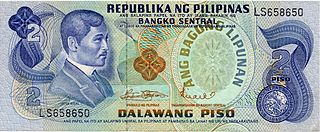
The Philippine two-peso note (₱2) was a denomination of Philippine currency. On its final release, José Rizal was featured on the front side of the bill, while the Declaration of the Philippine Independence was featured on the reverse side.

Market monetarism is a school of macroeconomic thought that advocates that central banks target the level of nominal income instead of inflation, unemployment, or other measures of economic activity, including in times of shocks such as the bursting of the real estate bubble in 2006, and in the financial crisis that followed. In contrast to traditional monetarists, market monetarists do not believe monetary aggregates or commodity prices such as gold are the optimal guide to intervention. Market monetarists also reject the New Keynesian focus on interest rates as the primary instrument of monetary policy. Market monetarists prefer a nominal income target due to their twin beliefs that rational expectations are crucial to policy, and that markets react instantly to changes in their expectations about future policy, without the "long and variable lags" postulated by Milton Friedman.

<span class="mw-page-title-main">Governor of the Bangko Sentral ng Pilipinas</span>

The Governor of the Bangko Sentral ng Pilipinas is the chief executive officer of the Bangko Sentral ng Pilipinas, the Philippines' central bank. This position succeeds and replaces the earlier post of Governor of the Central Bank of the Philippines.

The New Generation Currency (NGC) Series is the name used to refer to Philippine peso banknotes issued since 2010 and coins issued since 2018. The series uses the Myriad and Twentieth Century typefaces.

References

  1. "Monetary Policy" . Retrieved May 19, 2011.
  2. 1 2 3 Bheda, Disha. "An Overview of Key Money Supply Indicators - M0, M1, and M2". Data360. Retrieved May 18, 2011.
  3. 1 2 3 4 "Monetary Policy - Glossary and Abbreviations". Bangko Sentral ng Pilipinas. Retrieved May 18, 2011.
  4. "Other Money Supply Indicators". Data360. Retrieved May 18, 2011.
  5. "Money Supply- (27.06.04)" . Retrieved May 19, 2011.
  6. 1 2 3 "Inflation Targeting: The BSP's Approach to Monetary Policy" . Retrieved May 19, 2011.
  7. "Currency Swap Definition" . Retrieved May 19, 2011.
  8. "FRB: Reserve Requirements". Archived from the original on 2010-02-10. Retrieved May 19, 2011.
  9. "Republic Act No. 265: An Act Establishing the Central Bank of the Philippines, Defining its Powers in the Administration of the Monetary and Banking System, Amending the Pertinent Provisions of the Administrative Code with Respect to the Currency and the Bureau of Banking, and for Other Purposes". The Corpus Juris. The Corpus Juris. 15 June 1948. Retrieved 4 March 2016.
  10. "MANDATE" . Retrieved May 20, 2011.
  11. "Primer on Inflation Targeting" (PDF). Department of Economic Research. Retrieved May 19, 2011.
  12. 1 2 3 "Primer on Inflation Targeting" (PDF). Department of Economic Research. Retrieved May 20, 2011.
  13. 1 2 3 Gochoco-Bautista, Maria Socorro. "What Drives Monetary Policy?". University of the Philippines Diliman. Retrieved May 18, 2011.
  14. "Inflation Targeting: The BSP's Approach to Monetary Policy" . Retrieved May 18, 2011.
  15. 1 2 3 4 5 Lamberte, Mario. "Central banking in the Philippines: Then, Now and the Future" (PDF). Philippine Institute for Development Studies. Retrieved May 19, 2011.
  16. Mariano and Villanueva, Robert and Delano. "Monetary policy approaches and implementationin Asia: the Philippines and Indonesia" . Retrieved May 20, 2011.