Thumri is a vocal genre or style of Indian music. The term "thumri" is derived from the Hindi verb thumuknaa, which means "to walk with a dancing gait in such a way that the ankle-bells tinkle." The form is, thus, connected with dance, dramatic gestures, mild eroticism, evocative love poetry and folk songs, especially from Uttar Pradesh, though there are regional variations.

A Playmate is a female model featured in the centerfold/gatefold of Playboy magazine as Playmate of the Month (PMOTM). The PMOTM's pictorial includes nude photographs and a centerfold poster, along with a pictorial biography and the "Playmate Data Sheet", which lists her birthdate, measurements, turn-ons, and turn-offs. At the end of the year, one of the 12 Playmates of the Month is named Playmate of the Year (PMOTY). Every Playmate of the Month is awarded a prize of US$25,000 and each Playmate of the Year receives an additional prize of US$100,000 plus a car and other discretionary gifts. In addition, Anniversary Playmates are usually chosen to celebrate a milestone year of the magazine. The use of the word "Playmate" in a sexual sense did not originate with Playboy, and was seen at least as early as 1950 in Vue magazine.
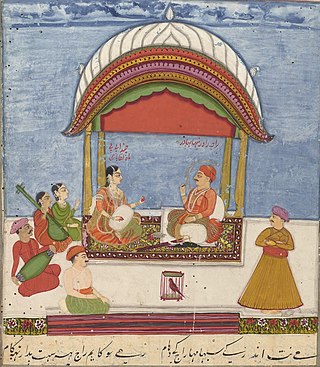
A tawaif was a highly successful courtesan singer‚ dancer‚ and poet who catered to the nobility of the Indian subcontinent, particularly during the Mughal era. Many tawaifs were forced to go into prostitution due to a lack of opportunities by the time of the British Raj.

Kundan Lal Saigal, often abbreviated as K. L. Saigal, was an Indian singer and actor who worked in Hindi cinema, which was centred in Calcutta (Kolkata) during Saigal's time, but is currently based in Bombay (Mumbai). Saigal's unique voice quality which was a mixture of baritone and soft tenor was the benchmark for most of the singers who followed him. In fact it remains the gold standard even today shining through very early and practically primitive recording technology. He did not sing songs on which other actors would lip-sync for the camera. It was only towards the very last stages of his career, during 1945 to 1947, that he sang to make studio recordings, and these were for himself as the actor on the screen. Thus, while other singers in Hindi Cinema are playback singers, he was not a playback singer.

Helen Ann Richardson Khan, known mononymously as Helen, is an Indian actress and dancer. She has appeared in over 1000 films, making her a prolific performer in Hindi cinema. In a career spanning 70 years, Helen has received two Filmfare Awards. She is often cited as one of the most popular nautch and caberet dancers of her time. In 2009, Helen was awarded with the Padma Shri by the Government of India.

The nautch was a popular court dance performed by girls in later Mughal and colonial India. The word "nautch" was a British corruption of Nachna, the Hindi verb "to dance". The culture of the performing art of the nautch rose to prominence during the later period of Mughal Empire and the rule of the East India Company.

Mujra is a dance performance by man/woman in a format that emerged during Mughal rule in India, where the elite class and local rulers like the nawabs of the Indian society used to frequent tawaifs (courtesans) for their entertainment.
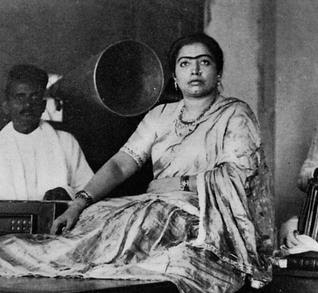
Gauhar Jaan was an Indian singer and dancer from Kolkata.

Pran Nevile was an Indian author of Indian Art, Indian Culture & Indian History best known for the 1992 book, Lahore: A Sentimental Journey. He was an authority on pre-1947 Lahore and Nautch.

Lahore - A sentimental Journey is a novel by Indian author Pran Nevile in which he recollects his pre-partition days in Lahore. Published in 1993 by Penguin Book India. The author takes us back in the 1930s and 40s right into the heart of Lahore. The story is set against the time before the partition, between India and Pakistan, from the fall of brotherhood between the two nations through the invasion of British Empire.

Marguerite Diane Webber was an American model, dancer and actress.

Zindagi is a 1940 Indian film, directed by Pramathesh Barua and produced by Birendranath Sircar. Starring K. L. Saigal, Jamuna Barua, Pahari Sanyal, Shyam Laha, Sitara Devi, and Nemo, it revolves around Ratan, an unemployed university graduate, and his relationship with Shrimati, who is on the run from her cruel husband.
Pran most often refers to prāṇa, the concept of a "life force" in Hindu philosophy.
Street Singer is a 1938 Indian film directed by Phani Majumdar. It was produced by New Theatres of Calcutta and was Phani Majumdar's first Hindi film as a director. The film was made in Bengali as Sathi in the same year. It stars K. L. Saigal, Kanan Devi, Jagdish Sethi and Bikram Kapoor. The music was composed by R. C. Boral with lyrics written by Arzu (Arzoo) Lucknavi. Two street urchins dream of singing and making it big in the glamorous world of theatre in Calcutta. They grow up with the girl being employed while the boy is not. The story follows them through first their enchantment and then the disillusionment with the theatre. Finally both choose to return to their roots in the village.
Mohabbat Ke Ansu is a 1932 Indian Urdu-language social romantic film. It was directed by Premankur Atorthy for New Theatres Ltd. Calcutta. The music for the film was directed by R. C. Boral. The film starred K. L. Saigal in his debut role with Akthari Muradabadi, Mahajabeen, Ansari and Sadiq. According to reports the film was not successful however Nevile claims that the "debut was successful beyond expectations" as it led to Saigal acting in several New Theatres films.
Mohabbat Ki Kasauti also called Rooplekha in Bengali was a 1934 Indian "semi-historical" bilingual film in Hindi and Bengali, directed by P. C. Barua for New Theatres. Though Barua is consistently mentioned as the director, according to author J. K. Bajaj, Debaki Bose directed Rooplekha in 1934. It had music by R. C. Boral and the cast included Rattanbai, K. L. Saigal, Pahari Sanyal, Noor Mohammed Charlie and Vishwanath. Jamuna started her career with a small role in the Hindi version.
Nevile is a surname and given name. Notable people with the name include:
Gulzar Begum, also known as Tamancha Jan was a Pakistani folk singer. She was known as The Singing Siren and The Nightingale of Lahore. She was a popular playback singer of 1930s and 1940s in Cinema of India.

