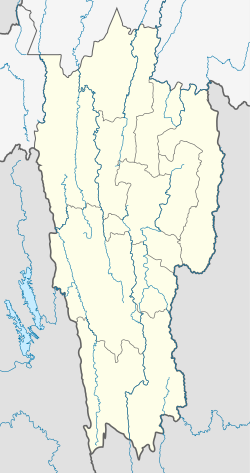
Ngengpui Wildlife Sanctuary is a wildlife sanctuary in the Lawngtlai district in the Indian state of Mizoram. The sanctuary covers about 110 km2 of largely undisturbed subtropical and semi-evergreen forest and lies near the borders with Bangladesh and Myanmar. Elevation in the sanctuary ranges from roughly 120–1,200 m above sea level depending on the source. [1][2][3]
Ngengpui Wildlife Sanctuary was officially constituted as a protected area by the Government of Mizoram through Notification No. B.12012/4/91-FST, issued under the provisions of the Wildlife (Protection) Act, 1972. The notification legally declared approximately 110 km2 of forest in southern Mizoram as a wildlife sanctuary, forming part of the state's protected area network. [4][5][6]
Geography and habitat
Ngengpui lies in south-west Mizoram. Vegetation types include sub-tropical evergreen and semi-evergreen forests with valley and montane forest communities; bamboo and dipterocarp elements are also reported in parts of the sanctuary. The Ngengpui River (from which the sanctuary takes its name) flows through parts of the protected area. [1][2]
Flora and fauna
Ngengpui supports a diversity of mammals, birds and herpetofauna typical of the Indo-Myanmar region. Fauna include gaur (Indian bison), sambar, barking deer, clouded leopard and several primate species. The sanctuary is also important for birdlife, including Bhutan peacock-pheasants, White-cheeked partridges, and Great Indian hornbills.[1][7]
Recent taxonomic and news reports have noted the discovery of several new bent-toed gecko lineages in northeastern India; one lineage is reported from Ngengpui (referred to as the "Ngengpui" or "Nengpui" bent-toed gecko in coverage), underlining the sanctuary's herpetological importance. [9][10] The sanctuary also houses the rare toad Bufoides meghalayanus.[11] Another rare species found is Rohanixalus senapatiensis, commonly known as Senapti's tree frog.[12][13]
Threats
Threats commonly reported for protected areas in the region — and noted in regional biodiversity discussion — include shifting cultivation in surrounding areas, human-wildlife conflict (notably with elephants), and pressures from resource extraction and habitat fragmentation; continued monitoring and engagement with local communities has been recommended. [2][14]
Access and tourism
Ngengpui is mentioned in state tourism material and travel writing as a destination for wildlife viewing and birding; visitors should coordinate with Mizoram Forest Department offices and local authorities for permissions and guidance. The drier months (roughly October–April) are commonly listed as the preferred visiting season. [15][16]
↑"Into the wild". India Today. 7 February 2011. Retrieved 29 November 2025.
This page is based on this Wikipedia article Text is available under the CC BY-SA 4.0 license; additional terms may apply. Images, videos and audio are available under their respective licenses.