Nicholas II of Saint-Omer

Last updated
Nicholas II of Saint Omer
Lord of one half of Thebes
Reign1258–1294
Predecessor Bela of Saint Omer
Successor Otho of Saint Omer
SpouseMary of Antioch
Anna Komnene Doukaina
Father Bela of Saint Omer
Mother Bonne de la Roche
ReligionRoman Catholic

Nicholas II of Saint Omer was the lord of half of Thebes in Frankish Greece from 1258 to his death in 1294. From his two marriages he became one of the richest and most powerful barons of his time, building a splendid castle at Thebes as well as the Old Navarino castle. He also served as bailli of the Principality of Achaea on behalf of the Angevins of Naples between 1287 and 1289.

Contents

Life

Nicholas was the son of Bela of Saint Omer and Bonne de la Roche, sister of the Lord of Athens and Thebes, Guy I de la Roche. Upon their marriage, in 1240, Guy gave Bela the lordship over half of Thebes. [1]

Along with his brothers, Otho and John, he participated in the War of the Euboeote Succession in the ranks of the coalition of most of the princes of Frankish Greece, who opposed the expansionist policies of the Prince of Achaea, William II of Villehardouin. [2] [3] In 1273, Charles I of Naples sent him as his envoy to the Bulgarian and Serbian courts, but he soon fell into disfavour with Charles, and was forced to exchange his holdings in the Morea with others in Sicily, under Charles' immediate control. His position and domains were not restored until after the death of Charles I in 1285. [2] During this time, Nicholas often resided in Italy, where Charles used him and other visiting Moreote barons as counsellors on the affairs of the Principality. [4] \
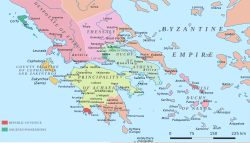
Map of the Greek and Latin states in southern Greece ca. 1278. Nicholas' domain, Thebes, lay within the Duchy of Athens (in light green). Greece in 1278.svg
Map of the Greek and Latin states in southern Greece ca. 1278. Nicholas' domain, Thebes, lay within the Duchy of Athens (in light green).

In 1287, the Neapolitan regent Robert of Artois named him the Angevins' representative governor ( bailli ) in the Principality of Achaea, [2] [5] in succession of William I of Athens, who had just died and whose heir, Guy II, was still under-age. At the time, Nicholas was the second richest and most influential baron living in the Latin East after Guy. [6] [7] He continued William's policy of fortification of Messenia and built the castle at Navarino and a smaller fortress at Maniatochori near Modon. [6] [7] [8] His regime was remembered for its peace and prosperity: according to the Chronicle of Morea , "He governed with nobility and wisdom, and kept the country at peace". He was succeeded in 1289 by the Baron of Vostitsa, Guy de Charpigny. [6]

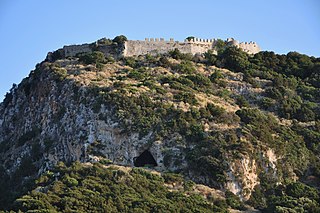
Nicholas married twice, both times to rich heiresses. His first wife was Mary of Antioch, daughter of Bohemond VI of Antioch, and his second, ca. 1280, was Anna, daughter of Michael II Komnenos Doukas and widow of William II of Villehardouin. [2] [6] [9] With financial aid from Mary of Antioch, Nicholas built the Castle of Saint Omer (in Greek Σανταμέρι, Santameri) in the Cadmea, the ancient acropolis of Thebes, which is much praised by the Chronicle of the Morea as being the strongest and most beautiful in Greece. It was richly furnished and decorated with frescoes depicting his ancestors' exploits in the Holy Land. Today, only a tower survives. [8] [10] Anna on the other hand, as Princess-dowager, brought with her a considerable property, including the castles of Kalamata and Chlemoutsi, comprising "some of the most fertile lands and the strongest fortress in the Morea", according to A. Bon. This worried King Charles, who was loath to cede these territories to an already very powerful and wealthy subject; in the event, they were exchanged in September 1281 with half the domains of the recently deceased Leonard of Veroli, comprising estates in both the Morea (in Elis and Messenia) and Italy. [11]

Both his marriages were childless, and on his death in 1294, he was succeeded by his younger brother Otho. [8] [12]
Related Research Articles

<span class="mw-page-title-main">Principality of Achaea</span> Crusader principality in southern Greece

The Principality of Achaea or Principality of Morea was one of the vassal states of the Latin Empire, which replaced the Byzantine Empire after the capture of Constantinople during the Fourth Crusade. It became a vassal of the Kingdom of Thessalonica, along with the Duchy of Athens, until Thessalonica was captured by Theodore, the despot of Epirus, in 1224. After this, Achaea became for a while the dominant power in Greece.

Nicholas III of Saint-Omer was one of the most powerful and influential lords of Frankish Greece. He was hereditary Marshal of the Principality of Achaea, lord of one third of Akova and of one half of Thebes. He also served on three occasions as bailli of the Principality of Achaea.

<span class="mw-page-title-main">Chlemoutsi</span> Medieval castle in Elis regional unit, Greece

Chlemoutsi, also known as Clermont, is a medieval castle in the northwest of the Elis regional unit in the Peloponnese peninsula of southern Greece, in the Kastro-Kyllini municipality.

<span class="mw-page-title-main">Old Navarino castle</span>

The Old Navarino castle is a 13th-century Frankish fortress near Pylos, Greece. It is one of two castles guarding the bay on which it sits; the other is the Ottoman-built New Navarino. It is frequently known simply as Palaiokastro or Paliokastro. It occupies the site of the Athenian fort at the 425 BC Battle of Pylos.

John Chauderon was the Baron of Estamira and Grand Constable of the Principality of Achaea, the strongest of the principalities of Frankish Greece.

Bela of Saint Omer was a French knight, descended from a Fauquembergues family who were castellans of the eponymous castle of Saint-Omer.

Otho of Saint Omer was the lord of half of Thebes in Frankish Greece from 1294 to ca. 1299.

<span class="mw-page-title-main">John of Saint-Omer</span> Lord of a third of the Barony of Akova, Marshal of the Principality of Achaea

John of Saint Omer was baron of a third of Akova and marshal of the Principality of Achaea.

<span class="mw-page-title-main">Barony of Akova</span>

The Barony of Akova was a medieval Frankish fiefdom of the Principality of Achaea, located in the mountains of eastern Elis in the Peloponnese peninsula in Greece, centred on the fortress of Akova or Mattegrifon. It was among the twelve original baronies of Achaea, but was conquered by the Byzantines in 1320.

<span class="mw-page-title-main">Barony of Chalandritsa</span>

The Barony of Chalandritsa was a medieval Frankish fiefdom of the Principality of Achaea, located in the northern Peloponnese peninsula in Greece, and centred on the town of Chalandritsa south of Patras.

Guy (II) of Dramelay was the third Baron of Chalandritsa in the Principality of Achaea in Frankish Greece, and also bailli of the Principality in 1282–85.

<span class="mw-page-title-main">Richard Orsini</span> Count palatine of Cephalonia (died 1303/4)

Richard Orsini was the count palatine of Cephalonia and Zakynthos from before 1260 to his death in 1303/4, and also Count of Gravina in 1284–91. He also served on behalf of the Angevin Kingdom of Naples as captain-general of Corfu in 1286–90 and as the bailli in the Principality of Achaea from 1297 to 1300. He assisted the Despot of Epirus in battle against the Byzantine Empire, and secured the marriage of his son, John I, to the Epirote ruler's daughter, which would lead in 1318 to the Orsini takeover of Epirus.

Geoffrey of Briel, in older literature Geoffrey of Bruyères, was a French knight and the third lord of the Barony of Karytaina in the Principality of Achaea, in Frankish Greece. He led a colourful and turbulent life, narrated in detail in the Chronicle of the Morea. Accounted the finest knight in the Principality, he fought in the wars against the Byzantine Greeks, was captured in the Battle of Pelagonia in 1259, and was sent back to Achaea bearing the Byzantine terms in 1261. Geoffrey was twice deprived of his barony, once for rebelling against his uncle, the Prince of Achaea William II of Villehardouin, and then for abandoning the Principality without leave in order to spend time with a mistress, the wife of one of his feudatories, in Italy. He was pardoned both times, but henceforth held his title as a gift of the Prince. He died childless in 1275, and the Barony of Karytaina was split up.

Anna Komnene Doukaina, known in French as Agnes, was princess-consort of the Principality of Achaea in 1258–1278 and regent between 1259–1262, during the captivity of her husband, Prince William II of Villehardouin, by the Byzantine emperor Michael VIII Palaiologos. After William II's death in 1278, she re-married to the powerful baron Nicholas II of Saint Omer.

Nicholas I of Saint Omer was a French knight who in the aftermath of the Fourth Crusade became a lord in the Frankish Duchy of Athens.

Nicholas le Maure was a French knight of the Principality of Achaea, lord of Saint-Sauveur, who served as the Principality's bailli on behalf of the Angevins of Naples between 1314 and 1315/6.

<span class="mw-page-title-main">Battle of Picotin</span> 1316 battle between Achaea and Majorca

The Battle of Picotin was fought on 22 February 1316 between the Catalan forces of the infante Ferdinand of Majorca, claimant to the Principality of Achaea, and the forces loyal to Princess Matilda of Hainaut, comprising native levies from the barons loyal to the Princess as well as Burgundian knights. The battle ended in a crushing victory for Ferdinand, but he was later engaged and killed by the troops of Matilda's husband, Louis of Burgundy, at the Battle of Manolada.

William of Saint Omer was a French knight, descended from a Fauquembergues family who were castellans of the eponymous castle of Saint-Omer.

The Second Parliament of Ravennika was convened in May 1210 by Latin Emperor Henry of Flanders in the town of Ravennika in Central Greece in order to resolve the differences between the princes of Frankish Greece and the Roman Catholic clergy of their domains.

<span class="mw-page-title-main">Battle of Saint George</span> Part of the Byzantine–Frankish conflicts of the Frankokratia

The Battle of Saint George took place on 9 September 1320 between the Latin Principality of Achaea and the forces of the Byzantine governor of Mystras, at the fortress of Saint George in Skorta in Arcadia. As a result of the battle, Arcadia, the heartland of the Morea, came firmly under Byzantine control.

References

  1. Lognon (1969), p. 244
  2. 1 2 3 4 PLP 24699
  3. Lognon (1969), p. 246
  4. Bon (1969), pp. 149, 153
  5. Bon (1969), pp. 153, 159
  6. 1 2 3 4 Lognon (1969), p. 261
  7. 1 2 Bon (1969), p. 159
  8. 1 2 3 Perra (2011), Νικόλαος Β΄
  9. Bon (1969), pp. 156, 707
  10. Bon (1969), p. 156
  11. Bon (1969), pp. 156, 159
  12. Bon (1969), p. 706

Sources

Preceded by Angevin bailli in the Principality of Achaea
12871289
Succeeded by
Preceded by Lord of one half of Thebes
12581294
Succeeded by