The Lada 4×4, formerly called the Lada Niva, is an off-road vehicle designed and produced by the Russian manufacturer AvtoVAZ specifically for the rural market, although models made for urban use are sold.

The White Sea is a southern inlet of the Barents Sea located on the northwest coast of Russia. It is surrounded by Karelia to the west, the Kola Peninsula to the north, and the Kanin Peninsula to the northeast. The whole of the White Sea is under Russian sovereignty and considered to be part of the internal waters of Russia. Administratively, it is divided between Arkhangelsk and Murmansk Oblasts and the Republic of Karelia.

The Kola Peninsula is a peninsula in the far northwest of Russia. Constituting the bulk of the territory of Murmansk Oblast, it lies almost completely inside the Arctic Circle and is bordered by the Barents Sea in the north and the White Sea in the east and southeast. The city of Murmansk is the most populous human settlement on the peninsula, with a population of over 300,000 as of the 2010 Census.

Kandalaksha is a town in Kandalakshsky District of Murmansk Oblast, Russia, located at the head of Kandalaksha Gulf on the White Sea, north of the Arctic Circle. Population: 35,654 (2010 Census); 40,564 ; 54,080 (1989 Census).

The Chevrolet Niva is a mini sport utility vehicle (SUV) produced by GM-AvtoVAZ, a joint venture between AvtoVAZ and General Motors, since 1998. The car is a development of the Lada Niva and was previously known as the VAZ-2123 in the design stage.

Venedikt Vasilyevich Yerofeyev, also Benedict Erofeev or Erofeyev was a Russian writer and Soviet dissident.
Sadko was a Russian and Soviet icebreaker ship of 3,800 tonnes displacement. She was named after Sadko, a hero of a Russian bylina.

Imandra is a lake in the south-western part of the Kola Peninsula in Murmansk Oblast, Russia, slightly beyond the Arctic circle. It is located 127 m above sea level; its area is about 876 km², maximum depth is 67 m. The shape of the shore line is complicated. There are a number of islands and the largest one, Erm Island measures 26 km². There are three principal parts of the lake connected by narrow straits: Greater Imandra or Khibinskaya Imandra in the north, Ekostrovskaya Imandra in the centre, and Babinskaya Imandra in the west. The lake drains into the Kandalaksha Gulf of the White Sea by the Niva River. The lake is known for the transparency of its water and its abundance of fish.

The Kandalaksha Gulf, Finnish: Kantalahti) is located in the Republic of Karelia, and Murmansk Oblast in northwestern Russia. Forming the north-western corner of the White Sea, it is one of four large bays and gulfs of this sea, the others being the Onega Bay (south-west), the Dvina Bay (south), and the Mezen Bay.

Umba is a 123 km long river on the Kola Peninsula, Murmansk Oblast, Russia.
Vitino is an oil port on the White Sea in Russia. It is located near Beloye More railway station, a few kilometers south of Kandalaksha, Murmansk Oblast, on the western shore of Kandalaksha Gulf.

Lupche-Savino River is a river in the south of the Kola Peninsula in Murmansk Oblast, Russia. It is 15 km in length. The Lupche-Savino River originates in the Lake Bolshoye Savino and flows into the Lupcha Bay of Kandalaksha Gulf.

Lapland Nature Reserve is a Russian 'zapovednik' in Murmansk Oblast, Russia, above the Arctic Circle. Officially established in 1957, the reserve protects an area of 2,784 km2 (1,075 sq mi) to the northwest of Lake Imandra, including 86 km² of inland water. The terrain is mountainous tundra and northern taiga. Since 1985 the zapovednik has been designated by UNESCO as a biosphere reserve.

Kolvitsa River is a river in the south of the Kola Peninsula in Murmansk Oblast, Russia. It is 12 km in length. The Kolvitsa River originates from the Lake Kolvitskoye and flows into the Kolvitskaya Bay, Kandalaksha Gulf, White Sea near the village of Kolvitsa.
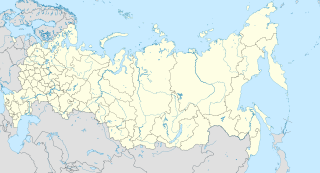
Kolvitsa is a village (selo) in the administrative jurisdiction of the town of Kandalaksha in Murmansk Oblast, Russia. The village is located beyond the Arctic circle, on the Kolvitsa River near its confluence with Kolvitskaya Bay of Kandalaksha Gulf, White Sea.
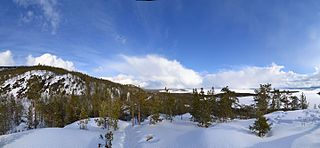
The Kandalaksha Coast is a coastal area in Murmansk Oblast in northwest Russia. It is located on the northern side of the White Sea, between Kandalaksha and mouth of Varzuga River. The major rivers flowing to the sea at the coast are the Umba and the Niva.

The Verman River is a river in Murmansk Oblast, Russia. For much of the Arctic Campaign of World War II stretches of it formed the front line, and much fighting occurred there.

Kandalakshsky District is an administrative district, one of the six in Murmansk Oblast, Russia. As a municipal division, it is incorporated as Kandalakshsky Municipal District. It is located in the southwest of the oblast, and borders with Kovdorsky District to the north, Loukhsky District of the Republic of Karelia, and with Finland to the west. The area of the district is 14,400 square kilometers (5,600 sq mi). Its administrative center is the town of Kandalaksha. Population: 49,544 (2010 Census); 60,140 (2002 Census); 78,239 (1989 Census). The population of Kandalaksha accounts for 72.0% of the district's total population.
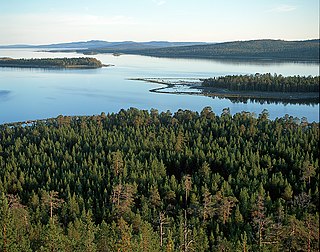
Kandalaksha Nature Reserve is a Russian 'zapovednik' on the south shore of Kandalaksha Bay in the Murmansk and Karelia regions on the opening to the White Sea. The reserve also includes two small sectors on the northern coast of the Kola peninsula on the Barents Sea; notably, the warm Atlantic current causes the northern sectors on the Barents Sea to be warmer than the more southerly White Sea sectors. Over 550 islands are covered in the boundaries of the reserve. It is one of the oldest nature reserves in Russia, created in 1932 to protect the marine habitats and waterfowl of the region, particularly the eider. The reserve is situated in the Kandalakshsky District, Kolsky District, and Lovozersky District of Murmansk Oblast. The nearest city, Kandalaksha, is at the northwest entrance to the Kandalaksha Gulf, about 5 km from the nearest point in the reserve. Since 1976, the reserve has been part of the RAMSAR wetland site of international importance "Kandalaksha Bay". It covers an area of 70,530 ha (272.3 sq mi).