A ringtone, ring tone or ring is the sound made by a telephone to indicate an incoming call. Originally referring to and made by the electromechanical striking of bells, the term now refers to any sound on any device alerting of a new incoming call—up to and including recordings of original telephone bells.
The Nokia 7250 is a mobile phone handset manufactured by Nokia. Announced in 2002 and released for sale in February 2003, it was designed at Nokia Design Center in California, by the Bulgarian-American designer Miki Mehandjiysky. The Nokia 7250 is notable for its unconventional design, striking colours and integrated digital camera, and also had Xpress-On covers. It was the successor of Nokia 7210.

The Nokia 3510 is a mobile phone for the GSM network, introduced by Nokia on 12 March 2002. The phone was the first Nokia phone to bring GPRS internet services to the mass market. It was also the first Nokia phone to ship with Beatnik's miniBAE engine, allowing for playback of polyphonic ringtones.
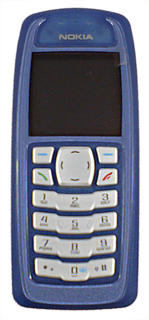
The Nokia 3100 is a triband-GSM mobile phone announced on 17 June 2003 as an entry-level phone from Nokia and released in September 2003, designed primarily for the newer generation of marketing audience.

The Nokia 1100 is a basic GSM mobile phone produced by Nokia. Over 250 million 1100s have been sold since its launch in late 2003, making it the world's best selling phone handset and the best selling consumer electronics device in the world at the time. The model was announced on 27 August 2003 and was discontinued in September 2009.

The Nokia 3200 is a mobile phone by Nokia, part of the Nokia Expression (youth) series and announced on 12 September 2003. It is based on the Nokia Series 40 platform. The phone is an update of the Nokia 3100, while adding features from the Nokia 7250i and 6610i. The phone's feature set was very similar to the 7250i and 6610i, but featured different software and firmware installed, and was sold at a lower price than the 7250i or 6610i. Of the three phones, the 3200 was mainly targeted towards the youth market, the 7250i towards fashion-conscious users, and the 6610i towards business users. Core features include an XHTML browser, alarm clock, flashlight, EDGE and FM stereo radio with a 128 × 128 12-bit (4096) color screen. The phone has multimedia features such as picture and text messaging. Features carried over from the Nokia 3100 include ringer profiles and voice memo capability. It also has Java games. The phone has an extensive calendar with a lunar calendar. The flashlight is located under the phone and can be activated by holding the "star" (asterisk) key. The camera is on the back of the phone. The 3200 can also play both polyphonic and monophonic ringtones. The phone's visual interface in its menu system is similar to that of the Nokia 3100, using large, static icons rather than animated ones.
Mobile content is any type of web hypertext and information content and electronic media which is viewed or used on mobile phones, like text, sound, ringtones, graphics, flash, discount offers, mobile games, movies, and GPS navigation. As mobile phone use has grown since the mid-1990s, the usage and significance of the mobile devices in everyday technological life has grown accordingly. Owners of mobile phones can now use their devices to make photo snapshots for upload, twits, mobile calendar appointments, and mostly send and receive text messages, listen to music, watch videos, take mobile pictures and make videos, use websites to redeem coupons for purchases, view and edit office documents, get driving instructions on mobile maps and so on. The use of mobile content in various areas has grown accordingly.
The Nokia tune is a phrase from a composition for solo guitar, Gran Vals, composed in 1902 by the Spanish classical guitarist and composer Francisco Tárrega. It has been associated with Finnish corporation Nokia since the 1990s, becoming the first identifiable musical ringtone on a mobile phone.
Mobile music is music which is downloaded or streamed to mobile phones and played by mobile phones. Although many phones play music as ringtones, true "music phones" generally allow users to stream music or download music files over the internet via a WiFi connection or 3G cell phone connection. Music phones are also able to import audio files from their PCs. The case of mobile music being stored within the memory of the mobile phone is the case similar to traditional business models in the music industry. It supports two variants: the user can either purchase the music for outright ownership or access entire libraries of music via a subscription model. In this case the music files are available as long as the subscription is active.

The Nokia 7600 is a camera phone developed by Nokia, running on Series 40. The 7600 was announced on 25 September 2003 and was Nokia's second 3G handset after the Nokia 6650. It is notable for its unique radical design.

The Nokia 2650 was first made public in the second quarter of 2004. The model was one of Nokia's few clamshell releases at that time, and being an entry-level phone, it became popular largely due to its low price.

The Nokia 6120 classic is a mid-range smartphone from Nokia that was announced on 17 April 2007. It runs on Symbian v9.2 with a S60 3rd Edition FP1 user interface.

The Sony Ericsson W580i is a mid range slider style mobile phone in the Walkman series. The phone was announced on 26 March 2007 and was released in early August. It is a 2.5G Quad-band (850/900/1800/1900) GSM phone with EDGE capabilities and has a 2 megapixel camera. It comes in "Style White", "Boulevard Black", "Metro Pink", "Urban Grey", "Jungle Green" and "Velvet Red".
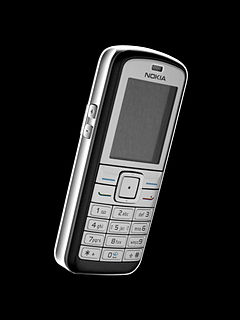
The Nokia 6070 is a mobile phone made by Nokia. It operates on GSM tri band frequency 900, 1800 and 1900 MHz, with automatic switching between frequencies. It is small in size with dimensions of 105.4 x 44.3 x 18.6 mm and weights 88 grams. It was released in the second quarter of 2006. The phone runs using Nokia S40 second edition. The features include a VGA camera, FM radio and voice recording.

The Nokia 1112 is a low-end GSM mobile phone sold by Nokia. The 1112 was released in 2006.

The Nokia 1680 classic is a Nokia dual-band GSM mobile phone. It has a VGA camera, speakerphone, multimedia playback, MMS messaging, web browser and e-mail client. Battery talk time is up to 7 hours and 40 minutes. Stand by time is 424 hours. Ringtones are Polyphonic 24 channels.
The Nokia 8810 is a slider-style mobile phone handset manufactured by Nokia, announced on March 18, 1998. It is most notable as being among the first phones to have an internal antenna. It was designed to be the flagship and the most luxurious of all Nokia phones at the time, and also one of the first phones with chrome plating.
The Nokia 7210 is a handset by Nokia, built on the Series 40 1st Edition software platform and enabled with J2ME (Java). The device features text and picture messaging, WAP browser, Stereo FM radio, Polyphonic ringtones, two preinstalled games and a 1.5", 128x128 pixel, 4,096 color display. It was the first Nokia phone for the mass market with a colour display and with polyphonic ringtones.
Ian Paul Livingstone is a British composer for television, films and video games. He jointly won an Ivor Novello Award in 2011 for a video game score for Napoleon: Total War. He was classically trained from the age of five and has a background as a pop/dance music producer, band member and session musician. He is a graduate of Salford University.

Beatnik, Inc., founded as Headspace, Inc., was a company that specialized in interactive audio technology. It was founded by musician Thomas Dolby in 1993 along with co-founder Mary Coller. It is best known for its Beatnik technology, which was used to provide sound in small file sizes on websites and later in billions of phones during the 2000s to play polyphonic ringtones, most notably the Nokia tune. During its earlier years it also produced music for video games such as Cyberia and Obsidian.


