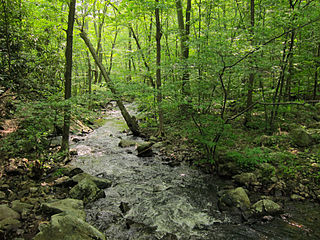
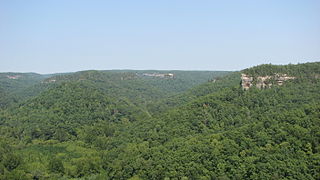
The Northeastern interior dry-mesic oak forest is a forest system found in Maine, Vermont, New Hampshire, Massachusetts, Connecticut, Rhode Island, New York, New Jersey, Ohio, Pennsylvania, Maryland, Virginia, and West Virginia. These forests cover large areas at low and middle elevations, typically on flat to gently rolling terrain.
Maine is a state in the New England region of the northeastern United States. Maine is the 12th smallest by area, the 9th least populous, and the 38th most densely populated of the 50 U.S. states. It is bordered by New Hampshire to the west, the Atlantic Ocean to the southeast, and the Canadian provinces of New Brunswick and Quebec to the northeast and northwest respectively. Maine is the easternmost state in the contiguous United States, and the northernmost state east of the Great Lakes. It is known for its jagged, rocky coastline; low, rolling mountains; heavily forested interior; and picturesque waterways, as well as its seafood cuisine, especially lobster and clams. There is a humid continental climate throughout most of the state, including in coastal areas such as its most populous city of Portland. The capital is Augusta.
Vermont is a state in the New England region of the northeastern United States. It borders the U.S. states of Massachusetts to the south, New Hampshire to the east, New York to the west, and the Canadian province of Quebec to the north. Vermont is the second-smallest by population and the sixth-smallest by area of the 50 U.S. states. The state capital is Montpelier, the least populous state capital in the United States. The most populous city, Burlington, is the least populous city to be the most populous city in a state. As of 2015, Vermont was the leading producer of maple syrup in the United States. In crime statistics, it was ranked as the safest state in the country in 2016.
New Hampshire is a state in the New England region of the northeastern United States. It is bordered by Massachusetts to the south, Vermont to the west, Maine and the Atlantic Ocean to the east, and the Canadian province of Quebec to the north. New Hampshire is the 5th smallest by area and the 10th least populous of the 50 states. Concord is the state capital, while Manchester is the largest city in the state. It has no general sales tax, nor is personal income taxed at either the state or local level. The New Hampshire primary is the first primary in the U.S. presidential election cycle. Its license plates carry the state motto, "Live Free or Die". The state's nickname, "The Granite State", refers to its extensive granite formations and quarries.
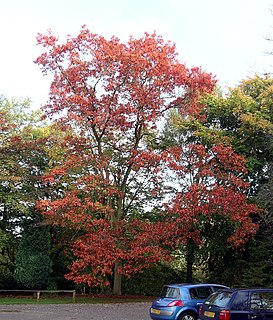
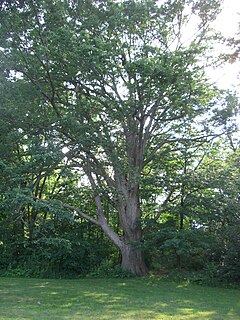
Common oaks are red oak ( Quercus rubra ), white oak ( Quercus alba ), and black oak ( Quercus velutina ). Other trees include hickories ( Carya spp.), red maple ( Acer rubrum ), sugar maple ( Acer saccharum ), white ash ( Fraxinus americana ), tulip tree ( Liriodendron tulipifera ), American beech ( Fagus grandifolia ), black cherry ( Prunus serotina ), black birch ( Betula lenta ), black tupelo ( Nyssa sylvatica ), and American elm ( Ulmus americana ). Flowering dogwood ( Cornus florida ) is a common understory tree. [1] [2]
Quercus rubra, commonly called northern red oak or champion oak, is an oak in the red oak group. It is a native of North America, in the eastern and central United States and southeast and south-central Canada. It grows from the north end of the Great Lakes, east to Nova Scotia, south as far as Georgia, Alabama, and Louisiana, and west to Oklahoma, Kansas, Nebraska, and Minnesota. It has been introduced to small areas in Western Europe, where it can frequently be seen cultivated in gardens and parks. It prefers good soil that is slightly acidic. Often simply called red oak, northern red oak is so named to distinguish it from southern red oak, also known as the Spanish oak. It is also the state tree of New Jersey and the provincial tree of Prince Edward Island.
Quercus alba, the white oak, is one of the preeminent hardwoods of eastern and central North America. It is a long-lived oak, native to eastern and central North America and found from Minnesota, Ontario, Quebec, and southern Maine south as far as northern Florida and eastern Texas. Specimens have been documented to be over 450 years old.
Quercus velutina, the eastern black oak or more commonly known as simply black oak, is a species in the red oak group of oaks. It is widespread in eastern and central North America, found in all the coastal states from Maine to Texas, inland as far as Michigan, Ontario, Minnesota, Nebraska, Kansas, Oklahoma, and eastern Texas.
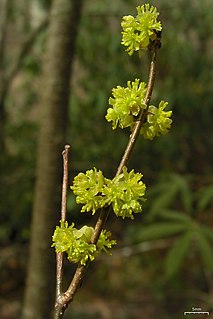
Common shrubs are maple-leaved viburnum ( Viburnum acerifolium ), spicebush ( Lindera benzoin ), and witch hazel ( Hamamelis virginiana ). In sandier or more acidic soils are mountain laurel ( Kalmia latifolia ), blueberry ( Vaccinium pallidum ), huckleberry ( Gaylussacia baccata ), and swamp azalea ( Rhododendron viscosum ). [1]
Viburnum acerifolium, the mapleleaf viburnum, maple-leaved arrowwood or dockmackie, is a species of Viburnum, native to eastern North America from southwestern Quebec and Ontario south to northern Florida and eastern Texas. It is adapted for USDA hardiness zones of 4 to 8.
Lindera benzoin is a shrub in the laurel family, native to eastern North America, ranging from New York to Ontario in the north, and to Kansas, Texas, and northern Florida in the center and south. Within its native range it is a relatively common plant where it grows in the understory in moist, rich woods, especially those with exposed limestone.
Hamamelis virginiana, known as common or American witch-hazel, is a species of witch-hazel native to eastern North America, from Nova Scotia west to Minnesota, and south to central Florida to eastern Texas.
Mayapple ( Podophyllum peltatum ) is a common herbaceous plant. [1]
Quercus muehlenbergii, the chinkapin oak, is an oak in the white oak group. The species was often called Quercus acuminata in older literature. Quercus muehlenbergii, is native to eastern and central North America, ranging from Vermont west to Wisconsin and south to South Carolina, western Florida, New Mexico, and northeastern Mexico from Coahuila south to Hidalgo.
The Northeastern coastal forests are a temperate broadleaf and mixed forests ecoregion of the northeast and middle Atlantic region of the United States. The ecoregion covers an area of 34,630 sq miles (89,691 km²) encompassing the Piedmont and coastal plain of seven states, extending from coastal southwestern Maine, southeastern New Hampshire, eastern Massachusetts, and Rhode Island, southward through Connecticut, New York State, New Jersey, southeast Pennsylvania, Delaware and Maryland.
The Atlantic coastal pine barrens is a temperate coniferous forest ecoregion of the Northeast United States distinguished by its nutrient-poor, often acidic soils and a pine tree distribution naturally controlled by frequent fires.
Nichols Arboretum, locally known as the Arb, is an arboretum operated by the University of Michigan. Located on the eastern edge of its Central Campus at 1610 Washington Heights in Ann Arbor, Michigan, the Arboretum is a mosaic of University and City properties operated as one unit. The arboretum is open daily from sunrise to sunset with no charge for admission. The Huron River separates a northern section of the arboretum's floodplain woods; the railroad marks the northern border.
The Appalachian mixed mesophytic forests is an ecoregion of the temperate broadleaf and mixed forests biome, as defined by the World Wildlife Fund. It consists of mesophytic plants west of the Appalachian Mountains in the Southeastern United States.
The Appalachian-Blue Ridge forests is an ecoregion in the Temperate broadleaf and mixed forests Biome, in the Eastern United States. The ecoregion is located in the central and southern Appalachian Mountains, including the Ridge-and-Valley Appalachians and the Blue Ridge Mountains. It covers an area of about 61,500 square miles (159,000 km2) in: northeast Alabama and Georgia, northwest South Carolina, eastern Tennessee, western North Carolina, Virginia, Maryland, and central West Virginia and Pennsylvania; and small extensions into Kentucky, New Jersey, and New York.
The Allegheny Highlands forests are a temperate broadleaf and mixed forests ecoregion of North America, as defined by the World Wildlife Fund.
The Southeastern mixed forests are an ecoregion of the temperate broadleaf and mixed forest biome, in the lower portion of the Eastern United States.
The Interior Low Plateaus are a physiographic region in eastern United States. It consists of a diverse landscape that extends from north Alabama across central Tennessee and Kentucky into southern Illinois, Indiana, and Ohio. Its natural communities are a matrix of temperate forests, woodlands, and prairies.
The Appalachian hemlock–northern hardwood forest is a forest system found in the Appalachian Mountains of New Hampshire, Vermont, Massachusetts, Connecticut, New York, New Jersey, Pennsylvania, Maryland, Virginia, West Virginia and western North Carolina. These forests occur in deep coves, moist flats, and ravines.
The Southern Ridge and Valley / Cumberland dry calcareous forest is a forest system found in Alabama, Georgia, Tennessee, Kentucky, Virginia, and West Virginia.
The Central Appalachian dry oak-pine forest is a forest system found from Maine south through New Hampshire, Vermont, Massachusetts, Rhode Island, Connecticut, New York, New Jersey, Pennsylvania, Maryland, to West Virginia and Virginia. It is abundant in the low- and mid-elevation central Appalachian Mountains and in the central Piedmont.