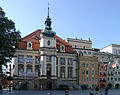
Wołów is a town in Lower Silesian Voivodeship in south-western Poland. It is the seat of Wołów County and Gmina Wołów. It lies approximately 38 kilometres north-west of the regional capital Wrocław. As of 2019, the town has a population of 12,373. It is part of the larger Wrocław metropolitan area.

Stanisław Żaryn was an architect, urbanist, historian and academic teacher who significantly contributed to process of reconstruction of Polish historical architecture after its destruction by Germans during WW2. He was born in Warsaw to Eugenia and Franciszek Zaryn.

Drawno is a town in Choszczno County, West Pomeranian Voivodeship, Poland, with 2,425 inhabitants (2004). The headquarters of the Drawa National Park are located here.

Milikowice is a village in the urban-rural Gmina Jaworzyna Śląska, within Świdnica County, Lower Silesian Voivodeship, in south-western Poland. It lies approximately 4 kilometres (2 mi) south of Jaworzyna Śląska, 5 km (3 mi) north of Świdnica, and 52 km (32 mi) south-west of the regional capital Wrocław.

Opinogóra Górna is a village in Ciechanów County, Masovian Voivodeship, in east-central Poland. It is the seat of the gmina called Gmina Opinogóra Górna. It lies approximately 7 kilometres (4 mi) north-east of Ciechanów and 79 km (49 mi) north of Warsaw. The village has a population of 630.

Brzeg Town Hall is a Renaissance building designed by Bernard Niuron built between 1569 and 1577. It is considered to be one of the most important Renaissance monuments in Poland. In addition to its role as the seat of the municipal government of Brzeg, the building houses several other institutions.

Byczyna Town Hall is a town hall built in the Baroque and Classical architectural style in Byczyna, Poland. In later years the building was modernised, during World War II the building was destroyed and subsequently rebuilt. The current tenants of the building are the Byczyna City Council, pharmacy, and a café.

Głogówek Town Hall - a Renaissance building built in 1608, and in the subsequent years frequently renovated and reconstructed. In 1945, the building was partially burnt down, and later rebuilt between 1955 and 1957. Currently, the town hall is the seat for the Głogówek City Council.

Lewin Brzeski Town Hall - a town hall built in the Classical architectural style in 1838. the building is located in the middle of the Lewin Brzeski Market Square (Rynek), the town hall is currently the seat of the Lewin Brzeski City Council and Gmina Lewin Brzeski authorities.

Olesno Town Hall - a Classical architectural style building built between 1820 and 1821, in the location of a former building from the seventeenth-century. The building was expanded in 1880, and in 1945 burnt down, and subsequently rebuilt after World War II. Currently, the office space in the town hall is rented.

Otmuchów Town Hall - a Renaissance building built in 1538, with the tower in 1604. In the later years the town hall was renovated and restored numerous times, and in between 1973 and 1976 underwent extensive renovation and restoration. Currently, the town hall is the seat of the Otmuchów City Council.

Paczków Town Hall - a building built in the Renaissance architectural style and later reconstructed into Neoclassicism, is located in the centre of the Market Square (Rynek) in Paczków, Poland. Currently, the town hall is the seat for the Paczków authorities.
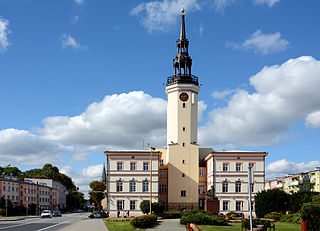
Strzelce Opolskie Town Hall - a Neo-Gothic building built between 1844 and 1846, in the location of a former, destroyed by fires town hall. In 1911, the town hall was reconstructed, in 1945 partially destroyed, and subsequently restored in the 1960s. Currently, the town hall is the seat for the Strzelce Opolskie City Council.

The Kamieniec Ząbkowicki Palace is a 19th-century monumental palace in the form of a medieval castle, located in the village of Kamieniec Ząbkowicki, Lower Silesia, in southwestern Poland. It was designed by Karl Friedrich Schinkel in the Neo-Gothic architectural style and completed in 1872 under the German Empire.

Korzkiew Castle - a fourteenth-century Romanesque castle located in Korzkiew, Lesser Poland Voivodeship in Poland. The castle is part of the Trail of the Eagles' Nests tourist route. The castle complex includes the castle ruins, housing residence, a grange and park, enlisted on the register of objects of cultural heritage of the Lesser Poland Voivodeship.

The Cathedral of Saint Apostles Peter and Paul in Legnica is located at Cathedral Square in the city of Legnica, Poland. The present building was erected between 1333 and 1380. A chapel was added in the fifteenth century, and in the late nineteenth century the church was converted into the neo-Gothic style. Over the centuries the church has acquired numerous statues and decorative features. Pope John Paul II established the church as a cathedral on March 25, 1992 and visited the cathedral on June 2, 1997.

Legnica City Hall, erected in 1905 in the Neo-Renaissance style, is currently the seat of the city authorities of Legnica, Poland.

The Town hall of Lubin - built in 1768 in Baroque style, rebuilt in the 19th century. The building was destroyed in 1945 and then rebuilt in 1950. Currently the town hall is a seat of the Historical Museum in Lubin and the Mayor as well as the City Council.

The origins of the Głogów Town Hall date back to the end of the 13th century, to the times of the town's incorporation by Conrad I of Głogów, when a watchtower was built. Over time the building was extended and in 1349 a two-winged, brick town hall was built. The building was damaged by fires in 1420 and 1433, however, the biggest fire took place in 1574, after which the town hall was rebuilt in a Renaissance style, while the tower was topped with a cupola. The appearance of the building from that period was immortalized in the 18th century in a drawing by Friedrich Bernhard Werner, which was published in Topographia Seu Compendium Silesiae.

The Łomnica Palace is a Baroque palace from the 17th century with a separate residential building, the so-called "Widow's House", located in the northern part of Łomnica, at the separation of roads to Karpniki and Wojanów, about five kilometers from Jelenia Góra.