Related Research Articles

Khiva is a district-level city of approximately 93,000 people in Khorazm Region, Uzbekistan. According to archaeological data, the city was established around 1500 years ago. It is the former capital of Khwarezmia, the Khanate of Khiva, and the Khorezm People's Soviet Republic. Itchan Kala in Khiva was the first site in Uzbekistan to be inscribed on the World Heritage List (1991). The astronomer, historian and polymath, Al-Biruni was born in either Khiva or the nearby city of Kath.

Itchan Kala is the walled inner town of the city of Khiva, Uzbekistan. Since 1990, it has been protected as a World Heritage Site.

Po-i-Kalan, or Poi Kalan, is an Islamic religious complex located in Bukhara, Uzbekistan. The complex consists of three parts, the Kalan Mosque, the Kalan Minaret to which the name refers, and the Mir-i-Arab Madrasah. The positioning of the three structures creates a square courtyard in its center, with the Mir-i-Arab and the Kalan Mosque standing on opposite ends. In addition, the square is enclosed by a bazaar and a set of baths connected to the Minaret on the northern and southern ends respectively.

Sarkhej Roza is a mosque and tomb complex located in the village of Makarba, 7 km south-west of Ahmedabad in Gujarat state, India.

The Polvon Gate is the eastern gate of the Itchan Kala fortress in Khiva (1806). The people also call it Poshshob (Jallod) Gate or Slave Gate. This gate is the main entrance to Khiva, Uzbekistan, and it was built by seven craftsmen under the supervision of a master builder. A canal that brought water from the Amu Darya river surrounded the fortress wall. The gate had a bridge that could be lifted at night. Polvon Gate's master builder received the same salary as the master builder who worked at the Ark Gate, the gate of the Khiva Khan's palace. The current appearance of Polvon Gate is the result of several renovations. Previously, the gate protruded slightly outward from the fortress wall. It had a watchtower on top that allowed to observe the outside of the city. The gate was rebuilt in 1806 by Eltuzarkhan from baked bricks. In addition, a long corridor – a vault was also built, which served as a place for trade stalls. The towers on the side of the gate were connected to the city wall. After the construction of the caravanserai and the covered bazaar in 1832–1833, the gate lost its role as a market. In 1835, the Olloqulixon Madrasa was built inside the gate, and its western part was rebuilt. A new bathhouse with two domes and a portal was built in front of it. The inner courtyard was enlarged as a result of the construction of the Olloqulikhan madrasah. It was also called the “Flower Gate” because of its beautiful glazed tiles. The gate was named after the Khiva poet, who lived in the seventh century, the author of more than three hundred quatrains, and the defender of the city, Pahlavon Mahmud. Pahlavon Mahmud was buried in a beloved tomb behind the Juma Mosque.

Termizi Memorial Complex, Hakim Termezi Mausoleum, is a historical site in Termez, Uzbekistan. Al-Hakim al-Termezi Mausoleum, considered sacred for Muslims, is situated in the ancient part of Termez. It houses the tomb of Abu Abdullah Muhammad Hakim Termezi, a prominent Islamic scholar, author of various philosophical and religious works, and the founder of a group of dervishes. The complex is associated with Abu Abdullah Muhammad Hakim Termezi. This mausoleum houses the grave of Termezi. The Termezi Memorial Complex has been reconstructed several times throughout the centuries. Today, this complex is considered one of the primary pilgrimage sites for visitors and guests of the province.
Yusuf Yasovulboshi Madrasah is an architectural monument in Khiva, Khorezm region. The madrasa was built in 1906, and today it is located at 30, Zargarlar Street, Itchan Kala neighborhood.
Shergazikhan Madrasah - an architectural monument in Khiva (1719-1726); It is one of the many buildings in the Itchan Kala. According to the sources, it was built in 1719–1726 with the funds and decree of the Uzbek ruler Shergazikhan. It is located in the center of Itchan Kala, at the entrance to the Pahlavon Mahmud complex. The construction of the structure began during Shergozikhan's campaign to Khurasan. Khan's body was buried in a small room built in the west of the madrasah.
Matniyoz Devonbegi Madrasah is an architectural monument in the city of Khiva, Khorazm Region. The madrasah was built in 1871, and today it is located at 19, Pahlavon Mahmud Street, "Itchan Kala" neighborhood of Khiva. The historical object "Itchan Kala" state museum-reserve belongs to the state property based on the right of operational management.

Muhammad Aminkhan Madrasah is an architectural monument in Khiva (1852-1855). Built by Muhammad Amin Khan. The Madrasah is located in the western part of the Itchan Kala. It was built in 1852–1855 with the funds and decree of the Uzbek ruler Muhammad Aminkhan. Muhammad Aminkhan Madrasah is the largest and most tiled in comparison to other Khiva madrasahs.

Abdurasulboy Madrasah is a former madrasa in Khiva, Uzbekistan. It was built according to the order of Mirzabashi Abdurasulboy in 1906. In 1990, it was included in the list of UNESCO World Heritage Sites as a part of Itchan Kala. Currently, it is used as a sozana embroidery workshop and exhibition space.
Yunuskhan Mausoleum is an architectural monument in the city of Khiva, Khorazm Region of the Republic of Uzbekistan. The mausoleum was built in 1559. Today, the mausoleum is located at 13, Pahlavon Mahmud street, Itchan Kala, next to the Pahlavon Mahmud complex.
Khojash Mahram Madrasah is an architectural monument in the city of Khiva, Khorazm Region of the Republic of Uzbekistan. The madrasah was built in 1839 by Khojash Mahram. Today, the madrasah is located at 11, Pahlavon Mahmud street, Itchan Kala, next to the Pahlavon Mahmud complex.
Khorezmshakhs' Madrasah is a cultural heritage object in Uzbekistan. The madrasa was built in 1915. It is located at 51 Mevaston Street, Mevaston neighborhood, Khiva, Khorazm Region. According to the decision of the Cabinet of Ministers of the Republic of Uzbekistan No. 100 dated February 24, 2021 on additional measures for the development of domestic and pilgrimage tourism, the Khorezmshakhs Madrasah was included in the priority restoration program of cultural heritage objects used in tourism routes in 2021–2025. The madrasah is in the possession of the Department of Cultural Heritage of Khorezm region.
Sheikh Kalandar Bobo Complex is an architectural monument in Khiva, Khorazm Region, Republic of Uzbekistan. The construction of the complex began in the 16th century and was completed in 1894. Today the complex is located at 36, Ismailov Street, "New Life" neighborhood.
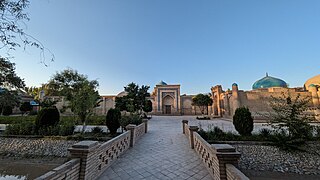
Said Mahruyjan Complex is an architectural monument in the Khiva city, Khorazm Region of the Republic of Uzbekistan. The complex consists of a madrasa, a monastery, etc. built in 1884 around the tomb of Said Muhammad Mahruyjan. Today it is located at 84, Amir Temur Street, "Mevaston" neighborhood.

Islamkhodja Madrasah is an architectural monument in Khiva. It is located in the center of the Itchan Kala. It was built by Islam Khodja,the prime minister and father-in-law of Khiva-Isfandiyar Khan(1908-1910).
Otajonboy Madrasah is an architectural monument in Khiva, Khorazm Region of the Republic of Uzbekistan. The madrasa was built in 1884 at the expense of Otajonboy, a rich man from Khiva. Today it is located at 23, Pahlavon Mahmud street, "Itchan Kala" neighborhood.
Musa Tora Madrasah is an architectural monument in the city of Khiva, Khorazm Region of the Republic of Uzbekistan. Today, the madrasa is located at 8, Boyochchilar Street, "Itchan Kala" neighborhood, in the central part of Itchan Kala. The monument was built in 1841 at the expense of funds of the Musa Tora, the grandson of Olloquli Khan,.
The Mozori Sharif Madrasa is an architectural monument in Khiva city of Khorezm region of the Republic of Uzbekistan. Currently, the madrasa is located in the Pahlavon Mahmud street, house 20. It was built in 1882 by the order of Muhammad Rahim Khan II (Feruz) and the funds of his son Toshhovuz ruler - Iso to’ra by the master Qalandar Kochim.
References
- 1 2 3 "Pahlavon Mahmud maqbarasi". meros.uz. Retrieved October 12, 2023.
- ↑ "Pahlavon Mahmud maqbarasi". kivamuseum.uz. Retrieved October 12, 2023.
- ↑ Arapov, Alexey (2016). Die historischen Denkmäler Usbekistans. Taschkent·Samarkand·Buchara·Chiva·Shahrisabz. Tashkent: SMI-ASIA. p. 102. ISBN 978-9943-17-075-9.
- ↑ National Encyclopedia of Uzbekistan. Volume 1. Tashkent, 2000
- ↑ Маньковская Л., Булатова В. 68. Комплекс у мавзолея Пахлавана-Махмуда // Памятники зодчества Хорезма / науч. ред. Г. А. Пугаченкова. — Ташкент: Издательство литературы и искусства
41°22′37″N60°21′34″E / 41.3769°N 60.3594°E [[Category:Religious buildings and structures in Uzbekistan]