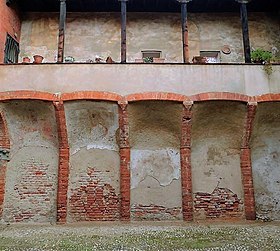
Pavia is a town and comune of south-western Lombardy, in Northern Italy, 35 kilometres south of Milan on the lower Ticino near its confluence with the Po. It has a population of c. 73,086.

Andrea Appiani was an Italian neoclassical painter.
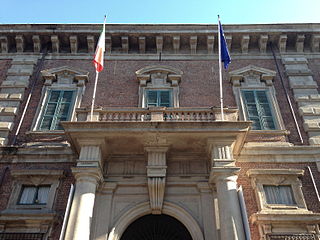
Palazzo Brera or Palazzo di Brera is a monumental palace in Milan, in Lombardy in northern Italy. It was a Jesuit college for two hundred years. It now houses several cultural institutions including the Accademia di Brera, the art academy of the city, and its gallery, the Pinacoteca di Brera; the Orto Botanico di Brera, a botanical garden; an observatory, the Osservatorio Astronomico di Brera; the Istituto Lombardo Accademia di Scienze e Lettere, a learned society; and an important library, the Biblioteca di Brera.

Brianza is a geographical, historical and cultural area of Italy, at the foot of the Alps, in the northwest of Lombardy, between Milan and Lake Como.
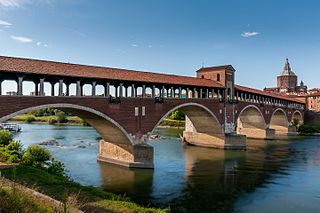
The Ponte Coperto or the Ponte Vecchio is a stone and brick arch bridge over the river Ticino in Pavia, Italy.

Santa Maria del Carmine is a church in Pavia, Lombardy, northern Italy, considered amongst the best examples of Lombard Gothic architecture. It was begun in 1374 by Gian Galeazzo Visconti, Duke of Milan, on a project attributed to Bernardo da Venezia. The construction followed a slow pace, and was restarted in 1432, being finished in 1461.

San Lanfranco is a Romanesque-style Catholic church and former abbey, located on via San Lanfranco Vescovo, 4/6, just west of the town center of Pavia, region of Lombardy, Italy.

Characteristic of the historic center of Pavia is the presence of medieval noble towers that survive in its urban fabric, despite having once been more numerous, as evidenced by the sixteenth-century representation of the city frescoed in the church of San Teodoro. They were mostly built between the 11th and 13th centuries when the Ghibelline city was at the height of its Romanesque flowering.
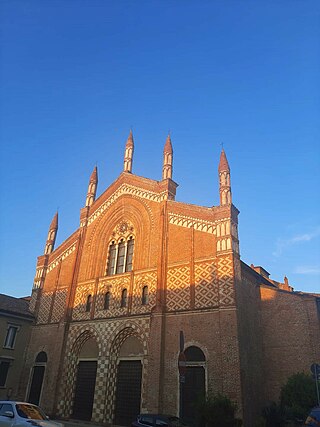
The church of San Francesco of Assisi is a Catholic religious building in Pavia, Lombardy, Italy.

The Basilica of Santissimo Salvatore is a Roman Catholic church in Pavia, region of Lombardy, Italy. It was founded in 657 by the Lombard king Aripert I and became a mausoleum for many of the Lombard kings.

The Teatro Fraschini is an opera house in Pavia, Italy.

The Broletto or Broletto Palace of Pavia, Italy has for centuries housed the civic government offices of this city found in the region of Lombardy, Italy. The term Broletto refers to a buildings equivalent to the town hall or town assembly.

The church of San Marino is a Roman Catholic church located on Via Siro Comi in Pavia, region of Lombardy, Italy
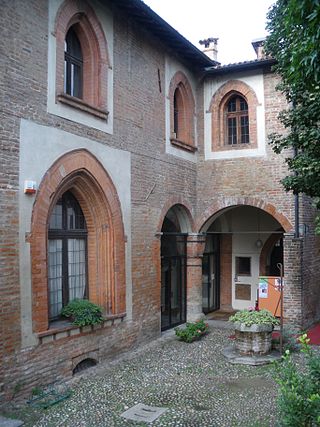
The Casa degli Eustachi is a medieval palace in Pavia in Lombardy.

Palazzo Mezzabarba is a palace in Pavia, Lombardy, a notable example of Lombard rococo. It has served as Pavia's city hall since 1875.

The Church of San Tommaso is a former Catholic church and monastery in the city of Pavia, Lombardy, Italy. It is located within the historic city center and belongs to the University of Pavia.

The monastery of Santa Maria Teodote, also known as Santa Maria della Pusterla, was one of the oldest and most important female monasteries in Pavia, Lombardy, now Italy. Founded in the seventh century, it stood in the place where the diocesan seminary is located and was suppressed in the eighteenth century.
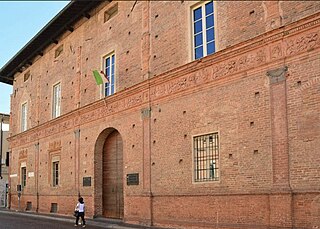
Palace Carminali Bottigella is a noble palace built by the ancient Beccaria family from Pavia. The original structure from the Sforza era was built between 1490 and 1499. The façade, which retains the original terracotta decorations, is one of the major examples of Renaissance civil building in Pavia.

The Palazzo Bellisomi Vistarino is an 18th-century palace in the city of Pavia and among the most important examples of Lombard rococo.

San Giacomo della Vernavola was a monastery located along the small river Vernavola outside the walls of Pavia.