
Khyber Pakhtunkhwa, often abbreviated as KP or KPK and formerly known as the North-West Frontier Province, is one of the four provinces of Pakistan. It is located in the northwestern region of the country, along the Afghanistan–Pakistan border.

Peshawar is the capital of the Pakistani province of Khyber Pakhtunkhwa and its largest city. It is the sixth-largest in Pakistan. Peshawar is also the largest Pashtun-majority city in Pakistan. Situated in the broad Valley of Peshawar just east of the historic Khyber Pass, close to the border with Afghanistan, Peshawar's recorded history dates back to at least 539 BCE, making it the oldest city in Pakistan and one of the oldest cities in South Asia.
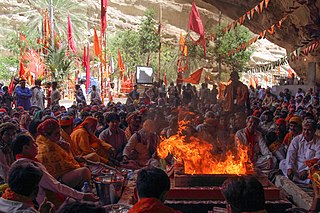
Hinduism is the second largest religious affiliation in Pakistan after Islam. Once the dominant faith in the region, Hindus presently account for 2.14% of Pakistan's population or 4.44 million people according to the 2017 Pakistan Census, although the Pakistan Hindu Council claims there are around more than 8 million in Pakistan, While the other official estimation shows that there are 7.5 million Hindus living in Pakistan as of 2021. However, one of the biggest issue the Hindu community faces in Pakistan is the forced conversion of minor Hindu girls to Islam; the number of such conversions, according to one highest estimate, is up to 1,000 per year.

Sikhism in Pakistan has an extensive heritage and history, although Sikhs form a small community in Pakistan today. Most Sikhs live in the province of Punjab, a part of the larger Punjab region where the religion originated in the Middle Ages, with some also residing in Peshawar in the Khyber-Pakhtunkhwa province. Nankana Sahib, the birthplace of Guru Nanak Sahib Ji, the founder of Sikhism, is located in Pakistan's Punjab province.
The Qayyum Stadium also known as Peshawar Sport Complex is located in Peshawar, the capital of Khyber Pakhtunkhwa province in Pakistan. It is the biggest sports complex in Peshawar and Khyber Pakhtunkhwa. The sport complex has facilities for all major sports including football, field hockey, squash, wrestling and badminton. The sport complex is owned by Government of Khyber Pakhtunkhwa. It has total capacity of 30,000 and it is located within walking distance from Peshawar Saddar and Peshawar Cantonment railway station.

The Shri Katas Raj Temples also known as Qila Katas, is a complex of several Hindu temples connected to one another by walkways. The temple complex surrounds a pond named Katas which is regarded as sacred by Hindus. The complex is located in the Potohar Plateau region of Pakistan's Punjab province. The temples are located near the town of Choa Saidanshah, and are near the M2 Motorway.

The Krishna Mandir is a Hindu temple (mandir) dedicated to the Hindu deity Krishna located in Ravi Road, opposite of Timber Market in Lahore, Punjab, Pakistan. In 2006, the temple became a centre of controversy due to media reports on its demolition which later turned out incorrect. It is one of the two Hindu temples in Lahore, the other being Valmiki Mandir.

The Hindu and Buddhist architectural heritage of Pakistan is part of a long history of settlement and civilization in Pakistan. The Indus Valley civilization collapsed in the middle of the second millennium BCE and was followed by the Vedic Civilisation, which extended over much of northern India and Pakistan.

In Pakistan, tourism is a growing industry. In 2010, Lonely Planet termed Pakistan "tourism's 'next big thing' for more years than we care to remember". The country is geographically and ethnically diverse, and has a number of historical and cultural heritage sites. The upsurge in tourism in the past few years has been aided by the Government of Pakistan's recent decision to end mandatory No Objection Certificates for foreign tourists seeking to visit certain parts of the country.
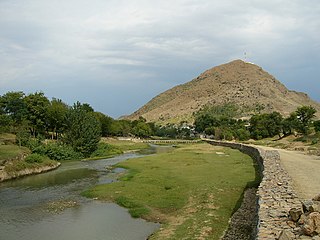
Panjpir is a town and Union council of Swabi District in the Khyber Pakhtunkhwa province of Pakistan that is surrounded by Shahmansoor, Kaddi, Thand Kohi, Bam Khel, Dara and Ismailabad. District Swabi has 4 Tehsils i.e. Swabi Tehsil, Lahor, Topi Tehsil and Razar. Each Tehsil comprises certain numbers of union councils. There are 56 union councils in district Swabi.

Kalibari Mandir is a Hindu temple located in Peshawar in Khyber Pakhtunkhwa Pakistan. This temple is dedicated to goddess Kali and Durga Puja is the main festival.

Dargah Pir Ratan Nath Jee is a Hindu temple located in Jhanda Bazar locality of Peshawar city, the capital of Khyber Pakhtunkhwa province of Pakistan. The temple is dedicated to Lord Shiva and Maha Shivratri is the main festival.

Goraknath Temple is a Hindu temple located in the Gorkhatri area of Peshawar in Khyber Pakhtunkhwa, Pakistan. The temple is dedicated to Guru Gorakhnath who founded the kanphata Jogi order at Tilla Jogian in the first century BC. The temple was built in 1851, but was closed in 1947 before reopening in 2011.

Churrio Jabal Durga Mata Temple is situated on a hill named Churrio, located in Nangarparkar in the Tharparkar District in the Sindh province of Pakistan. This is a historic temple and is visited annually by 200,000 pilgrims on Shivratri. Hindus bring cremated ashes of their departed beloveds to immerse in the holy water in the temple. The valuable and multi-coloured hill supporting the temple is mined for its rare and expensive granite, which is posing a serious threat to the temple.
City Museum was established on an archaeological site of Gorkhatri, Peshawar, Khyber Pakhtunkhwa, Pakistan. The museum was inaugurated on 23 March 2006 by Akram Khan Durrani the Chief Minister of Khyber Pakhtunkhwa. The museum consists of three galleries: archaeological, ethnological, and antiquities. The latter is the most recent addition, for the exhibition of the antiquities of the British time which provides detailed information about archaeological and ethnological profile of Peshawar.
Mufti Shahabuddin Popalzai is an Islamic cleric, Imam, Khatib and head of the regional moon-sighting committee at the historic Qasim Ali Khan Mosque, Peshawar, Khyber Pakhtunkhwa, Pakistan. The committee, whose existence predates the creation of Pakistan, traditionally declares the sighting of the Ramadan and Shawwal moons, resulting in the fasting and Eid in certain regions of Khyber Pakthunkhwa including Peshawar, although most of the rest of Pakistan follows the central Ruet-e-Hilal Committee.

Provincial elections were held in Khyber Pakhtunkhwa on 25 July 2018 to elect the members of the 11th Provincial Assembly of Khyber Pakhtunkhwa
Hinduism is a minority religion in Khyber Pakhtunkhwa followed by 0.02% of the population of the province.
 Pakistan

