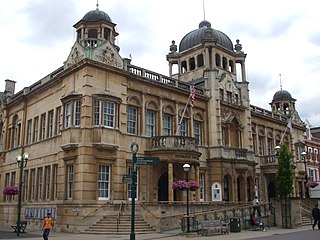
Ilford is a large town in east London, England, 9 miles (14 km) northeast of Charing Cross. Part of the London Borough of Redbridge, Ilford is within the ceremonial county of Greater London. It had a population of 168,168 in 2011, compared to 303,858 for the entire borough.

Becontree or is an area of approximately 4 square miles (10 km2) in the London Borough of Barking and Dagenham. It is located 11 miles (17.7 km) east-northeast of Charing Cross and was constructed in the interwar period as the largest public housing estate in the world. The Housing Act 1919 permitted the London County Council to build housing outside the County of London and Becontree was constructed between 1921 and 1935 to cottage estate principles in the parishes of Barking, Dagenham and Ilford, then in the administrative and ceremonial county of Essex. The official completion of the estate was celebrated in 1935, by which time the estate had a population of around 100,000 people in 26,000 homes.

The London Borough of Barking and Dagenham is a London borough in East London. It lies around 9 miles (14 km) east of Central London. The borough was created in 1965 as the London Borough of Barking; the name was changed in 1980. It is an Outer London borough and the south is within the London Riverside section of the Thames Gateway; an area designated as a national priority for urban regeneration. At the 2011 census it had a population of 187,000. The borough's three main towns are Barking, Chadwell Heath and Dagenham. The local authority is the Barking and Dagenham London Borough Council. Barking and Dagenham was one of six London boroughs to host the 2012 Summer Olympics.
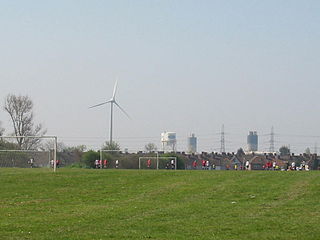
Dagenham is a town in East London, England, within the London Borough of Barking and Dagenham. Dagenham is centred 11+1⁄2 miles east of Charing Cross.

Barking is a riverside town in East London, England, within the London Borough of Barking and Dagenham. It is 9.3 miles (15 km) east of Charing Cross. The total population of Barking was 59,068 at the 2011 census. In addition to an extensive and fairly low-density residential area, the town centre forms a large retail and commercial district, currently a focus for regeneration. The former industrial lands to the south are being redeveloped as Barking Riverside.

Chadwell Heath is an area of Dagenham in East London, England. It is split between the London Borough of Barking and Dagenham and the London Borough of Redbridge, around 2 miles (3.2 km) west of Romford and 4 miles (6.4 km) east of Ilford, and 12 miles (19 km) north-east of Charing Cross.
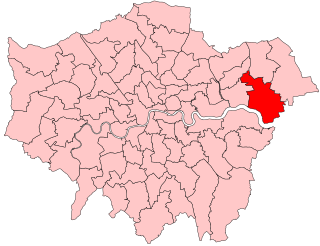
Dagenham and Rainham is a parliamentary constituency in Greater London that was created in 2010. It has been represented in the House of Commons of the United Kingdom since 2024 by Margaret Mullane and was previously represented from 2010 by Jon Cruddas, both members of the Labour Party.
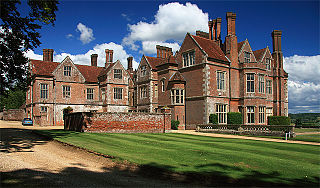
Breamore House is an Elizabethan manor house noted for its fine collection of paintings and furniture and situated NW of Breamore village, north of Fordingbridge, Hampshire, England. Though it remains in private hands, it is open to visitors from April to October.

Valence House Museum is the only surviving of the five manor houses of Dagenham. The timber-framed museum building, partially surrounded by a moat, is situated in Valence Park off Becontree Avenue, in the London Borough of Barking and Dagenham, London, England. The building has been used as a manor house, a family home, a town hall, the headquarters of the library service and now houses a museum.
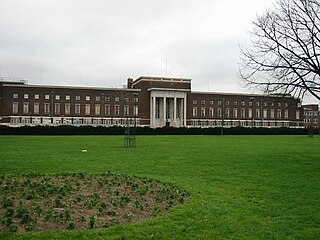
The London Borough of Barking and Dagenham, one of the outer London boroughs, has over 25 parks, gardens and open spaces within its boundaries. These provide the "green lungs" for leisure activities.

Castle Green is a park and suburb in the London Borough of Barking and Dagenham, United Kingdom. The locality is close to Creekmouth and is part of the Becontree estate.

William Fanshawe was an English politician who sat in the House of Commons between 1614 and 1625.
The Sydney Russell School is a coeducational secondary school and sixth form located in Dagenham, London, England.

Mayesbrook Park is a 43 hectare public park in the London Borough of Barking and Dagenham and in the post town of Dagenham and the pre-1965 borough of Barking. It is owned and managed by the borough council. The southern end, which is mainly a large lake, is a Local Nature Reserve.[broken link] The area covered by the park was once part of the historic Manor of Jenkins, seat of the Fanshawe family. For reasons which remain obscure, the park is nicknamed "Matchstick Island".

Parsloes Park is a 58 hectare public park in Dagenham in the London Borough of Barking and Dagenham. It is owned and managed by the borough council. A small area opposite the Wren Road entrance is managed for wildlife and designated as a Local Nature Reserve called Parsloes Park Squatts.

Jenkins was a manor under the overlordship of Barking manor. It was also known as 'Dagenham' manor, 'Dagenhams' and 'Dagenham Place' throughout the centuries. Today, the once open area has been consumed by suburbia.
The Revd Abraham Blackborne was a vicar in Dagenham, who died at age 82 in 1797, having served for 58 years. Blackborne also served a parish in Middlesex, where he and his wife Frances had the use of an estate in St. Martin-in-the-Fields, according to their deed of 1791.

Sir Thomas Fanshawe (1628–1705) was an English politician.

Marks was a manor house located near Marks Gate at the northern tip of the London Borough of Barking and Dagenham in London, England, the house standing on what is now Warren Hall Farm, about two miles west of Romford. The name Marks is believed to have been derived from the de Merk family who built the original manor in the 14th century. The manor house was demolished in 1808.
