Related Research Articles

Yom Kippur is the holiest day of the year in Judaism. It occurs annually on the 10th of Tishrei, corresponding to a date in late September or early October.

Horchata, or orxata, is a name given to various beverages, which are generally plant based, but sometimes contain milk. In Spain, it is made with soaked, ground, and sweetened tiger nuts. In some parts of the Americas, the base is jicaro, melon or sesame seeds, or white rice, along with other spices. Different varieties can be served hot or cold, and may be used as a flavor in other beverages, such as frappé coffee.

Avgolemono is a family of sauces and soups made with egg yolk and lemon juice mixed with broth, heated until they thicken.

A tajine or tagine, also tajin or tagin is a Maghrebi dish, named after the earthenware pot in which it is cooked. It is also called maraq or marqa.

Jewish cuisine refers to the worldwide cooking traditions of the Jewish people. During its evolution over the course of many centuries, it has been shaped by Jewish dietary laws (kashrut), Jewish festivals and holidays, and traditions centred around Shabbat. Jewish cuisine is influenced by the economics, agriculture, and culinary traditions of the many countries where Jewish communities have settled and varies widely throughout the entire world.

Ruta graveolens, commonly known as rue, common rue or herb-of-grace, is a species of the genus Ruta grown as an ornamental plant and herb. It is native to the Balkan Peninsula. It is grown throughout the world in gardens, especially for its bluish leaves, and sometimes for its tolerance of hot and dry soil conditions. It is also cultivated as a culinary herb, and to a lesser extent as an insect repellent and incense.

Harira is a traditional North African soup prepared in Morocco and Algeria. Algerian harira differs from Moroccan harira in that Algerian harira does not contain lentils. It is popular as a starter but is also eaten on its own as a light snack. There are many variations and it is mostly served during Ramadan, although it can be made throughout the year.

Bourekas or burekas are a popular baked pastry in Sephardic Jewish cuisine and Israeli cuisine. A variation of the burek, a popular pastry throughout southern Europe, northern Africa and the Middle East, Israeli bourekas are made in a wide variety of shapes and a vast selection of fillings, and are typically made with either puff pastry, filo dough, or brik pastry, depending on the origin of the baker.
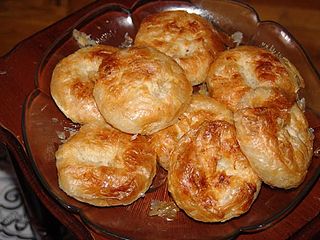
Sephardic Jewish cuisine, belonging to the Sephardic Jews—descendants of the Jewish population of the Iberian Peninsula until their expulsion in 1492—encompassing traditional dishes developed as they resettled in the Ottoman Empire, North Africa, and the Mediterranean, including Jewish communities in Turkey, Greece, Bulgaria, North Macedonia, and Syria, as well as the Sephardic community in the Land of Israel. It may also refer to the culinary traditions of the Western Sephardim, who settled in Holland, England, and from these places elsewhere. The cuisine of Jerusalem, in particular, is considered predominantly Sephardic.

Israeli cuisine primarily comprises dishes brought from the Jewish diaspora, and has more recently been defined by the development of a notable fusion cuisine characterized by the mixing of Jewish cuisine and Arab cuisine. It also blends together the culinary traditions of the various diaspora groups, namely those of Middle Eastern Jews with roots in Southwest Asia and North Africa, Sephardi Jews from Iberia, and Ashkenazi Jews from Central and Eastern Europe.

A break-fast is a meal eaten after fasting.
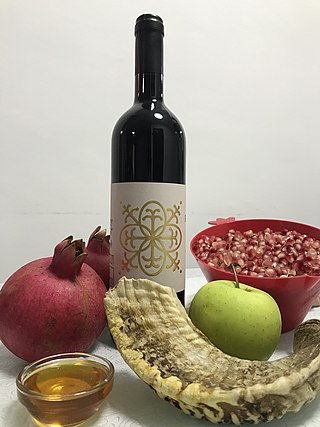
Rosh Hashanah is the New Year in Judaism. The biblical name for this holiday is Yom Teruah. It is the first of the High Holy Days, as specified by Leviticus 23:23–25, that occur in the late summer/early autumn of the Northern Hemisphere. Rosh Hashanah begins ten days of penitence culminating in Yom Kippur, as well as beginning the cycle of autumnal religious festivals running through Sukkot which end on Shemini Atzeret in Israel and Simchat Torah everywhere else.

Mizrahi Jewish cuisine is an assortment of cooking traditions that developed among the Mizrahi Jewish communities of the Middle East, North Africa and Central Asia. Influenced by the diverse local culinary practices of countries such as Morocco, Libya, Egypt, Iraq, Iran, Yemen, and Syria, Mizrahi cuisine prominently features rice, legumes, meats, and an array of spices such as cumin, turmeric, and coriander. Signature dishes include kubbeh (dumplings), pilafs, grilled meats, and stews like hamin.

Muhallebi is a milk pudding commonly made with rice, sugar, milk and either rice flour, starch or semolina, popular as a dessert in the Middle East. While the dessert is called Muhallebi in Turkey and Iraq, the Egyptian variant is called mahalabia and the Levantine variant, common in Jordan, Lebanon, Palestine and Syria, is called mahalabiyeh.

This is a categorically organized list of foods. Food is any substance consumed to provide nutritional support for the body. It is produced either by plants, animals, or fungi, and contains essential nutrients, such as carbohydrates, fats, proteins, vitamins, and minerals. The substance is ingested by an organism and assimilated by the organism's cells in an effort to produce energy, maintain life, or stimulate growth.

Middle Eastern cuisine or West Asian cuisine includes a number of cuisines from the Middle East. Common ingredients include olives and olive oil, pitas, honey, sesame seeds, dates, sumac, chickpeas, mint, rice and parsley, and popular dishes include kebabs, dolmas, falafel, baklava, yogurt, doner kebab, shawarma and mulukhiyah.

Whitefish salad is a salad of smoked freshwater whitefish and mayonnaise. Whitefish salad is a staple fare of Ashkenazi Jewish American cuisine, often found at appetizing stores and Jewish delicatessens. Common ingredients that can be added to whitefish salad include dill, lemon juice, capers, celery, chives, green peppers, vinegar, hard-boiled egg, and mustard. The mayonnaise can be substituted with sour cream, lebneh, or crème fraîche. Whitefish is often served on a bagel.
Zom is a traditional Yemenite Jewish soup that is most commonly served as part of the Yom Kippur break fast among those in the Yemenite Jewish community, mostly in Israel.
Boulou, also known as boulous, is a Libyan Jewish sweet bread or cake of Maghrebi Jewish origin, similar to mouna, tishpishti, or pound cake, that is traditionally made into loaves or rolls and consumed as part of the meal preceding the Yom Kippur Fast, or as part of the break fast that follows. It is most commonly found today in France, and Israel. Boulou has a sweet taste enriched with sugar, eggs, honey, oil, and golden raisins it often contains seeds such as fennel, sesame, and nigella seeds.
References
- 1 2 3 4 5 6 7 Marks, Gil (2010-11-17). Encyclopedia of Jewish Food. HMH. ISBN 978-0-544-18631-6.
- ↑ "How Jews around the world break the Yom Kippur fast". The Times of Israel . September 29, 2017.
- ↑ Glazer, Phyllis; Times, Special to the Los Angeles (2010-09-16). "Beverages and snacks after the Yom Kippur fast". Los Angeles Times. Retrieved 2024-10-11.
- 1 2 3 Kagan, Aaron (2010-09-15). "Pepitada, The Greek Way to Break the Fast". The Forward . Retrieved 2024-10-11.
- ↑ Flandrin, Jean-Louis; Montanari, Massimo (2013-05-21). Food: A Culinary History. Columbia University Press. p. 232. ISBN 978-0-231-11155-3.
- ↑ Apan, Mukaddes Arigül; Zorba, Murat (2018-03-22). "Improvement of quality and shelf-life of Sübye, a traditional beverage of Turkey". Food Science and Technology. 38 (4): 719–725. doi: 10.1590/1678-457X.12517 . ISSN 0101-2061.